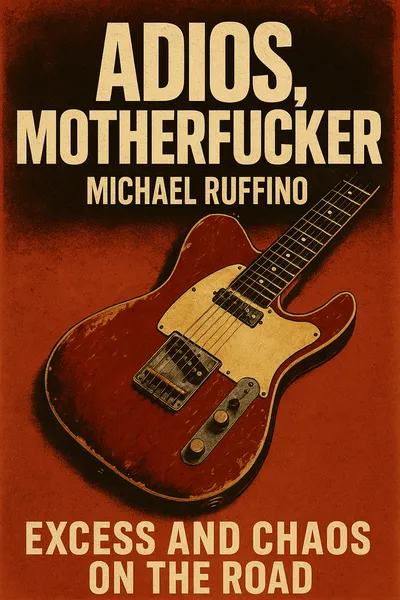
Adios, Motherfucker
Excess and chaos on the road
Description
Michael Ruffino's "Adios, Motherfucker" emerges from the author's extensive fieldwork within the American heavy metal scene, positioning itself as both ethnographic study and cultural critique. The work examines the nostalgic revival of hair-metal culture through the lens of touring circuits in Middle America, where aging performers and their audiences negotiate the tensions between past authenticity and present commodification. Ruffino's expertise in subcultural analysis allows him to penetrate beyond surface-level observations of musical performance to reveal deeper sociological mechanisms at work in contemporary American entertainment culture.
The central research question driving the work asks: How does the nostalgic commodification of hair-metal culture reflect broader patterns of cultural appropriation and the transformation of authentic rebellion into marketable spectacle? Ruffino's defended thesis argues that the hair-metal nostalgia tour represents a fundamental betrayal of the genre's original transgressive potential, transforming genuine subcultural resistance into safe, consumable entertainment for middle-class audiences seeking vicarious rebellion. The main stake is to demonstrate how the institutionalization of countercultural movements serves to neutralize their critical force while maintaining the illusion of authentic transgression.
Ruffino's analysis presents a coherent critique of how contemporary American culture processes and neutralizes subcultural resistance through nostalgic commodification. The work demonstrates that the hair-metal revival functions as a paradigmatic case of cultural appropriation that serves to reinforce rather than challenge existing social hierarchies. The author's ethnographic approach reveals the mechanisms through which authentic cultural expressions are transformed into safe consumer products that provide the illusion of transgression without its substance. The theoretical framework successfully integrates cultural criticism with sociological analysis to produce insights that extend beyond music culture to illuminate broader patterns of cultural domination. The work's intellectual contribution lies in its demonstration of how the entertainment industry serves ideological functions by systematically evacuating the critical potential of subcultural movements while maintaining their surface appeal.
Table of contents
01The Mechanics of Cultural Appropriation
Ruffino's analysis reveals how the hair-metal revival operates through sophisticated mechanisms of cultural appropriation that strip the genre of its original social critique. The touring circuit functions as a laboratory for observing how authentic subcultural expressions become transformed into commodified spectacle. The author demonstrates that this process involves not merely the commercialization of musical forms, but the systematic evacuation of their transgressive content.

02Performative Masculinity and Class Dynamics
The work's examination of gender performance within the hair-metal context unveils complex class dynamics that underpin the genre's nostalgic revival. Ruffino demonstrates how the exaggerated masculinity of hair-metal performers serves multiple social functions, providing working-class audiences with both identification models and escapist fantasies. The touring circuit becomes a space where traditional masculine roles are simultaneously celebrated and parodied, revealing the deep anxiety surrounding gender identity in post-industrial America.
03Temporal Displacement and Historical Consciousness
Ruffino's exploration of nostalgia reveals how the hair-metal revival operates through systematic temporal displacement that obscures historical understanding. The nostalgic frame transforms the specific historical conditions that produced hair-metal culture into timeless aesthetic categories divorced from their original social context. This process involves the active suppression of historical consciousness, replacing complex social analysis with simplified emotional responses.
04The Ethics of Cultural Memory
The final analytical dimension addresses the ethical implications of transforming subcultural history into entertainment commodity. Ruffino argues that the hair-metal revival represents a form of cultural grave-robbing that exploits the memory of genuine rebellious movements while betraying their original intentions. The ethical problem extends beyond simple commercialization to encompass questions of cultural responsibility and historical integrity.
05Critical Assessment and Future Directions
Despite its theoretical sophistication, Ruffino's analysis suffers from certain limitations that constrain its critical potential. The work's focus on hair-metal culture, while providing rich ethnographic detail, may limit the generalizability of its findings to other subcultural contexts. Additionally, the author's theoretical framework, heavily influenced by situationist critique, occasionally produces deterministic conclusions that underestimate the agency of both performers and audiences within the nostalgic circuit. The analysis could benefit from greater attention to the ways individuals and communities resist or subvert the commodification process, rather than presenting them as passive victims of cultural appropriation.
Related books