
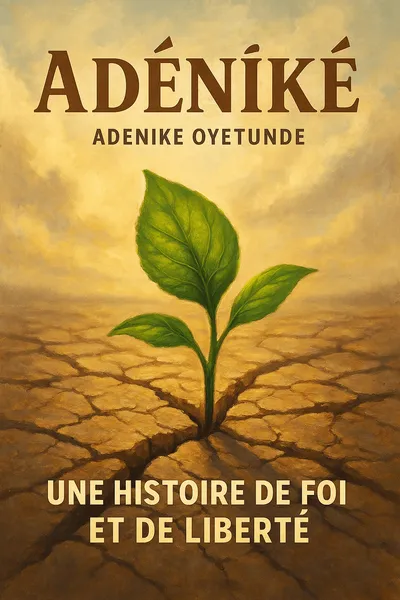
Adénìké
From trauma to authentic liberation
Description
Adenike Oyetunde's "Adénikẹ́" positions itself within the contemporary landscape of autobiographical literature that seeks to transform personal trauma into collective wisdom. The author, drawing from her expertise in community development and faith-based healing, constructs a narrative that transcends individual testimony to propose a theoretical framework for understanding resilience mechanisms. The work emerges within a broader African literary tradition that privileges experiential knowledge as legitimate epistemological foundation, while simultaneously engaging with universal questions about human capacity for transformation under extreme adversity.
The central research question of the work examines how faith, hope, and love function as transformative forces capable of reconstituting fractured identity and enabling authentic self-actualization following traumatic disruption. The defended thesis maintains that the triumvirate of faith, hope, and love constitutes an irreducible foundation for human resilience that can overcome any circumstantial adversity through community support and spiritual surrender. The main stake lies in demonstrating that individual transformation through adversity represents not merely personal recovery but a pathway to authentic liberation that challenges deterministic understandings of trauma's permanent effects.
Oyetunde's "Adénikẹ́" constitutes significant contribution to contemporary understanding of trauma, resilience, and transformation through its integration of experiential knowledge with theoretical sophistication. The work successfully demonstrates how personal narrative can function as legitimate sociological investigation, revealing universal patterns within particular experiences. The author's central thesis regarding faith, hope, and love as transformative forces receives compelling support through detailed phenomenological analysis and careful attention to community dimensions of healing processes. The intellectual coherence of the work lies in its consistent commitment to understanding transformation as both individual and collective phenomenon, requiring both personal agency and communal support. Oyetunde's theoretical framework successfully bridges traditional African communal values with contemporary psychological insights, creating synthesis that respects both cultural specificity and universal applicability.
Table of contents
01 Trauma as Existential Rupture
Oyetunde's theoretical framework rests upon a sophisticated understanding of trauma as existential rupture that fundamentally destabilizes established identity constructions. The author conceptualizes the protagonist's "overnight" transformation not as singular catastrophic event but as revelatory moment exposing underlying structural vulnerabilities within conventional life arrangements. This phenomenological approach reveals how traumatic experiences function as involuntary initiations into alternative modes of being, forcing confrontation with previously unconscious assumptions about security, identity, and meaning.

02 Community as Therapeutic Container
The author's examination of communal support systems reveals profound insights into the social construction of healing processes. Oyetunde demonstrates how individual recovery necessarily occurs within relational matrices that provide both witness to suffering and mirror for emerging identity reconstruction. The "community of Love" functions not merely as external support network but as constitutive element of the healing process itself, suggesting that authentic transformation requires social validation and collective participation.
03 The Dialectics of Surrender and Agency
The author navigates complex theoretical terrain in examining the relationship between surrender and empowerment within transformation processes. Oyetunde's analysis reveals apparent paradox whereby relinquishment of control enables authentic agency, suggesting that conventional understanding of autonomy may actually inhibit genuine self-determination. The progression through "brokenness" and "surrender" toward "freedom and liberty" demonstrates sophisticated grasp of spiritual transformation dynamics.
04 Faith as Epistemological Foundation
The author's treatment of faith transcends conventional religious discourse to propose alternative epistemological framework based on experiential knowledge rather than empirical verification. Oyetunde demonstrates how faith functions not as belief system but as mode of knowing that enables perception of possibilities invisible to rational analysis. This reconceptualization positions faith as cognitive methodology particularly suited to navigating uncertainty and ambiguity inherent in transformation processes.
05 Critical Assessment and Future Directions
Despite its theoretical contributions, the work exhibits certain limitations that constrain its analytical scope. The emphasis on faith-based transformation may inadvertently marginalize alternative pathways to resilience, potentially excluding individuals whose worldviews do not accommodate spiritual frameworks. The author's commitment to triumphant narrative arc, while inspirational, risks minimizing the legitimate reality of incomplete recovery or ongoing struggle for many trauma survivors.
The work would benefit from more explicit engagement with structural factors that contribute to traumatic circumstances, as the focus on individual transformation may inadvertently obscure systemic issues requiring collective political response rather than personal spiritual development. Additionally, the theoretical framework could be strengthened through more rigorous engagement with contemporary trauma studies and critical analysis of potential gender, class, and cultural specificities within the proposed universal principles.
Related books