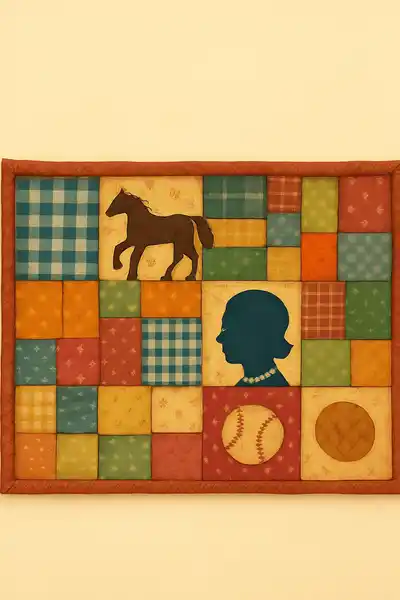
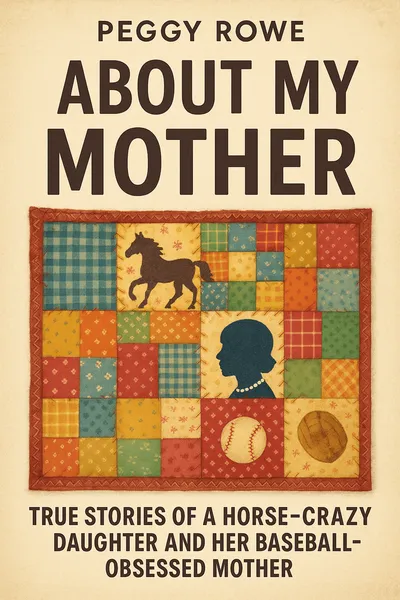
About My Mother
True Stores of a Horse-Crazy Daughter and Her Baseball-Obsessed Mother
Description
Peggy Rowe's "About My Mother" emerges within the contemporary landscape of memoir literature that examines intergenerational relationships and family heritage. The author, drawing from her dual expertise as educator and family chronicler, constructs a narrative that transcends simple biographical recounting to engage with broader questions of cultural transmission and maternal influence. The work situates itself within the tradition of domestic memoir while challenging conventional boundaries between personal anecdote and sociological observation.
The central research question driving this work explores how maternal figures transmit values, wisdom, and cultural knowledge across generations through everyday interactions and domestic practices. Rowe defends the thesis that the profound influence of maternal relationships extends beyond immediate family dynamics to shape broader cultural and social understanding, with mothers serving as primary architects of moral and practical wisdom transmission. The main stake of the work is to demonstrate that ordinary domestic interactions contain extraordinary formative power, challenging dismissive attitudes toward maternal contributions to social development.
Rowe's comprehensive examination of maternal influence reveals a sophisticated system of knowledge transmission that operates through intimate family relationships to produce broader social effects. The author successfully demonstrates that domestic interactions contain profound formative power, challenging dismissive attitudes toward maternal contributions to social development. The work establishes maternal figures as essential architects of cultural continuity and moral development. The intellectual contribution lies in revealing the complex pedagogical strategies employed within family systems and their broader social implications. Rowe's analysis provides a framework for understanding how informal knowledge transmission systems complement and sometimes surpass formal educational structures in their effectiveness and lasting impact.
Table of contents
01 The Architecture of Maternal Influence
Rowe's exploration reveals maternal influence as a complex architectural system rather than simple authoritative direction. The author demonstrates how mothers construct frameworks of understanding through seemingly casual interactions, embedding life lessons within routine domestic exchanges. This conceptual approach challenges traditional hierarchical models of knowledge transmission by revealing the sophisticated pedagogical strategies employed in maternal relationships.

02 Generational Dialogue and Cultural Continuity
The examination of intergenerational communication reveals complex negotiations between tradition and adaptation. Rowe demonstrates how mothers navigate the delicate balance between preserving cultural heritage and allowing for evolutionary change within family systems. This dynamic creates tension between conservative impulses to maintain established patterns and progressive tendencies to adapt to contemporary realities.
03 Ruptures and Reconfigurations in Family Narrative
Rowe's investigation uncovers the transformative potential of family disruptions and conflicts. Rather than viewing disagreements as destructive forces, the analysis reveals how tensions create opportunities for deeper understanding and relationship reconfiguration. The author demonstrates how apparent ruptures often catalyze growth and facilitate more authentic connections between family members.
04 Ethical Foundations and Societal Responsibility
The ethical dimensions of maternal influence emerge as a central concern in Rowe's analysis. The author explores how mothers shape moral frameworks that extend beyond individual family units to influence broader social behavior patterns. This examination reveals the profound responsibility inherent in maternal relationships and their contribution to social moral development.
05 Critical Assessment and Future Directions
The work's primary limitation lies in its potentially romanticized portrayal of maternal relationships, which may obscure the negative aspects of family influence systems. The analysis tends to emphasize positive outcomes while minimizing discussion of dysfunctional family patterns that can perpetuate harmful behaviors across generations. Additionally, the focus on traditional family structures may limit applicability to contemporary diverse family configurations.
The theoretical framework occasionally lacks engagement with existing sociological literature on family systems and knowledge transmission, potentially missing opportunities for deeper academic contextualization. The emphasis on personal narrative, while engaging, sometimes compromises analytical depth and theoretical sophistication.
Related books