A World in Black and White
How the colour line was drawn
Description
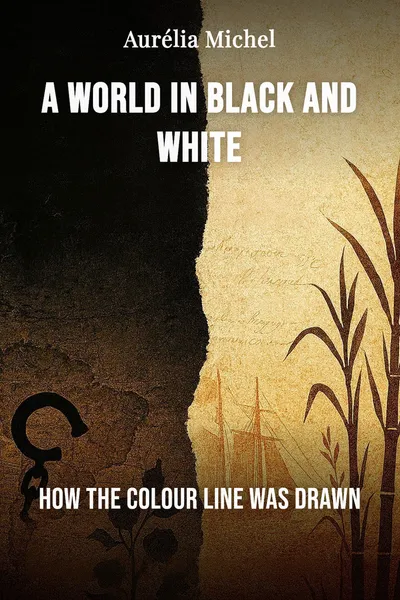
There is a habit of speaking about race as if it were a fact of nature, something the eye simply registers when it looks at another person. Aurélia Michel, a historian of the Atlantic world, spends her book "A World in Black and White" dismantling exactly that assumption. Her argument runs against the intuition most of us carry: the categories "Black" and "White" are not old, not universal, and not descriptions of anything that existed before people decided they should. They were made, in a specific place, over a specific stretch of centuries, to solve a specific problem. And the problem was money.
The place was the Atlantic, roughly between the fifteenth and nineteenth centuries. The problem was that European powers wanted to hold millions of human beings as property, sell their labour and their children, and do it inside societies that were beginning, at the very same moment, to talk loudly about liberty and the rights of man. Something had to give. What gave was the idea that some human beings were not quite included in humanity at all. Race is the name Michel gives to that exclusion once it hardened into a rule.
What makes her account bracing is that she refuses to treat racism as a prejudice that came first and slavery as its unfortunate consequence. She reverses the order. The trade came first, the categories were manufactured to justify it, and the justification outlived the thing it was built to defend. That reversal changes what we are looking at when we look at the colour line today.
The question we’re asking : Where does the line between "Black" and "White" actually come from, and what was it built to do?What we’ll see : How a commercial system produced a racial order, wrote it into law, and left it standing long after the chains came off.
Table of contents
01Chapter 1 — A category that had to be built
Start with a fact that unsettles the whole picture: for most of human history, there was no such thing as a "Black" person or a "White" person. There were Wolof and Yoruba, Genoese and Flemish, subjects of this king or that empire, believers and unbelievers. People noticed skin, of course, the way they noticed height or accent. But nobody organised the world into two great colour-coded halves, because there was no reason to. Michel's first move is to make that absence visible, so the categories stop looking eternal and start looking like an invention with a date.
The oldest line that mattered, she argues, was not colour but status. Slavery is ancient and it was everywhere, and for most of that history the enslaved could be anyone unlucky enough to lose a war or a debt. What made someone a slave was a legal condition, not a body. Crucially, that condition was reversible: you could be freed, your children could be free, you could be absorbed back into the community. Slavery was a misfortune, not a nature. Nobody was born permanently outside humanity.

02Chapter 2 — The Atlantic machine that needed a lie
The engine driving all of this was the plantation. Sugar, then tobacco, then cotton demanded enormous quantities of forced labour under murderous conditions, in colonies too far away and too deadly to attract willing workers. The Atlantic economy Michel describes was not a side venture of European wealth but one of its foundations, moving roughly twelve million captives across the ocean over the course of the trade. Numbers on that scale cannot run on improvised cruelty. They need a system, and a system needs a story that makes it look ordinary.
The story had a genuine obstacle to overcome, and Michel does not soften it. The same European societies expanding the slave trade were also the ones developing the language of natural rights, of equality, of the dignity every man supposedly carried by virtue of being a man. The Enlightenment and the slave ship sailed the same seas at the same time. This is not hypocrisy to be tutted at from a distance; it is a contradiction that had to be managed, actively, or the whole moral scaffolding would collapse under the weight of the trade beneath it.
03Chapter 3 — When the law made race
Ideas alone do not hold an economy together; law does. Michel follows the categories as they harden into legal codes, and the clearest example is the French Code Noir, first issued in 1685 to govern slavery in the Caribbean colonies. The text reads like bureaucratic housekeeping, which is precisely what makes it chilling. It regulates baptisms, marriages, punishments and the sale of bodies with the same flat tone, converting the racial fiction into enforceable procedure.
The decisive legal invention was making status pass through the mother. A child inherited the condition of the woman who bore it, which meant a child born to an enslaved woman was born enslaved, regardless of the father. In one clause, the system guaranteed its own reproduction. It also, not incidentally, turned the rape of enslaved women into an engine of capital: every child was new property. Race, on paper, is largely this rule, made durable and made hereditary.
04Chapter 4 — Emancipation without repair
Abolition, when it finally came across the nineteenth century, ended the institution but not the order the institution had built. This is the pivot of Michel's argument, and it is where the book turns from history to the present. The chains were struck off; the categories were not. Slavery had spent centuries teaching whole societies to see the world in "Black" and "White", and that lesson did not expire the day the trade became illegal. The fiction had outlived its function and simply kept going.
She draws attention to how emancipation was actually staged, and the details are damning. In several places it was the former enslavers, not the formerly enslaved, who received compensation for the loss of their human property. The people freed walked out with nothing, into economies still organised around the categories that had held them down, and were promptly reabsorbed as cheap and disposable labour. Freedom on paper, dependence in fact. The racial hierarchy that slavery required to exist proved perfectly capable of existing without slavery.
05Conclusion
Aurélia Michel's account ends where it must, not with a tidy resolution but with a debt left open. The colour line was drawn by hands we can name, in codes we can read, to solve a problem that was economic before it was anything else. It was never a fact about bodies. It was a rule about property, dressed up as a fact about bodies, and repeated until the costume became the face. Abolition removed the profit motive and left the rule standing, unclaimed and unexamined.
Related books