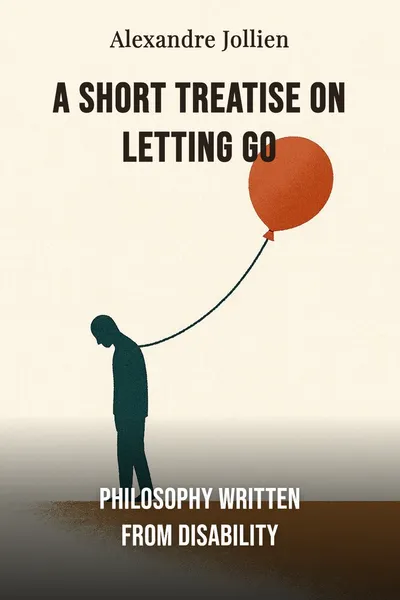
A Short Treatise on Letting Go
Philosophy written from disability
Description
Alexandre Jollien spent seventeen years, from age three to twenty, in a specialized institution in Switzerland for people with disabilities. He was born with cerebral palsy after the umbilical cord cut off his oxygen at birth, which left him with movements he never fully commands — a gait that lurches, hands that don't always obey, speech that takes its time. The place he grew up in sorted its residents by what their bodies could do. His job, for part of those years, was rolling cigars. Nobody there was preparing him to read Socrates, and yet that is roughly where his life went.
The book he eventually wrote, A Short Treatise on Letting Go, is not a memoir of overcoming, and it isn't a self-help manual dressed up in Greek. It's philosophy done from inside a body that won't fall in line — a body that makes every ordinary gesture a small negotiation. From that vantage point, Jollien asks a question most of us postpone: what do we do with the part of our lives that will not change, no matter how hard we push against it? He reaches back to Socrates, the Stoics, the Christian mystics, and a few Eastern voices, not as a scholar cataloguing them but as someone who needs them to get through a Tuesday.
What makes the treatise worth sitting with is where it refuses to go. It doesn't counsel acceptance as defeat, and it doesn't promise that letting go will make the hard thing disappear. It points somewhere stranger — toward a joy that doesn't wait for conditions to improve. Jollien writes from a place where conditions mostly won't improve, which is exactly why his version of joy has to be built differently.
The question we’re asking : When a part of our life simply won't bend to our will, what does it actually mean to let go of it — and can joy survive that?What we’ll see : A philosophy forged inside a body that resists, drawing on old thinkers to find a way of living that stops bargaining with reality.
Table of contents
01Chapter 1 — The body that refuses to cooperate
Jollien's starting material is not abstract. It's the fact of a body that does what it wants. Picking up a glass, signing a form, walking across a room — these are not neutral tasks for him but ongoing small struggles, each one a reminder that the will and the body are not the same thing. Most philosophy is written by people whose bodies obey them so reliably they forget the body is there. His is written by someone for whom that illusion was never available.
This changes what a thinker can honestly say. A great deal of popular wisdom assumes we can reshape our circumstances if we only want it badly enough — that effort is sovereign, that obstacles exist to be removed. Jollien knows from the inside that some obstacles don't move. His disability is not a chapter he's working toward closing. It's permanent, and pretending otherwise would be a lie he can't afford. So his philosophy has to do something harder than motivate. It has to help him live well alongside what cannot be fixed.

02Chapter 2 — What the Greeks and the Stoics kept whispering
To make sense of his situation, Jollien turns to thinkers who were asking the same thing long before him. Socrates sits at the center — not the Socrates of doctrines, but the one who kept insisting he knew nothing, who treated every certainty as something to be questioned rather than clung to. For Jollien, that posture is itself a form of letting go: releasing the need to have the answer, to control the conversation, to be seen as competent. The man who grew up being underestimated finds in Socratic ignorance a surprising kind of freedom.
The Stoics give him the sharper tool. Epictetus, who had himself been enslaved and was lame, drew a line Jollien keeps returning to: some things are within our power, and most things are not. We can't govern our bodies, other people, reputation, or outcomes. What we can govern is the stance we take toward them. The whole art, for Epictetus, is learning not to waste our lives fighting what was never ours to command. Coming from a formerly enslaved man with a damaged leg, this isn't cold theory — it's a survival technique, and Jollien receives it as one.
03Chapter 3 — Joy that doesn't wait for the obstacle to clear
The hinge of the book is the distinction between letting go and giving up, which look alike from the outside and are opposites underneath. Giving up is a withdrawal — you stop caring because caring hurts. Letting go, as Jollien describes it, is the reverse: you keep caring, but you release your grip on how things must turn out. You stop issuing conditions to reality. The struggle that drops away is not the struggle to live well; it's the exhausting, invisible struggle to make the world different from what it is.
He's blunt about how this applies to him. He will not wake up one morning cured. The question is whether his happiness is held hostage to a change that will never come. If it is, he's condemned to a life of waiting. His answer is to stop making joy contingent — to refuse the deal where he's only allowed to be content once the hard fact is fixed. The fact isn't going to be fixed, so the deal has to be torn up.
04Chapter 4 — Letting go as a daily craft, not a slogan
Read from the outside, it's tempting to file this as a special wisdom for a special case — moving, but not quite ours. Jollien resists that reading hard. His whole wager is that his situation only makes visible, in sharp relief, a condition everyone shares. No one commands their body in the long run. No one controls how they'll be received, whether they'll be loved back, how their health or their luck will hold. His limits are more obvious than most people's, but they are a difference of degree, not of kind. We are all living alongside things that won't bend to us; we've just gotten better at pretending otherwise.
Which is why he insists that letting go is not an insight you have once and keep. It's a craft, practiced badly and daily, closer to physical training than to revelation. You grip, you notice you're gripping, you loosen, you grip again an hour later. The ancient thinkers he leans on understood philosophy this way too — as exercise, as a discipline of attention you return to every morning, not a conclusion you file away. Jollien's version carries the dignity of someone who knows that nothing worth doing stays done.
05Conclusion
The boy rolling cigars in a Swiss institution was not supposed to become a philosopher, and the body that lurches across a room was not supposed to be the source of anything wise. Jollien takes both of those facts and turns them over until they yield something unexpected: a way of living that stops negotiating with reality without going cold toward it. He keeps his attachments, keeps his tenderness, keeps caring about the people in front of him — and sets down only the demand that his life run on terms it was never going to meet.
Related books