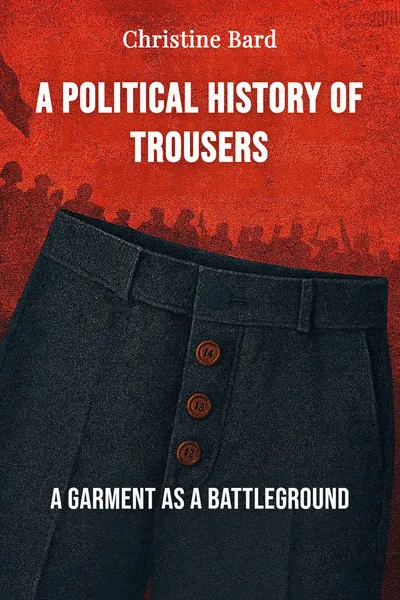
A Political History of Trousers
A garment as a battleground
Description
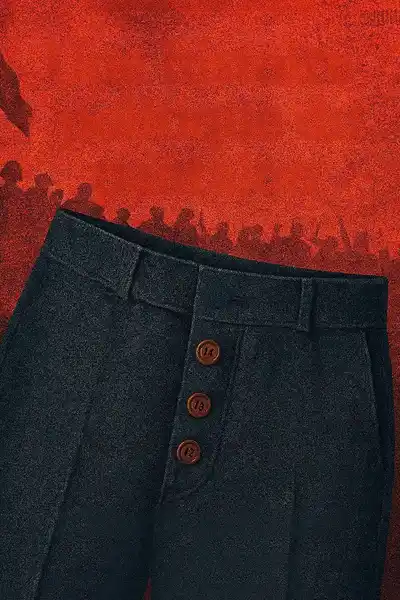
On November 7, 1800, the Paris police prefecture issued an ordinance that reads today like a curiosity and, at the time, like common sense: any woman wishing to dress as a man had to request permission from the authorities, on medical grounds, with a doctor's certificate. The text was short, administrative, almost bureaucratic in its dryness. It did not ban a crime. It regulated a garment. And the garment in question was the pair of trousers — the culotte, then the pantalon — which the French Revolution had just turned into a political emblem for men and, by the same move, sealed off from women. The ordinance would not be formally struck from the books until 2013.
Two centuries. That is how long a rule that nobody enforced by the end, that everybody had quietly stopped obeying, stayed technically on the statute. George Sand wore trousers in the 1830s and drew stares and admiration in roughly equal measure. Rosa Bonheur, the painter, requested and received her permission — the permission de travestissement — because she needed to sketch in slaughterhouses and horse markets where skirts were a hazard. The document existed. Women applied for it. The state granted or refused it. A piece of cloth had become something a woman had to petition for.
The historian Christine Bard set out to follow that thread, and what she found was not a fashion story at all. It was a story about who gets to move freely, who gets to work, who gets to be taken for a citizen — and how a society encodes all of that into the cut of a seam. The trouser turns out to be one of the most heavily policed objects in modern Western history, precisely because it looked like it was about nothing.
The question we’re asking : Why did a garment as ordinary as trousers become a two-hundred-year-long site of prohibition, permission and defiance?What we’ll see : How an item of clothing carried the weight of citizenship, labor and the line between the sexes — and what it took to unpick it.
Table of contents
01 Chapter 1 — A Parisian ordinance that outlived the Revolution
The ordinance of 1800 did not appear out of nowhere. It came at the tail end of a decade in which clothing had become explicitly political. During the Revolution, the sans-culottes — literally "those without knee-breeches" — had made the long trouser a badge of the common man against the aristocrat's silk culotte. Trousers meant the people, the worker, the citizen in arms. They were saturated with republican meaning. And that meaning was, from the start, masculine. The citizen the Revolution imagined was a man; the trouser he wore said so.
So when the young republic drew its lines, it drew one through the wardrobe. Women had marched, petitioned, and organized during the Revolution, and had then been pushed firmly back toward the domestic sphere. Bard reads the trouser ban as part of that retreat — a way of marking, at the level of the body, that political life had an entrance and women did not have the ticket. To dress as a man was to lay a symbolic claim on the man's place, and the state preferred that claim not be made lightly.

02 Chapter 2 — The garment men reserved for themselves
To understand why the ban held so long, it helps to see what trousers had come to mean by the nineteenth century. The garment had not always been coded so hard. In much of the world, and in earlier European centuries, the boundary between what men and women wore below the waist was looser and more regional. What hardened it, Bard argues, was the industrial and bourgeois nineteenth century, which built an unusually rigid grammar of the sexes and dressed each one in its uniform. Men in dark, practical trousers suited to work and movement; women in skirts, corsets, layers — clothing that signaled dependence and ornament rather than labor.
The trouser, in that grammar, said action. It said the office, the factory, the street, the public world where things were decided and money was made. The skirt said the parlor and the home. This was not neutral tailoring; it was an argument about where each sex belonged, sewn into the daily act of getting dressed. To wear trousers was to dress for the world men had claimed, and that is exactly why it was withheld.
03 Chapter 3 — The long insurgency of the women who wore them anyway
Against all this stood a scattered, stubborn line of women who put trousers on regardless. Some did it under cover of a permission, like Rosa Bonheur. Some did it in open provocation, like George Sand, who wore men's clothes partly for freedom and partly because a man's suit let her into places — theaters, streets at night, cheap seats — that a respectable woman in silk could not go. Sand's trousers were a passport as much as a statement. What she was buying with them was access.
Others made trousers a banner. In the 1850s, the American reformer Amelia Bloomer lent her name, if not the invention, to a costume of loose trousers under a shortened skirt, promoted as rational dress for women's health and mobility. The "bloomer" was mocked mercilessly, caricatured in the press, and largely abandoned by its own advocates, who found the ridicule cost more than the reform gained. But the episode marked a turn: dress had become an explicit front in the fight for women's rights, argued in the open rather than smuggled through a doctor's note.
04 Chapter 4 — What a seam decides
Step back from the trouser itself and what Bard has really traced is how a society turns clothing into law. Not metaphorically — literally. There was a statute, a certificate, an enforcement, a repeal. The garment was regulated the way a weapon or a substance is regulated, because it was understood, correctly, to grant a kind of power: the power to pass, to move, to be read as belonging to the public world. Dress codes are among the oldest legal instruments precisely because clothing is the most visible, most instant marker of who someone is allowed to be.
The striking thing is how rarely such codes are argued out loud. The 1800 ordinance did not explain itself; it simply assumed that men and women belonged in different clothes and legislated the assumption. Most dress rules work this way. They feel like manners, like taste, like nature — until someone crosses the line and the enforcement appears, revealing that a boundary was there all along, waiting. The trouser was invisible as a rule right up to the moment a woman put one on.
05 Conclusion
The Parisian ordinance of 1800 asked women to bring a doctor's note before they could wear a pair of trousers, and it took the French state two hundred and thirteen years to admit the note was no longer needed. In that span, women rode bicycles, ran factories, sketched in slaughterhouses, marched, and eventually simply dressed as they pleased — and the law lagged behind every one of those changes, a fossil of a moment when citizenship and cloth were sewn to the same body.
Related books