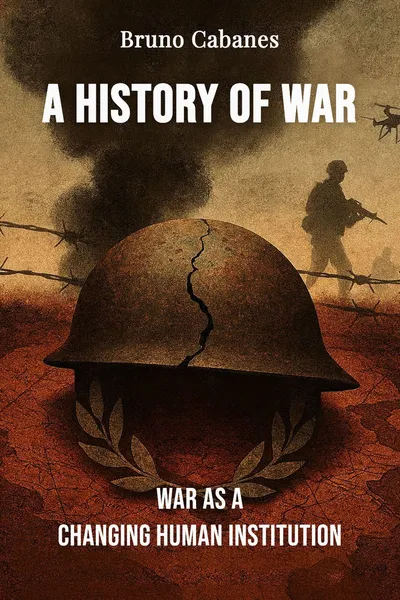
A History of War
War as a changing human institution
Description
In the spring of 1917, a French soldier in the trenches of the Chemin des Dames could go weeks without ever seeing a German. The enemy was a noise, a shell that arrived before its sound, a gas that crept along the ground. This was war, and yet almost nothing in it resembled the war his grandfather had described from 1870 — the massed charges, the visible lines, the officers on horseback. In one lifetime the very shape of combat had changed beyond recognition. Bruno Cabanes, a French historian who has spent his career studying the aftermath of conflict, takes exactly this kind of vertigo as his starting point. War, in his telling, is not one thing that recurs. It is an institution that societies keep rebuilding.
That framing runs against a stubborn intuition. We tend to talk about war as if it were a constant of the human condition — timeless, natural, always essentially the same act of killing for advantage. Cabanes's history pulls in the other direction. It treats war as a made thing: shaped by technology, by law, by the emotions a society is willing to mobilize, by the stories it tells to explain why the killing is necessary. Change any of those, and you change the war itself.
What emerges is less a parade of battles than an account of how deeply war is woven into everything around it — economies, bodies, grief, the machinery of the state. And it raises a quieter question that sits underneath the whole survey: if war keeps changing form, does the thing that makes a society say yes to it change too?
The question we’re asking : If war has taken so many different forms across history, what actually stays the same — and what has quietly been transformed?What we’ll see : How warfare has been remade across periods and technologies, and how the reasons societies give themselves for fighting have shifted along with it.
Table of contents
01 Chapter 1 — The battlefield stops being the whole story
For a long time, the history of war was written as a history of battles — dates, generals, decisive afternoons. Cabanes belongs to a generation of historians who widened the frame. His central move is to insist that the battlefield is only the visible tip of something much larger. A war is also the harvest that doesn't get planted, the letters that stop arriving, the prisoners marched off, the civilians whose town happens to sit on the road. To understand war, he argues, we have to look at everything that happens around the fighting, not just the fighting.
This matters because for most of human history, the people most affected by war were not the ones holding weapons. Sieges starved cities. Armies lived off the land they crossed, which is a polite way of saying they took the food. Disease killed far more soldiers than combat did, well into the nineteenth century. The line we like to draw between soldier and civilian, between the front and the rear, turns out to be surprisingly recent and surprisingly leaky.

02 Chapter 2 — When machines took command
If any single force has remade war, it is technology — but Cabanes is careful not to tell it as a simple story of better weapons. New tools don't just make killing more efficient; they change who can fight, how far, and at what emotional distance. Gunpowder eroded the armored knight and, with him, a whole social order built on mounted aristocratic warriors. The musket made it possible to turn ordinary men into soldiers in weeks rather than years. Each shift rippled outward into politics.
The industrial revolution is the great hinge. Railways moved armies of a size no previous age could have supplied. Factories turned out ammunition by the trainload, which meant that the side with the deeper economy, not just the braver troops, tended to prevail. The machine gun and rapid-fire artillery of the First World War produced casualty figures that overwhelmed every prior assumption about what men could endure. War became, in a real sense, an industrial process — with the whole nation as its workforce.
03 Chapter 3 — The war that never quite ends
Cabanes's own scholarly signature is his attention to what happens after the shooting stops — and one of his strongest claims is that wars rarely end when the treaties say they do. The armistice of November 1918 did not switch off the violence in central and eastern Europe; it curdled into revolutions, border wars and pogroms that ran for years. Peace, in his account, is not a moment but a long, uneven, often unfinished process.
Part of what refuses to end is inside people. Millions of men came home from the trenches carrying wounds that had no name yet — shell shock, war neurosis, what we would later call trauma. Societies had to invent ways of dealing with disabled veterans, widows, orphans, and a generation of men who could not simply resume their old lives. The economics of pensions, the politics of remembrance, the awkward business of reintegrating people trained to kill: all of this is war too, stretched out over decades.
04 Chapter 4 — The moving line between what is and isn't allowed
Step back from the weapons and the casualty counts, and a different thread runs through the whole history: the reasons societies give themselves for fighting, and the limits they claim to respect while doing it. This, more than any technology, is where Cabanes locates war as a genuinely human institution. Killing on this scale always demands justification, and the shape of that justification has never stopped moving.
For centuries, war needed little argument — it was the ordinary business of kings, a legitimate instrument of policy, glorious even. To die for one's sovereign, or later one's nation, was among the highest goods a man could aspire to. That consensus has been slowly, unevenly dismantled. The scale of twentieth-century slaughter drained a great deal of the glory out of the story. War came to need a better excuse than ambition: self-defense, liberation, human rights, the protection of civilians. The vocabulary shifted from conquest to justice.
05 Conclusion
Return to that soldier at the Chemin des Dames, unable to see the enemy killing him. His confusion was real, but it was also a symptom: war had outrun the story his society still told about it — men, honor, a visible foe. Across Cabanes's long survey, that gap keeps reappearing. Technology, economics and law race ahead, and the human meanings scramble to catch up. War is never simply inherited; each generation has to reassemble it, and reassemble the reasons for it.
Related books