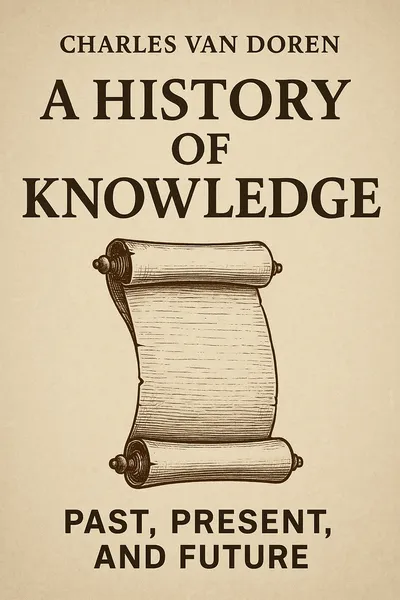
A History of Knowledge
Civilizations building one inheritance
Description
Van Doren's ambitious undertaking emerges from his extensive experience as an encyclopedist and his deep engagement with the Western intellectual tradition. Published as a comprehensive synthesis of human intellectual development, this work positions itself within the tradition of grand historical narratives that seek to identify patterns and continuities across civilizations. The author leverages his editorial expertise and broad scholarly background to construct a sweeping account that transcends disciplinary boundaries, addressing both specialist audiences and educated general readers seeking to understand the architecture of human knowledge formation.
The central research question driving this work asks: How has human knowledge evolved as an interconnected system across civilizations, and what patterns govern its transmission and transformation? Van Doren defends the thesis that knowledge develops through cumulative processes where each civilization contributes distinct elements to a unified intellectual heritage that transcends cultural boundaries. The main stake is to demonstrate that human understanding forms a coherent narrative of progressive accumulation rather than isolated cultural achievements, thereby validating the unity of human intellectual endeavor.
Human knowledge represents a continuous, interconnected evolution where each civilization and epoch builds upon previous achievements, creating a cumulative tapestry of understanding that transcends cultural and temporal boundaries. This comprehensive framework reveals Van Doren's fundamental belief in the coherence and directionality of intellectual development, positioning knowledge as humanity's collective achievement rather than the possession of particular cultures or epochs.
Table of contents
01 The Architecture of Intellectual Continuity
Van Doren constructs his analytical framework upon the premise that knowledge operates as a dynamic system rather than static accumulation. His theoretical approach draws from both historicist and progressivist traditions, positing that intellectual achievements emerge through dialectical processes between tradition and innovation. The author employs a synthetic methodology that privileges connectivity over rupture, seeking to identify the underlying structures that enable knowledge transmission across temporal and cultural divides.

02 Cultural Synthesis and Power Dynamics
The work's treatment of cross-cultural knowledge exchange reveals complex tensions between inclusivity and hierarchy. While Van Doren explicitly acknowledges non-Western contributions to human understanding, his analytical framework consistently positions Western intellectual traditions as the primary organizing principle for global knowledge synthesis. This approach generates significant implications for how we understand the politics of knowledge production and the mechanisms through which certain intellectual traditions achieve dominance over others.
03 Periodization and Historical Ruptures
Van Doren's periodization strategy reveals fundamental tensions in his conceptual framework. His identification of major epochs—Renaissance, Scientific Revolution, Information Age—reflects conventional historical categories that privilege dramatic transformations over gradual developments. This approach creates analytical problems when attempting to maintain the continuity thesis that underlies his broader argument about knowledge accumulation.
04 Contemporary Knowledge and Democratic Access
The work's engagement with contemporary developments in knowledge production and dissemination raises crucial questions about the democratization of intellectual resources. Van Doren's optimistic assessment of the Information Age reflects broader assumptions about technology's capacity to realize the democratic potential inherent in knowledge accumulation. His analysis suggests that current developments represent the culmination of historical processes toward universal access to human intellectual achievement.
05 Critical Assessment and Future Directions
Van Doren's synthetic achievement lies in his demonstration of knowledge as a fundamentally connective enterprise that transcends conventional cultural and temporal boundaries. His comprehensive scope and accessible presentation make visible the underlying architecture of human intellectual development in ways that illuminate both achievements and possibilities. The work succeeds in challenging parochial approaches to intellectual history and demonstrates the value of broad synthetic vision for understanding contemporary knowledge challenges.
The intellectual coherence of Van Doren's project emerges through his consistent application of connectivity as both analytical principle and normative ideal. His argument that knowledge represents humanity's collective achievement rather than the possession of particular cultures or epochs provides a valuable framework for thinking about intellectual heritage and responsibility. The work's pedagogical effectiveness stems from its ability to make complex intellectual relationships accessible without sacrificing analytical sophistication.
Related books