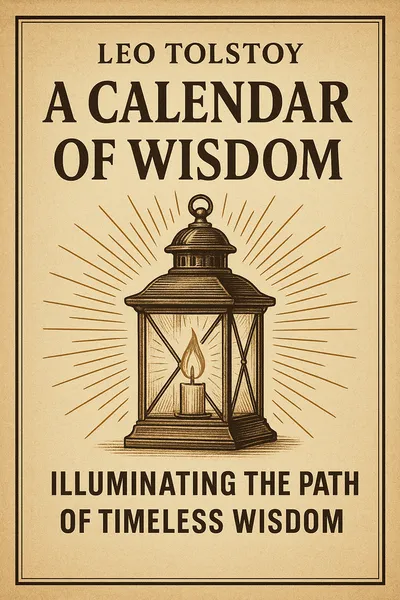
A Calendar of Wisdom
Illuminating the path of timeless wisdom
Description
A Calendar of Wisdom emerged during Tolstoy's final decades as his spiritual testament to humanity. Conceived as a daily devotional stripped of orthodox religious doctrine, this compilation synthesizes wisdom from diverse philosophical, religious, and literary traditions. Tolstoy crafted this work as accessible moral guidance for ordinary readers, transcending the literary complexity of his earlier novels. The text reflects his mature philosophical position following his radical spiritual conversion, representing a synthesis of Christian ethics, Eastern philosophy, and humanitarian rationalism.
The work addresses a central research question: How can universal moral wisdom be made accessible to guide daily ethical living independent of institutional religious authority? Tolstoy's defended thesis argues that authentic spiritual wisdom transcends denominational boundaries and can be synthesized into practical guidance for moral development through individual conscience rather than ecclesiastical mediation. The main stake is to democratize spiritual wisdom by creating a secular yet deeply spiritual framework for ethical living that challenges both religious orthodoxy and materialist modernity.
A Calendar of Wisdom represents Tolstoy's mature attempt to synthesize universal moral wisdom into accessible daily guidance for ethical living. The work's democratizing impulse, anti-institutional stance, and practical focus reflect his broader philosophical evolution from literary artist to moral teacher. Despite inherent tensions between universalist aspirations and particular limitations, the Calendar offers valuable resources for contemporary ethical reflection by emphasizing individual moral agency while drawing from humanity's diverse wisdom traditions.
Table of contents
01 The Democratization of Moral Philosophy
Tolstoy's Calendar represents a radical departure from elitist philosophical discourse by rendering complex moral concepts accessible to common readers. This democratizing impulse reflects his broader rejection of aristocratic privilege and intellectual exclusivity. The daily format transforms philosophical reflection from academic exercise into lived practice, embodying his conviction that wisdom must be experientially integrated rather than merely intellectually comprehended.

02 Resistance to Institutional Authority
The Calendar's suppression under Soviet rule reveals its subversive potential regarding state authority and ideological control. Tolstoy's emphasis on individual moral conscience directly threatens totalitarian systems requiring absolute obedience to external authority. His synthesis of spiritual insight with social criticism creates a framework for resistance rooted in ethical rather than merely political grounds.
03 The Tension Between Universal and Particular
The Calendar embodies a fundamental tension between Tolstoy's universalist aspirations and his particular cultural position. Despite drawing from diverse traditions, his selection and interpretation inevitably reflect his Russian Orthodox background and European intellectual formation. This limitation raises questions about the possibility of truly universal moral discourse and the inevitable cultural specificity of wisdom compilation.
04 Ethical Implications for Contemporary Society
The Calendar's relevance to contemporary moral crises demonstrates the enduring significance of Tolstoy's approach to ethical guidance. In an era of moral relativism and institutional distrust, his emphasis on individual conscience and universal principles offers resources for navigating ethical complexity. The work's focus on daily practice rather than abstract theory provides practical tools for moral development in secular contexts.
05 Critical Assessment and Contemporary Relevance
The Calendar's principal limitation lies in its decontextualized approach to wisdom extraction, potentially diluting the transformative power of insights rooted in specific spiritual practices and community contexts. Tolstoy's individualistic emphasis may inadequately address the social dimensions of moral development and the role of community in sustaining ethical commitment. Additionally, his universalist claims risk obscuring the particular cultural and historical conditions that generate specific forms of wisdom.
Related books