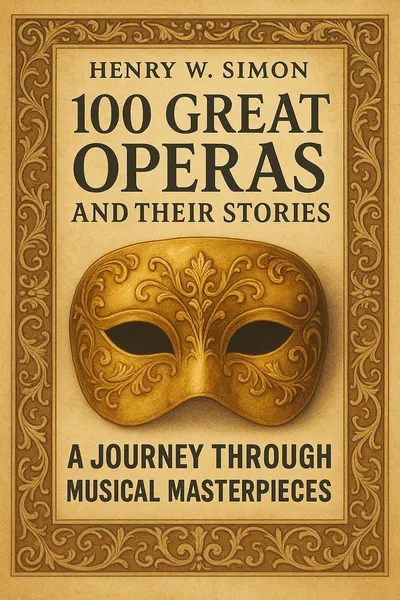
100 Great Operas and Their Stories
A journey through musical masterpieces
Description
Henry W. Simon presents an ambitious cartographic enterprise of operatic literature, establishing a canonical framework for understanding the evolution and significance of lyric drama from its baroque origins to twentieth-century innovations. His comprehensive survey positions opera not merely as entertainment but as a sophisticated cultural institution that encapsulates the aesthetic, philosophical, and social preoccupations of Western civilization across four centuries of artistic development.
The central research question examines how operatic works function as cultural documents that preserve and transmit the fundamental human experiences and social transformations of their respective historical periods. Simon defends the thesis that great operas transcend mere musical entertainment to constitute a parallel historical narrative that illuminates the evolution of human consciousness and social structures through artistic synthesis. The main stake is to demonstrate that operatic literature represents an essential cultural archive requiring systematic preservation and interpretation for contemporary understanding of Western artistic heritage.
Simon's contribution lies in systematizing this vast repertoire while maintaining appreciation for individual artistic achievements and their collective cultural significance. His methodological approach successfully bridges scholarly rigor with accessible presentation, creating a framework for understanding operatic literature that serves both educational and preservational functions. The author's selection and analysis reveal opera's unique capacity to synthesize multiple dimensions of human experience within coherent artistic structures, positioning these works as indispensable resources for understanding Western cultural development.
Table of contents
01 The Operatic Canon as Cultural Memory
Simon's methodological approach reveals opera as a mechanism of cultural memory, where musical narratives preserve societal values, anxieties, and transformations across historical epochs. His selection criteria implicitly construct a canonical hierarchy that reflects both aesthetic excellence and cultural significance, positioning certain works as essential repositories of collective experience. The author demonstrates how operatic composers function as cultural historians, encoding within their musical dramas the psychological and social tensions of their respective periods.

02 Democratic Accessibility and Elite Culture
The author navigates the inherent tension between opera's aristocratic origins and its democratic potential, examining how these theatrical works have functioned simultaneously as elite cultural markers and popular entertainment. Simon's approach reveals the paradoxical nature of operatic culture, where complex artistic constructions achieve broad emotional resonance while maintaining sophisticated aesthetic demands.
03 Historical Evolution and Aesthetic Transformation
Simon traces the evolution of operatic form as a reflection of broader cultural and philosophical transformations, positioning stylistic changes within larger intellectual movements. His chronological progression reveals how operatic innovations correspond to shifts in social consciousness, political structures, and aesthetic philosophies, establishing opera as both product and producer of cultural change.
04 Contemporary Relevance and Cultural Transmission
The author addresses the contemporary function of operatic tradition, examining how historical works maintain meaning within modern cultural contexts. Simon's analysis reveals the mechanisms through which operatic repertoire continues to generate significance despite temporal distance from original contexts, positioning these works as living cultural documents rather than museum artifacts.
05 Critical Assessment and Future Directions
Simon's canonical approach, while pedagogically valuable, reflects the cultural biases and exclusions characteristic of mid-twentieth-century scholarship. His selection criteria privilege European traditions while marginalizing alternative operatic developments and non-Western musical theater forms. The author's emphasis on narrative accessibility occasionally diminishes attention to musical innovation and experimental techniques that challenge conventional operatic structures.
Related books