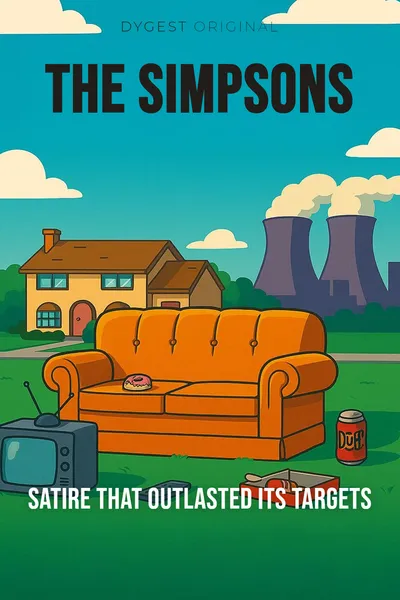
The Simpsons
Satire that outlasted its targets
Description
On December 17, 1989, an animated family with yellow skin and overbites walked into American living rooms in a Christmas special about a father who can't afford presents and bets the money on a greyhound. The Simpsons had started two years earlier as crude filler shorts on The Tracey Ullman Show, drawn by cartoonist Matt Groening in a matter of minutes because he didn't want to sign away the rights to his real comic strip. Fox, then a scrappy fourth network with little to lose, gambled on a full series. Almost nobody involved expected it to run more than a season or two.
It is still running. Thirty-six seasons and counting, more than 780 episodes, the longest-scripted primetime series in American television history — longer than the careers of most of the politicians, executives and celebrities it has spent decades mocking. Along the way it stopped being just a sitcom about a working-class family and became a kind of national reference library, a shared archive of jokes that Americans quote at each other without remembering the episode. Presidents have complained about it. School boards have banned its merchandise. And the show kept going, outlasting the outrage every time.
What makes this odd is not the longevity itself — plenty of shows run forever by going soft. The Simpsons stayed on the air while remaining, at least for a long stretch, genuinely acidic about the country that watched it. That combination of mass popularity and real bite is rare, and it raises a puzzle about how satire works, how it ages, and what happens when the joke sticks around longer than the thing it was laughing at.
The question we’re asking : How did a throwaway cartoon become a satire durable enough to outlive the very institutions and figures it set out to skewer?What we’ll see : How the show built its method, how that method turned it into an accidental oracle, and what its own long life reveals about the shelf life of comedy.
Table of contents
01Chapter 1 — A cartoon nobody expected to last
The Simpsons arrived in a television landscape that had a clear idea of what a family sitcom was supposed to be. The dominant model was warm and aspirational: The Cosby Show, Family Ties, households that solved their problems in twenty-two minutes and hugged before the credits. Groening's family did none of that. Homer was lazy and often selfish, Bart was a proud underachiever, and the show treated the American family as a site of low-grade dysfunction rather than moral instruction. Critics were divided; some found it corrosive. Bart T-shirts reading "Underachiever and proud of it" were banned from certain schools within months.
The early seasons were rougher and more sentimental than the show would later become, closer to a hard-luck family drama with jokes than the machine-gun parody it turned into. But the ambition was there from the start. The writers' room, unusually, was stacked with Harvard Lampoon alumni — people trained to take apart the conventions of comedy itself. That pedigree mattered. It meant the show was written by people who understood the sitcom form well enough to attack it from the inside, rather than simply doing it badly.

02Chapter 2 — The method: mock the frame, not just the joke
The reason The Simpsons aged better than most topical comedy is that its satire rarely depended on a single target being current. The show's real method was to mock the frame around a subject rather than the subject itself — to laugh at how television covers a scandal, how corporations talk about safety, how a town congratulates itself. Mr. Burns is funny not because he resembles one specific tycoon but because he embodies the logic of unaccountable wealth, blocking out the sun over Springfield because it is bad for business. The joke survives because the logic survives.
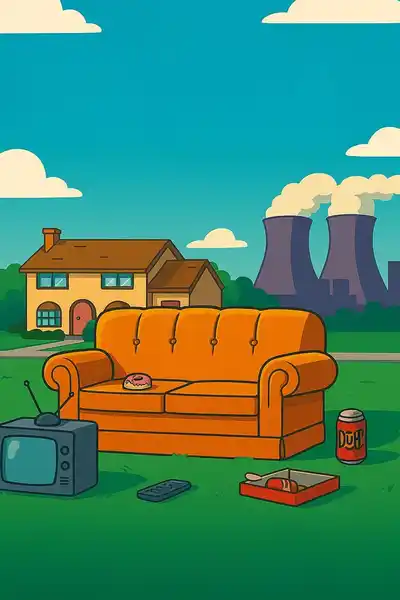
Springfield itself was the key instrument. By refusing to locate the town in any real state and populating it with a caricature of every American institution — a corrupt mayor, a cynical news anchor, a burnt-out school system, a nuclear plant run on negligence — the writers built a machine that could satirize almost anything without leaving home. The show did not have to chase the headlines. It had already assembled a miniature America whose failures mirrored the real one's, so any new absurdity could be dropped into a setting that was ready for it.
03Chapter 3 — When satire started predicting the news
Somewhere in the internet era, The Simpsons acquired a strange second reputation: as a show that predicts the future. Fans assemble lists of moments the series supposedly foresaw — the most famous being a 2000 episode that mentioned a future President Trump, played for absurdity at the time and circulated endlessly after the 2016 election. The reputation is mostly a trick of volume. A show with hundreds of episodes and thousands of throwaway gags will inevitably land a few that later look prophetic, and the misses are quietly forgotten.
But the "predictions" are less mystical than they seem, and understanding why explains the show's method better than any coincidence could. When the writers imagined a Trump presidency, they were not seeing the future; they were extrapolating from a logic already visible in the culture — celebrity, spectacle, wealth as qualification. Good satire works by pushing present tendencies to their absurd conclusion. Sometimes reality then catches up to the absurd conclusion, and the joke looks like a forecast. It was really a diagnosis that aged into a description.
04Chapter 4 — The problem of being older than your targets
The deeper puzzle the show poses is what happens to satire when it stops being an outsider. The Simpsons began as a rude interruption of a smug television order. But an interruption that runs for thirty-six years becomes part of the order it interrupted. It is now an institution with theme-park rides, a film, and a place in the same establishment it once needled from the margins. The show that mocked corporate self-congratulation is itself one of the most valuable pieces of intellectual property its network owns. Satire that succeeds completely tends to be absorbed by what it satirized.
This is the honest core of the endless "golden age" debate among fans, who tend to canonize roughly the first eight or nine seasons and argue the show declined afterward. Some of that is nostalgia hardening into dogma. But some of it is structural. The early show had the energy of something with nothing to lose, written by people startled that they were getting away with it. A long-running hit cannot keep that posture. It has a legacy to protect, a tone audiences expect, and the impossible task of surprising a country that now quotes it back to itself.
05Conclusion
The greyhound bet in that first Christmas special was a long shot that paid off in a way nobody at Fox imagined. A cartoon drawn in minutes to protect an artist's rights turned into the longest-running scripted show in American primetime and a permanent fixture of how the country talks to itself. It buried the sitcom conventions it was born to mock, and it outlasted a president who once wished America looked less like it.
Related books