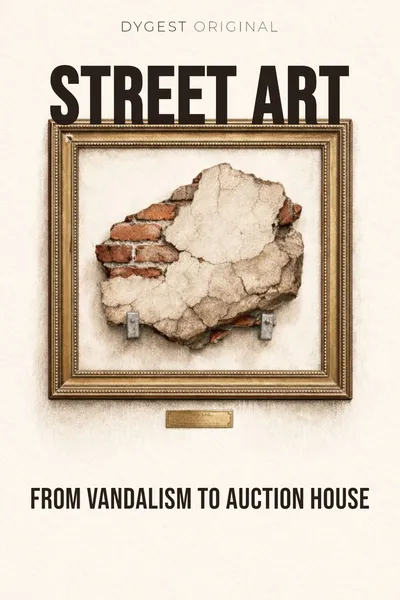
Street Art
From vandalism to auction house
Description
On a train yard in the Bronx in the early 1970s, a teenager named Demetrius signed his name — TAKI 183 — on walls and subway cars across New York until a 1971 New York Times piece turned the tag into a phenomenon. There was no gallery involved, no buyer, no frame. The whole point was that the name traveled where the person couldn't, on surfaces nobody owned and everybody saw. Getting caught meant a fine, sometimes a cell. The risk wasn't a side effect. It was part of what the signature meant.
Half a century later, a canvas by Jean-Michel Basquiat — who started spraying cryptic phrases on Lower Manhattan walls under the name SAMO — sold for $110.5 million at Sotheby's in 2017. A Banksy stencil that began life on a public wall can now change hands for millions in a climate-controlled room. The movement that police departments once treated as a quality-of-life crime has become a blue-chip asset class, complete with authentication boards, provenance disputes, and insurance riders. The same gesture that got kids arrested now gets collected.
That journey — from crime to commodity, from the street to the saleroom — is one of the strangest round-trips in the history of art. It didn't happen by accident, and it didn't happen without cost. Something got gained in the translation, and something got left on the wall.
The question we’re asking : How did an art form built on being illegal, free and public end up as one of the market's most bankable products — and what got lost in the trade?What we’ll see : How the market learned to sell something that was never meant to be owned, and what refuses to fit behind the glass.
Table of contents
01Chapter 1 — The wall was never asking permission
Modern street art grew out of two things that had nothing to do with money. The first was writing — the tags and pieces that spread through New York and Philadelphia subway systems in the late 1960s and 1970s, a competition over who could get their name up, biggest, in the most impossible places. The reward was recognition inside a small circuit of people who knew what they were looking at. The second was a refusal of permission. A mural commissioned by a city is public art; a stencil sprayed at three in the morning is something else. The difference is consent, and the whole grammar of the form was built on not having it.
That illegality wasn't incidental decoration. It shaped everything — the speed of a stencil over the patience of a brush, the fat cap on the spray can, the lookout, the getaway. Keith Haring drew his radiant babies and barking dogs in the black paper of unused subway ad panels precisely because the space was free, seen by millions, and technically forbidden. He got arrested for it more than once. The work existed in a gap the city hadn't monetized, and it addressed everyone who passed through that gap, without a ticket or a login.

02Chapter 2 — The gallery learns to sell the street
The solution, when it came, was not to bring the wall inside but to bring the artist's hand inside and leave the wall as advertising. The pivotal figure is Shepard Fairey, whose OBEY sticker campaign spread across cities through the 1990s as pure street propaganda before he built it into a design studio, a clothing line, and eventually the 2008 Obama HOPE poster. Fairey grasped something the first generation hadn't: the street work could function as a marketing engine for editions, prints and canvases sold through conventional channels. The illegal piece became the trailer; the signed screenprint became the product.
Banksy, emerging from Bristol's stencil scene around the same time, refined the model further. He kept working anonymously and illegally on public walls, which preserved the outlaw aura, while a company set up to authenticate his work — Pest Control — controlled which pieces could enter the market with his blessing. The genius was in separating the two economies. The wall stayed free and criminal; the sanctioned prints and canvases carried a certificate. Collectors weren't buying the vandalism. They were buying proof of association with it.
03Chapter 3 — Banksy shredded a painting and it doubled in value
In October 2018, at Sotheby's in London, a framed Banksy stencil called Girl with Balloon sold for just over £1 million. The instant the hammer fell, a shredder hidden in the frame whirred to life and fed the canvas halfway through its own blades, leaving strips of the girl dangling below the frame while the room watched. It looked like sabotage — an artist attacking the auction that had just turned his image into a seven-figure asset. It was staged, or at least Banksy claimed credit immediately, releasing footage of the mechanism being built.
The gesture read as the ultimate protest against the market. Here was an artist literally destroying the object at the moment of its sale, refusing to let the saleroom fully own it. And then the market did what the market does. The buyer went through with the purchase. The half-shredded work was renamed Love is in the Bin. Three years later, in October 2021, it returned to Sotheby's and sold for £18.5 million — roughly eighteen times the pre-shred price. The act of destruction had become the object's most valuable feature.
04Chapter 4 — What the auction house can't put behind glass
When street art moves from the wall to the saleroom, three things it was built on get quietly deleted, and it's worth naming them precisely rather than mourning in general. The first is illegality. A piece on a public wall carries the charge of having been made without permission, in real risk, addressed to no buyer. Once it hangs authenticated in a room, that charge is simulated at best. The market keeps the aesthetic of the crime and discards the crime, the way a leather jacket keeps the shape of a rebellion nobody's having anymore.
The second is ephemerality. The whole prestige economy of writing ran on the fact that the work would not last — that reputation lived in memory and photographs, not in property. An auction requires the opposite: an object durable enough to insure, store and resell. So the versions that enter the market are precisely the ones made to survive, which means they are, by definition, not the thing the movement was about. The subway car that got buffed in a day was the real work. The canvas that lasts forever is the souvenir.
05Conclusion
The teenager tagging train cars in the Bronx and the collector bidding at Sotheby's are looking at the same gesture and seeing two entirely different objects. One sees a name traveling free through a city that never gave permission. The other sees a certificate of authenticity attached to a scarce and storied asset. Both are real. What connects them is a fifty-year process in which the market learned that it didn't need to tame the street — it only needed to sell a parallel version indoors and let the street keep doing its dangerous, unpaid work as the brand.
Related books