Pop Art
Mass culture enters the gallery
Description
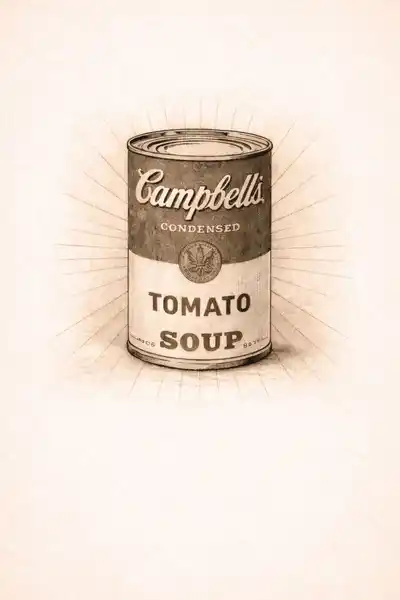
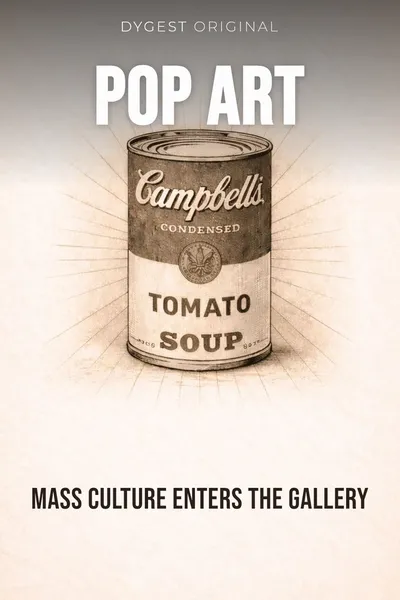
On July 9, 1962, a Los Angeles gallery called Ferus put thirty-two paintings on a narrow shelf running around the walls. Each one showed a single Campbell's soup can, painted by hand, differing only in the flavor stenciled on the label — tomato, chicken noodle, pepper pot, on down the list of thirty-two varieties the company sold. The artist was a thirty-three-year-old commercial illustrator named Andy Warhol, until then better known for drawing shoes for magazine ads. A nearby grocery store, sensing an opening, stacked actual Campbell's cans in its window with a sign: get the real thing, cheaper. The joke wrote itself, and that was more or less the point.
What looked like a stunt was the visible edge of a shift already under way on two continents. In London a few years earlier, a small circle of artists had begun cutting up advertisements, cataloging Cadillacs and pin-ups and refrigerators as if they were archaeological finds. In New York, painters were lifting comic-strip panels, Coke bottles and movie stars straight off the printed page and hanging them, at scale, where a landscape or an abstraction was supposed to go. The material of everyday commerce — the stuff of billboards, supermarkets and tabloids — was walking into the room reserved for high culture and refusing to apologize.
The gallery had spent the postwar decade convinced that serious painting meant private struggle, the lone artist wrestling paint into pure feeling. Then a soup can showed up, and it did not struggle at all. It just sat there, flat and cheerful and mass-produced, asking why a can was any less worth looking at than a sunset. The answer the art world eventually gave — grudgingly, then completely — reshaped what a picture could be about.
The question we’re asking : How did the imagery of supermarkets and comic strips end up on museum walls, and what did artists actually do to it once it got there?What we’ll see : How a handful of artists in London and New York turned mass culture into a method, and why the result never quite decided whether it was laughing at us or with us.
Table of contents
01Chapter 1 — The soup can arrives
The term itself came out of London before New York claimed the movement. Around 1955, a loose group calling themselves the Independent Group — critic Lawrence Alloway among them, alongside artists Richard Hamilton and Eduardo Paolozzi — had started treating advertising, Hollywood and consumer goods as material worth studying rather than sneering at. Hamilton's small 1956 collage, stuffed with a bodybuilder holding a giant Tootsie Pop, a canned ham on a coffee table and a movie marquee out the window, is usually named the first genuinely Pop image. Alloway is generally credited with putting the word "pop" to this appetite for the mass-produced.
There was a logic to why it surfaced then. The 1950s were the first decade of full-throttle consumer abundance, and postwar Britain and America were saturated with a new visual language — glossy magazine spreads, television commercials, packaging designed to be irresistible on a shelf. This imagery was everywhere and, by the rules of serious art, invisible. It was considered beneath notice, the wallpaper of commerce. What the Pop artists proposed was heretical in its simplicity: this is the actual landscape people live in, so why paint mountains?

02Chapter 2 — A method built on the surface
What made Pop Art a method rather than a prank was its relationship to the surface of things. Where earlier art had used everyday objects as symbols — a skull for mortality, fruit for abundance — Pop refused the depth charge. A soup can meant a soup can. A comic panel meant a comic panel. The subject was not standing in for something loftier; it was itself, presented at a scale and with a seriousness that forced you to actually look at what you saw a hundred times a day and never registered.
The techniques followed from this flatness. Lichtenstein didn't just draw comics, he reproduced the industrial process that made them — the Ben-Day dots, the heavy black outlines, the cheap primary colors of newsprint. He would project a panel, trace it, then paint each dot by hand, so a mechanical image became a labored, deliberate painting that still looked mechanical. The effort went into erasing the appearance of effort. That paradox was the whole trick.
03Chapter 3 — The factory and the machine
Warhol took the logic to its literal conclusion. In 1963 he rented a Manhattan loft, lined it with silver foil, and named it the Factory. The name was not ironic decoration. He staffed it with assistants who cranked out silkscreens, films and prints under his direction, and he said, more than once, that he wanted to be a machine, that painting by hand was something he'd rather stop doing. The romantic figure of the tormented genius, alone with the canvas, was being openly mocked by a man running an art assembly line.
The Factory was also a scene — a churn of socialites, drag performers, musicians and drifters that Warhol called his "superstars," many of them filmed in his experimental movies. He produced the Velvet Underground, screen-tested anyone who wandered in, and turned his own affectless public persona into a work of art in itself. The output blurred every line the art world cared about: was the painting the product, or was the whole spectacle around it? Warhol's answer seemed to be yes.
04Chapter 4 — The wink and the embrace
The lasting puzzle of Pop Art is that no one, including the artists, could ever quite say whether it was criticism or celebration. Hold up a giant soup can and you might be exposing the emptiness of consumer culture, forcing people to see the machinery they usually swallow whole. Or you might be throwing a party for it, delighting in the color and the abundance and the sheer democratic cheerfulness of a supermarket. Pop refused to settle the question, and that refusal was not laziness — it was the most honest thing about the movement.
Consider how differently its two anchors read. Lichtenstein's weeping women and exploding planes carry a faint melancholy, a sense that the emotions comics traffic in are as canned as the soup, mass-produced feeling for mass-produced people. Warhol is harder to pin down still. His disaster series — car crashes, the electric chair, race riots, printed in the same flat repetition as the Marilyns — suggests that endless reproduction numbs us to horror as easily as to glamour. Yet he insisted, blandly, that he liked things exactly as they were, that there was nothing behind the surface. The mask never slipped.
05Conclusion
The grocer who stacked real Campbell's cans in his window, undercutting Warhol on price, thought he was puncturing a fraud. He was actually completing the joke. The whole point was that the painted can and the real can lived in the same world now, separated only by a shelf and a frame and whatever meaning you decided to bring to the difference. Within a decade, Pop had won so completely that its scandal became invisible; the idea that supermarket imagery belonged on a museum wall stopped being an argument and became a fact.
Related books