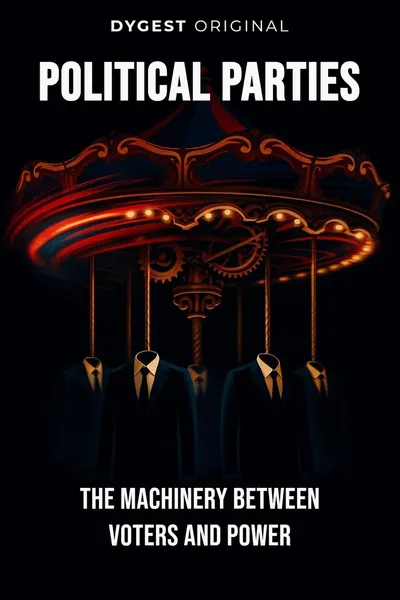
Political Parties
The machinery between voters and power
Description
In 1950, if you wanted to understand how a democracy actually ran, you looked at its parties. Not its constitution, not its parliament — its parties. In Britain, the Labour Party counted over a million individual members; in West Germany and Italy and across Scandinavia, parties were among the largest voluntary organizations a person could join, bigger than most churches and unions. They ran newspapers, youth wings, women's sections, summer camps, funeral funds. A card-carrying member in Vienna or Manchester might spend their entire social life inside a party's orbit. The party was not something you voted for once every few years. It was something you belonged to.
That world has quietly dissolved. Across almost every established democracy, party membership has collapsed — often by more than half, in some cases by ninety percent — over the span of a few decades. The organizations are still there, still winning elections, still forming governments. But the thing underneath them, the mass of ordinary people who paid dues and stuffed envelopes and showed up on wet Tuesdays, has thinned to a shadow. The machinery kept running. The engine that drove it emptied out.
Parties are the strangest institution in democratic life. No constitution invented them; most framers actively feared them. Yet nothing moves between a voter and actual power without passing through one. They recruit the candidates, write the programs, discipline the legislators, organize the campaigns. They are the connective tissue of representative government, and that tissue has been quietly atrophying for fifty years while almost nobody was watching.
The question we’re asking : If parties are the machinery that connects citizens to power, what happens to that connection when the citizens stop showing up?What we’ll see : How an institution nobody designed became indispensable, what it quietly does all day, and why its foundations have been eroding beneath the surface.
Table of contents
01 Chapter 1 — The organizations nobody designed
The people who built modern democracies did not want political parties. James Madison warned against the "mischiefs of faction" in 1787. George Washington used his farewell address to caution against the "spirit of party." Across the Atlantic, early parliamentary thinkers saw organized groupings as a corruption of the legislator's duty to judge each question on its merits. Parties were meant to be, at best, a temporary coalition of like-minded men — not a permanent machine with a name, a treasury, and a membership roll.
They arrived anyway, because the logic of mass elections demanded them. Once the vote extended beyond a narrow propertied elite, no candidate could reach hundreds of thousands of strangers alone. Someone had to knock on doors, print the leaflets, agree on a common program, and coordinate which candidate ran where so allies did not split the vote and hand victory to the other side. That coordination work is the party. It emerged not from theory but from the sheer impossibility of doing democracy at scale without it.

02 Chapter 2 — What a party actually does
Ask most people what a party is for and they will say: winning elections. True, but that is the visible tip of a much larger job. The deeper function is sorting — taking the chaotic spread of what millions of citizens want and compressing it into a small number of coherent, governable packages. On its own, an electorate is a cloud of contradictory preferences. A party turns that cloud into a program: a bundle of positions on tax, health, defense, and a hundred other things, offered as a single take-it-or-leave-it choice. Without that compression, voting would be unmanageable.
Parties also do the unglamorous work of recruitment. Governments need thousands of people willing to stand for office, run ministries, chair committees, serve on local councils. These people do not appear from nowhere. Historically the party was the pipeline: you joined young, you were noticed, you were given a ward to organize, then a seat to contest, then a junior role. The apprenticeship filtered and trained a political class. It also meant the people who ended up governing had spent years inside an organization that knew them, could vouch for them, and could rein them in.
03 Chapter 3 — The long thinning out
The numbers are stark, and they point the same way almost everywhere. In the years after the Second World War, parties across Western Europe held memberships that counted in the millions. By the 2010s, researchers tracking the trend — notably the political scientists Peter Mair and Ingrid van Biezen — documented declines so steep they struggled to find a European democracy that bucked them. Average membership as a share of the electorate fell from well over ten percent in some countries to the low single digits. Britain's major parties, which once counted members in the millions between them, had shrunk to a fraction of that by the early 2000s. The mass party, as a lived reality, had largely gone.
Several forces pulled in the same direction. Television, and later the internet, let leaders speak to voters directly, bypassing the network of local branches that had once carried the message. State subsidies, introduced across much of Europe to reduce dependence on dubious donors, meant parties no longer needed members' dues to survive — the money now came from the treasury, not the rank and file. And the dense world of class and confession that had bound people to parties frayed: fewer stable industrial jobs, emptier churches, a more mobile and individualist society. The social glue dissolved, and the membership drifted off with it.
04 Chapter 4 — Membership and the hollow machine
Step back from any one country and a general condition comes into view. The mass-membership party — the great integrating institution of twentieth-century democracy — has been quietly converting itself into something else: a professional organization of donors, consultants, and office-holders that no longer needs a membership to function. The outer shell is intact. Parties still have names, colors, and loyal voters. But the thick layer of active members that once connected those voters to the leadership has worn through, and what remains is closer to an electoral enterprise than a movement.
This matters because of what the membership was doing all along. It was not merely a reserve of free labor. It was a two-way channel. Members carried the leadership's message outward, but they also carried the country's mood inward — they argued, resisted bad ideas, forced leaders to justify themselves to someone other than a focus group. Remove that layer and the party can still win elections, but it loses its ear. It hears the electorate only through polling, which tells you what people think but not what they are willing to fight for, or forgive.
05 Conclusion
Return to the card-carrying member in 1950s Vienna, whose whole social world ran through the party — the newspaper, the youth wing, the summer camp, the Tuesday meetings. That figure is almost extinct now, and the organization they belonged to has learned to live without them. It still wins elections, still forms governments, still fields the whips and writes the manifestos. The machinery between voters and power is intact. What has drained away is the crowd that used to work it from the inside.
Related books