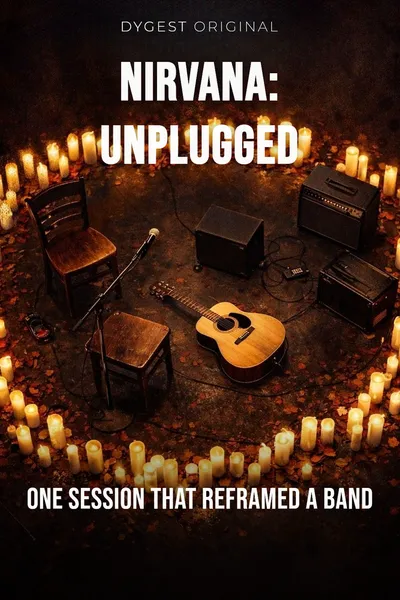
Nirvana: Unplugged
One session that reframed a band
Description
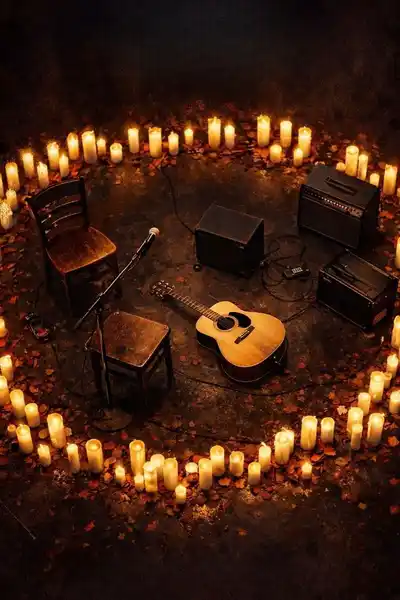
On November 18, 1993, Nirvana walked into Sony Music Studios in New York to record an episode of MTV Unplugged, the acoustic showcase that had already given career-defining nights to Eric Clapton and Mariah Carey. The producers wanted the format they knew: the band's biggest songs, stripped down, played to a room that clapped in the right places. Kurt Cobain wanted something else. He arrived with a setlist heavy on covers and album tracks, a stubborn refusal to play the songs everyone came to hear, and an insistence that the stage be dressed with black candles and stargazer lilies. A producer reportedly asked if he meant to make the place look like a funeral. Cobain said yes, exactly like that.
The session lasted a single take, unusual for a show that often stitched together multiple passes. The band was nervous, under-rehearsed on the acoustic arrangements, and openly worried it would fall apart. What came out instead was a performance that felt less like a concert than a confession — a loud band playing softly, a frontman singing to the floor, six covers sitting comfortably next to the hits that weren't there. Five months later Cobain was dead, and the recording took on a weight nobody in the room could have assigned it that night.
The tape has outlived almost everything else the band made. It won a Grammy, sold in the millions, and became the version of Nirvana many people carry in their heads — not the feedback and the smashed guitars, but the cardigan, the candles, the hush. What happened in that room in one evening reorganized how the band would be remembered, and it did so on purpose, through choices that looked like fragility and worked like a statement.
The question we’re asking : How did a single acoustic evening come to outweigh everything else a famously loud band had done?What we’ll see : The decisions behind the session — the setlist, the covers, the staging — and why choosing exposure turned out to be a kind of power.
Table of contents
01Chapter 1 — The band that showed up to break the rules
MTV Unplugged had a house style by 1993. The show favored greatest-hits sets, tidy arrangements, and a crowd primed to recognize every song. It rewarded polish. Nirvana, at the peak of a fame that Cobain openly distrusted, was not a polished band, and it did not want to be treated like one for the cameras. The friction started early. According to people who worked on the taping, the network pushed for the anthems — for the songs that had put the band on every radio station in the world — and Cobain pushed back with something close to refusal.
The band had also decided, quietly, not to lean on its own catalog the way the format expected. Cobain wanted guests, and he wanted them to matter to the performance rather than decorate it. He invited the Meat Puppets, an Arizona band he admired, to join for three of their own songs — a choice that baffled the producers, who would rather have had famous faces than a cult act most of the audience had never heard of. Nirvana got its way. Cris and Curt Kirkwood came out and played their own material with the band backing them.

02Chapter 2 — A setlist that refused the hits
The most telling decision was what the band left out. Nirvana played fourteen songs that night, and the one everyone expected — the single that had made them inescapable — was not among them. There was no attempt to translate the biggest anthem into acoustic form. Instead the set opened with a slower album track and moved through material that a casual listener would not have recognized. For a band that could have coasted on its own recognition, the omission was almost provocative.
In place of the hits came the covers, and the covers carried the night. The band played David Bowie's "The Man Who Sold the World," a song obscure enough at the time that Cobain reportedly worried people would assume he'd written it. They played three Meat Puppets songs with the Kirkwood brothers. And they closed with a version of "Where Did You Sleep Last Night," an old folk song most associated with the blues singer Lead Belly, whom Cobain had championed for years. The set functioned as a map of Cobain's own listening — a way of pointing past his band toward the music that had shaped it.
03Chapter 3 — The room, the flowers, the funeral
The staging was Cobain's, and he was specific about it. He asked for stargazer lilies, black candles, and a crystal chandelier — the visual grammar of a wake rather than a broadcast. When someone on the production reportedly asked whether he wanted the set to look like a funeral, the answer was yes. Whatever else that instruction meant, it told the crew that the evening was to feel solemn, intimate, and slightly wrong for television, in a way that photographs of the set still carry.
The performances matched the room. Cobain sang much of the set hunched over his guitar, often looking down rather than out, his voice cracked and unforced. He kept the between-song banter deprecating and small, apologizing for the arrangements, joking about his own nervousness. There was no showmanship to hide behind. The physical setup — everyone seated, the lights low, the band close together — removed the distance a rock show usually puts between a performer and a crowd. What the audience got instead was proximity, and proximity to someone visibly uncomfortable being looked at.
04Chapter 4 — When quiet becomes the loudest thing a band can do
It is tempting to read the Unplugged session as a fragile document — a glimpse of a man about to disappear, the candles and lilies retroactively arranged into an omen. That reading is powerful, and it is also unfair to the choices that made the night what it is. Nothing about the session was accidental in the way tragedy invites us to believe. The setlist, the covers, the staging, the single take: these were decisions, made by a band that wanted to control its own image at the exact moment the world was trying to fix that image in place. Vulnerability here was not something that happened to Nirvana. It was something the band chose to show.
That distinction is what reframes the whole story. Rock had long equated power with volume, spectacle, dominance over a room — the smashed guitar as the ultimate statement. Nirvana had done plenty of that. What the acoustic session proposed was the opposite thesis: that the most forceful thing a loud band could do was sit down, turn the amplifiers off, and let itself be seen without armor. Exposure became the power move. Refusing the hits, refusing the polish, refusing the applause-ready finish — each refusal was a way of insisting that the band, not the format, got to decide what it meant.
05Conclusion
The candles burned down, the band played its fourteen songs in a single evening, and the tape sat unreleased until after Cobain's death made it something other than a television special. When it finally came out in 1994, it won a Grammy and became one of the band's best-selling records — a strange fate for a set built on covers and refusals, on everything the format had been designed to prevent. The version of Nirvana that most endures is not the one that broke through with distortion, but the one that sat still in a room dressed like a wake and sang toward the floor.
Related books