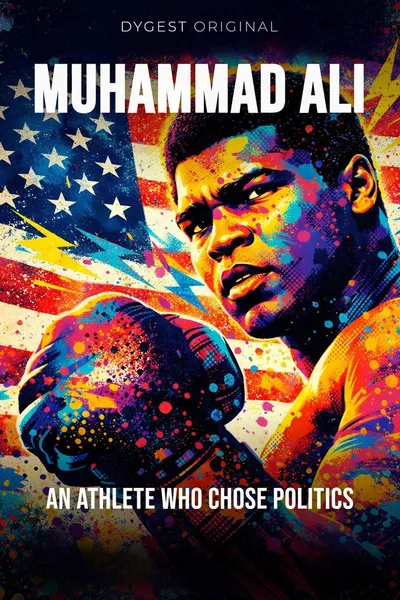
Muhammad Ali
An athlete who chose politics
Description
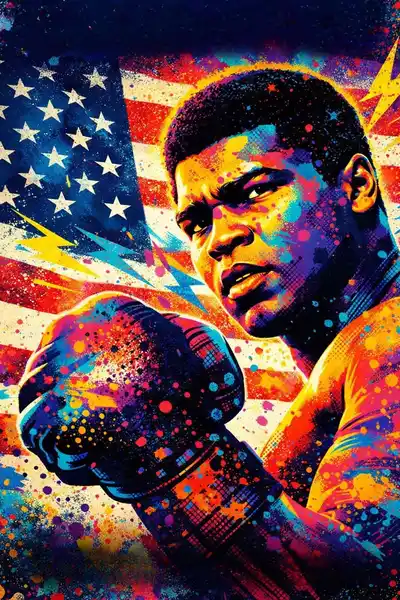
On April 28, 1967, a heavyweight boxer walked into an induction center in Houston, Texas, and refused to step forward when his name was called for the draft. He was twenty-five years old, the reigning world champion, and arguably the most famous athlete alive. The officer read the name again — Cassius Marcellus Clay — and again the young man stood still. Within hours he had been stripped of his title. Within weeks he faced a five-year prison sentence and a ten-thousand-dollar fine. He would not fight professionally again for more than three years, the exact span that should have been the physical prime of his career.
The refusal did not come out of nowhere. By 1967 the man the world still called Clay had already renamed himself Muhammad Ali, joined the Nation of Islam, and turned every press conference into a stage for something larger than boxing. He had beaten Sonny Liston against all odds, talked more brilliantly than anyone in the sport's history, and made himself the loudest voice in American life at a moment when American life was splitting open over Vietnam and civil rights. What happened in Houston was the point where all of that stopped being talk.
Athletes make headlines. Very few of them trade their entire livelihood for a sentence they believe in, at the peak of what they can do, with no guarantee they will ever get it back. Ali did exactly that, and the choice reshaped how we understand what a sportsman can be. It is worth following the arc from the ring to the courthouse, because the two are not separate stories.
The question we’re asking : What happens when an athlete at the height of his powers decides his conscience matters more than his title?What we’ll see : How a boxer became a public figure, why he risked everything on a single refusal, and what that refusal actually cost him.
Table of contents
01Chapter 1 — The mouth that wrote checks the fists could cash
He was born Cassius Clay in Louisville, Kentucky, in 1942, and started boxing at twelve after a thief stole his bicycle. He won a gold medal at the 1960 Rome Olympics as a light heavyweight, came home a local hero, and turned professional the same year. What set him apart early was not just the footwork — light for a big man, a style built on speed rather than power — but the talking. He predicted rounds, recited doggerel, called himself the greatest before anyone else would. Sportswriters found it grating. Crowds could not look away.
The talk reached its peak before the first Liston fight in February 1964. Sonny Liston was a fearsome ex-convict champion, and almost every reporter expected Clay to be flattened. Clay called him a big ugly bear and promised to float like a butterfly and sting like a bee. Then he went out and did it, battering Liston until the champion quit on his stool after six rounds. At twenty-two, Clay was heavyweight champion of the world, and the mouth that everyone had mocked had turned out to be attached to a fighter who could deliver.

02Chapter 2 — The name and the faith
The name change landed harder than any punch. Cassius Clay, he explained, was a slave name, handed down from a white Kentucky family, and he wanted no part of it. He took the name Muhammad Ali, given to him by Elijah Muhammad, leader of the Nation of Islam. For years afterward, promoters, journalists and even opponents refused to use it. When Ernie Terrell insisted on calling him Clay before their 1967 fight, Ali punished him brutally over fifteen rounds, shouting "What's my name?" between combinations.
The Nation of Islam was not a mainstream choice, and it made powerful enemies. It preached Black separatism and self-reliance, rejected integration, and frightened much of white America. Ali's close friendship with Malcolm X, the movement's most charismatic voice, deepened the association — though the friendship fractured painfully when Malcolm broke with the Nation shortly before his assassination in 1965. Ali later said his failure to stand by Malcolm was one of the great regrets of his life.
03Chapter 3 — The three words that cost him everything
Ali had failed the army's qualifying test in 1964, judged not smart enough to serve. As the war escalated and the military lowered its standards, he was reclassified as eligible in early 1966. His reaction became one of the most quoted lines of the era: "I ain't got no quarrel with them Viet Cong." He said no Vietnamese had ever called him by a racial slur, and asked why he should travel ten thousand miles to drop bombs on brown people while Black people at home were denied basic rights.
He applied for conscientious objector status on religious grounds, arguing that his faith forbade him from fighting in a war not sanctioned by Islam. The claim was denied. When he refused induction in Houston in April 1967, the response was swift and total. The New York State Athletic Commission suspended his license the same day. Other states followed. His title was taken. He was convicted of draft evasion in June 1967, sentenced to five years, and had his passport confiscated, which meant he could not even fight abroad.
04Chapter 4 — When conviction has a price tag
It is easy to admire a stand that costs nothing. Athletes today wear slogans, kneel during anthems, post statements — and some of it carries real risk, some of it carries almost none. What makes Ali's case still resonate is the sheer scale of what he put on the table. He did not risk a sponsorship or a few weeks of criticism. He surrendered his title, his income, and the physical prime of a boxer, with no assurance that any of it would ever come back. The refusal was not a gesture. It was a wager against his own career.
This is the distinction that his story forces into the open. A stance means something in proportion to what it endangers, and Ali endangered everything at the exact moment he had the most to lose. Had he refused induction at thirty-five, a fading champion, the sacrifice would read differently. He did it at twenty-five, undefeated, with the whole sport in front of him. The years he lost were not a footnote to his greatness; they were carved directly out of it, and everyone who followed boxing knew it.
05Conclusion
He came back, of course. He beat Frazier and Foreman, won the title twice more, and by the time he lit the Olympic flame in Atlanta in 1996, his hands trembling with Parkinson's, the country that had once called him a traitor had made him a saint. The transformation was so complete that it can obscure how contested he was in 1967, when standing still in a Houston induction center made him one of the most hated men in America.
Related books