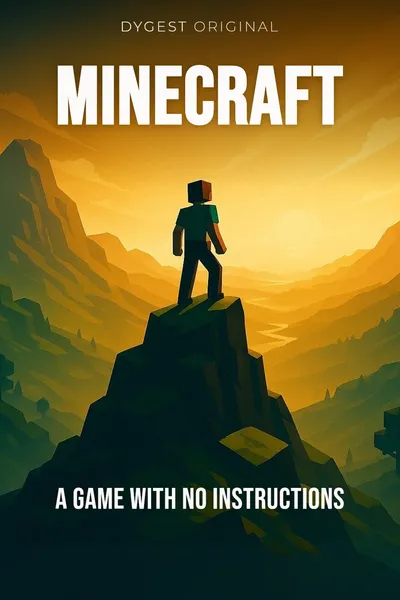
Minecraft
A game with no instructions
Description
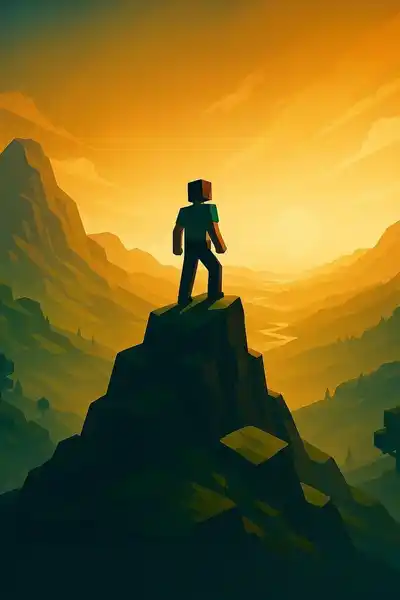
In May 2009, a Swedish programmer named Markus Persson posted an early, half-broken version of a game to an indie forum called TIGSource. It had blocky graphics, no menu screen worth the name, no tutorial, and no stated point. You appeared in a landscape of cubes, and that was it. Persson kept building it in public, in the open, releasing rough updates while thousands of strangers played and sent feedback. By the time Minecraft left its "alpha" and "beta" labels and got a proper 1.0 release in November 2011, it had already sold millions of copies — a finished product that had grown up in front of its own audience.
What is strange, when we sit with it, is that the game never told anyone what to do. There was no princess to rescue, no timer, no score climbing in the corner. Most games are a set of instructions dressed up as a story: press this, reach here, beat that. Minecraft handed players a world and a pickaxe and walked away. And rather than confusing everyone, that absence became the whole appeal. In 2014 Microsoft bought the studio, Mojang, for about $2.5 billion. By the 2020s Minecraft had sold well over 300 million copies, making it the best-selling video game ever made.
A game with no instructions should, by every intuition we hold about design, fail. People are supposed to want to be guided. Instead, the emptiness turned out to be the engine — it pulled players into figuring things out, teaching each other, and eventually building things nobody at Mojang had imagined. That is the puzzle worth sitting with: why does a game that refuses to explain itself end up being the one everyone understands.
The question we’re asking : Why did a game that never tells you what to do become the most-played of all time?What we’ll see : How an unfinished world of cubes turned its own silence into an invitation — and where that invitation eventually led.
Table of contents
01Chapter 1 — The game that shipped without a manual
Persson didn't set out to reinvent anything. He borrowed heavily from an earlier game called Infiniminer, a small mining-and-building experiment, and from Dwarf Fortress, a famously opaque simulation with a learning curve like a cliff face. What he kept was the idea that a world could be generated endlessly and dug into freely. What he added was a day-night cycle, and monsters that came out after dark. That single decision — that the sun sets and something wants to hurt you — quietly gave the game everything a tutorial usually provides, without a word of text.
Because here is what happens the first night. You spawn, you wander, you notice the light fading, and then the screen goes dark and things start making noises. You die. You spawn again. This time you understand, without being told, that you need shelter before nightfall. You punch a tree, because punching things is what you do in games, and it turns into wood. The wood becomes planks, the planks become a workbench, and suddenly you're inside a system with its own grammar. Nobody explained the grammar. The world enforced it, gently, by killing you until you learned.

02Chapter 2 — A world made of the same cube
The design trick underneath all of it is almost embarrassingly simple: nearly everything in Minecraft is the same shape. A one-meter cube. Dirt, stone, gold, glass, wool — they differ in what they look like and what they do, but they occupy the same grid, snap to the same positions, and follow the same rules. This is not how the physical world works, and it's not how most games work either, where a chair is modeled as a chair and can only ever be a chair. In Minecraft a block of stone is raw material, and raw material is the opposite of an instruction.
This uniformity is what makes building feel like thinking rather than following. If every element behaves predictably, you can hold the whole system in your head and combine pieces the way you combine words in a sentence. A player who has placed one block has, in principle, learned to place all of them. The complexity doesn't live in the parts; it lives in the arrangements. That's why a beginner and an expert are playing recognizably the same game — the expert just knows longer sentences.
03Chapter 3 — The players finished the game
Because the game withheld so much, the players supplied it. The most-visited Minecraft resource for years wasn't made by Mojang at all — it was the community wiki, an enormous, obsessively detailed encyclopedia of every block, recipe, and mechanic, written and rewritten by volunteers. When a game ships without instructions, someone writes the instructions. The difference is that these were written by people who had actually figured it out, for people who wanted to, which is a warmer and more useful kind of manual than any studio produces.
Then there was YouTube. Minecraft arrived at almost the same moment that watching other people play games became a genre of its own. Channels built entire careers narrating their own builds and survival runs; a Swedish creator known as PewDiePie and countless others turned the game into performance. For a huge number of players, especially younger ones, the tutorial wasn't in the game — it was a person on a screen saying "okay, first thing you want to do is punch a tree." The teaching moved outside the software entirely, into a culture that grew up around it.
04Chapter 4 — When a toy becomes a tool
Step back from the cubes and monsters and something larger comes into view: Minecraft is an accidental argument about how people actually learn. Every instinct in mainstream design says reduce friction, guide the user, remove the places where they might get stuck. Minecraft did the reverse and got a generation of players who taught themselves engineering, logic, spatial reasoning and collaboration — not because a lesson plan told them to, but because they wanted to finish the castle. The stuckness was the point. Getting unstuck is what learning feels like from the inside.
Teachers noticed this before Microsoft did. Around the world, educators had been quietly hauling the game into classrooms — using it to teach geometry, history, chemistry, even ancient architecture — precisely because it turned abstract ideas into things you could pick up and place. In 2016 Microsoft made it formal with Minecraft: Education Edition, a version built for schools with lessons and controlled worlds. But the striking part is the direction of travel: the educational tool grew out of a game that had no educational intent whatsoever. The classroom followed the players, not the other way around.
05Conclusion
The game that Persson posted to a forum in 2009, half-finished and unexplained, never did add the thing everyone assumed it needed. There is still no princess, no ending, no voice telling you what to do. You spawn in a world of cubes as the light starts to fade, and the first night still teaches you the same lesson it taught the first players: build a wall before dark, and figure out the rest as you go. What changed is not the game but the sheer size of the crowd that has now walked into that empty world and decided, collectively, what it's for.
Related books