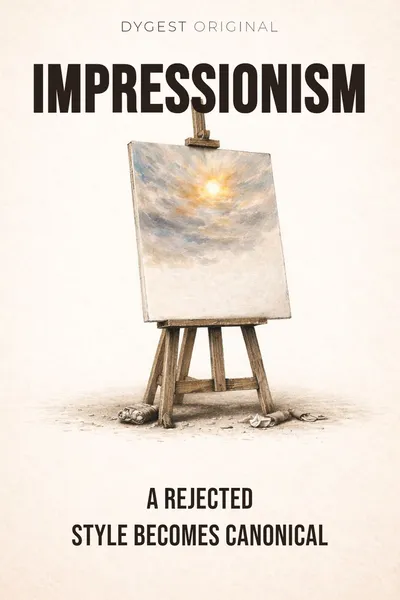
Impressionism
A rejected style becomes canonical
Description
In April 1874, thirty or so painters who could not get a fair hearing at the official Salon rented the former studio of the photographer Nadar, on the boulevard des Capucines in Paris, and put on their own show. Among the canvases was a small harbor scene by Claude Monet, painted in Le Havre, all smeared orange sun and blue-grey water. Monet called it Impression, Sunrise. A critic named Louis Leroy seized on the word and used it to mock the whole group in a satirical review titled "Exhibition of the Impressionists." He meant it as an insult — these were sketches, not finished paintings, the daubs of people who had never learned to draw.
The insult stuck, and the painters, with a certain nerve, kept it. Over the next twelve years they mounted eight of these independent shows, and for most of that time the work barely sold, the reviews stayed hostile, and the men and women making it lived close to broke. Monet at one point wrote to friends begging for enough money to get through the winter. And yet a century later, the same pictures that Leroy dismissed as unfinished are the ones museums build entire wings around, the ones that pull the longest lines and command the highest auction prices in the history of painting.
That reversal is the whole story — how a word thrown as a slur became the name of the most beloved movement in Western art, and how work rejected by every institution of its day ended up defining what we now think a masterpiece looks like. It did not happen by accident, and it did not happen only because the paintings were good.
The question we’re asking : How does a style that every official gatekeeper rejected end up as the most canonical art of its era?What we’ll see : We follow the movement from the scandal of 1874 to the walls of the world's great museums, and ask what actually carried it there.
Table of contents
01Chapter 1 — The Salon shut the door
To understand why 1874 mattered, we have to see what these painters were locked out of. In nineteenth-century France there was essentially one way to have a career as a painter, and it ran through the official Salon, the enormous annual state-sponsored exhibition organized by the Académie des Beaux-Arts. A jury of established artists decided what got hung. Acceptance meant reviews, buyers, commissions, a name. Rejection meant obscurity. The Salon was not one venue among many — it was the market, the press, and the prize, all in a single hall.
And the jury had firm ideas about what painting should be. It prized history and mythology, careful drawing, smooth invisible brushwork, subjects arranged like theater. A painting was supposed to look finished, its surface polished until the hand that made it disappeared. What Monet, Pierre-Auguste Renoir, Camille Pissarro, Alfred Sisley and their circle were doing broke nearly every one of those rules. They painted ordinary things — a train station, a riverbank, women at lunch, snow on a road. They left their brushstrokes visible, loose, almost violent. They worked fast, outdoors, chasing light rather than form.

02Chapter 2 — Paint the light, not the thing
What actually made these paintings look so wrong to trained eyes was a shift in what the painters thought they were painting. The Salon tradition treated a scene as a set of solid objects to be rendered accurately — this is a tree, this is a face, draw its true shape and color. The Impressionists were after something slipperier: not the object but the light bouncing off it at a particular moment, and the way the eye actually receives that light before the mind names what it is seeing.
This was partly a matter of new tools and new science. Paint had recently started coming in portable metal tubes, which meant a painter could carry a full palette out of the studio and work directly in front of the subject, in the field, in an afternoon. And there was fresh thinking about color — the observation that shadows are not simply grey or black but full of the complementary colors around them, that a shadow on snow can be blue and violet. So the Impressionists stopped mixing everything into muddy neutrals and started laying bright, broken strokes side by side, letting the viewer's eye blend them at a distance.
03Chapter 3 — The dealer who bet on the losers
The person who did the most to change that, in plain commercial terms, was not a painter or a critic. He was a dealer named Paul Durand-Ruel. Durand-Ruel had inherited an art business and a taste for backing painters the establishment ignored — he had already championed the Barbizon landscapists. In the early 1870s he met Monet and Pissarro in London, where both had fled the Franco-Prussian War, and he started buying their work in quantity, sometimes buying everything a painter could produce.
This was a genuinely new way to operate. Rather than waiting for buyers to appear, Durand-Ruel bought pictures outright, held them, and worked to build demand — lending to exhibitions, courting critics, staging solo shows for individual painters, publishing on them. He was, in effect, trying to manufacture a reputation and a price where none existed. It nearly ruined him. Through the 1870s and 1880s the French market stayed cold, he ran deep into debt, and there were stretches where he could barely pay the artists he was betting his business on.
04Chapter 4 — How a scandal becomes a room in the museum
Step back from Le Havre and Giverny, and Impressionism turns out to be one of the clearest lessons we have in how artistic value actually gets made. We tend to tell the story as pure vindication: the geniuses were right, the philistines were wrong, and time simply revealed the truth. But time did not act alone. Taste was built — by a dealer holding inventory, by American buyers outside the French pecking order, by critics slowly turning, by the sheer accumulation of prices that make a thing feel important because it costs a great deal.
This is not a cynical claim that the paintings are only worth what someone will pay. It is a claim that quality alone does not move through the world on its own legs. A style rejected by every institution needs an alternative institution to carry it, and Impressionism got one almost by accident — an independent exhibition society, then a dealer, then a foreign market, then museums scrambling to acquire what had suddenly become desirable. Each step made the next one look inevitable in hindsight, though none of it felt inevitable at the time.
05Conclusion
Monet's little harbor scene, the one Louis Leroy used to name and mock the whole movement, hangs today in the Musée Marmottan Monet in Paris, insured and guarded, a founding relic. The word Leroy threw as a sneer is now the label on museum wings and blockbuster shows the world over. Nothing about the canvas changed in the intervening century — the sun is still a smudge of orange over grey water, the strokes still loose. What changed was the machinery that decides what such a picture is worth looking at, and who gets to say so.
Related books