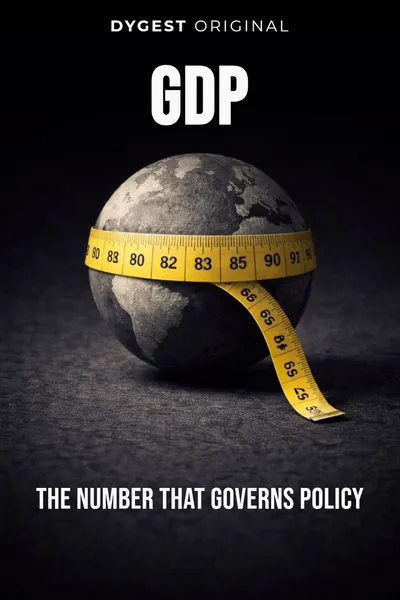
GDP
The number that governs policy
Description
In 1934, a Russian-born economist named Simon Kuznets delivered a report to the US Congress with an unassuming title: National Income, 1929–1932. The country was three years into the Depression, and nobody in Washington could say with confidence how bad things actually were. Unemployment figures were guesses. Output was a matter of anecdote. Kuznets and his team at the National Bureau of Economic Research had spent years assembling the first systematic estimate of what the entire American economy produced, and the answer was grim: national income had roughly halved between 1929 and 1932. For the first time, a government could see the size of its own economy in a single figure.
That figure, refined and renamed over the following decade, became gross domestic product. It is now the most powerful number in public life. When a central bank raises rates, when a finance minister writes a budget, when a newspaper announces a recession or a country is called "the world's fifth-largest economy," GDP is doing the talking. Growth is the target nearly every government on earth organizes itself around, and a quarter of shrinkage can end careers and topple ruling parties.
And yet Kuznets himself spent the rest of his life warning against the thing he had helped build. He thought it measured too much of the wrong stuff and missed too much of what mattered. That tension — between a number that runs the world and the man who invented it telling us not to trust it too far — is where the story of GDP actually lives.
The question we’re asking : How did one accounting figure come to define what an entire society calls progress — and what does it quietly leave out?What we’ll see : We follow GDP from a wartime accounting fix to the master metric of modern government, and the growing effort to measure what it never could.
Table of contents
01 Chapter 1 — A wartime accounting problem
Kuznets built his estimates to answer a peacetime emergency, but the tool got its real shape from war. When the United States entered the Second World War, the government faced a question it had never had to answer at scale: how much could the country produce, and how much of that could be diverted to tanks, ships and planes without starving the civilian side? Guessing wrong meant either weak armies or empty shelves. An accurate map of total output was suddenly a matter of survival.
The economists who did the mapping, chief among them Kuznets and later the young Milton Gilbert at the Commerce Department, worked out how to add up everything an economy makes in a year into one comparable figure. The trick was to count final goods and services at their market prices and avoid double-counting the steel that goes into the car. Do that consistently, quarter after quarter, and you get a dial you can watch. Wartime planners used it to decide that yes, America could arm itself and keep its people fed at the same time.

02 Chapter 2 — The line between counted and uncounted
GDP counts a transaction when money changes hands for a final good or service. That single rule is what gives the number its power — it is objective, comparable and hard to fudge — and it is also the source of nearly every complaint against it. The rule draws a hard line, and a great deal of what makes a society function sits on the wrong side of it.
The classic example is care. If someone hires a nanny, a cook and a cleaner, all three salaries add to GDP. If a parent does the same work at home for their own family, none of it counts, because no market transaction took place. Kuznets flagged this early: the unpaid labor that holds households together, overwhelmingly done by women, is simply invisible to the measure. The same goes for volunteering, for a neighbor fixing your fence, for the open-source software that quietly runs the internet. Valuable, but unpriced, so uncounted.
03 Chapter 3 — One number, a whole politics
None of these blind spots would matter much if GDP were just one figure among many. The reason they matter is that GDP quietly became the thing everything else answers to. Growth is the implicit goal of almost every government, and "growth" almost always means GDP growth. A recession is defined by it. A country's debt is judged sustainable or not as a ratio to it. Development aid, IMF programs and a nation's standing in the world are all filtered through it.
This gives the number a strange gravitational pull on policy. Because paid work counts and unpaid work does not, a reform that pushes household labor into the formal market registers as growth even if daily life is unchanged. Because GDP does not track who receives the income, a decade in which the total rises while most people's wages stagnate still reads, officially, as success. The United States and several other rich countries lived exactly that: rising GDP through the 2000s and 2010s alongside flat median wages, and a politics increasingly baffled by voters who refused to feel prosperous.
04 Chapter 4 — The measure and what it makes us want
Step back from the mechanics and GDP reveals something larger: a number built to solve a single wartime problem now defines what a whole civilization treats as progress. We did not decide, in any deliberate way, that a good society is one whose market output goes up every year. We inherited a wartime dial, kept watching it because it was the best one we had, and slowly let it become the definition of the goal itself. The instrument reshaped the aim.
This is why the argument over GDP is never really about statistics. It is about what we are trying to maximize. A country that optimizes for GDP will, over time, quietly favor the things GDP can see — paid transactions, market throughput, measurable output — and neglect the things it cannot: unpaid care, clean air, leisure, the health of a coastline, the durability of a community. Not out of malice, but because what gets measured gets managed, and what stays invisible slips down the priority list.
05 Conclusion
Simon Kuznets died in 1985, having spent five decades qualifying the invention that made his name. His warning had been blunt from the start: the welfare of a nation, he wrote in that 1934 report, can scarcely be inferred from a measurement of national income. He meant it as a caution printed on the label. Instead the caution got lost and the number went on to run the world, doing exactly what he feared — standing in for prosperity, for progress, for the good life, when it was only ever a tally of what got bought and sold.
Related books