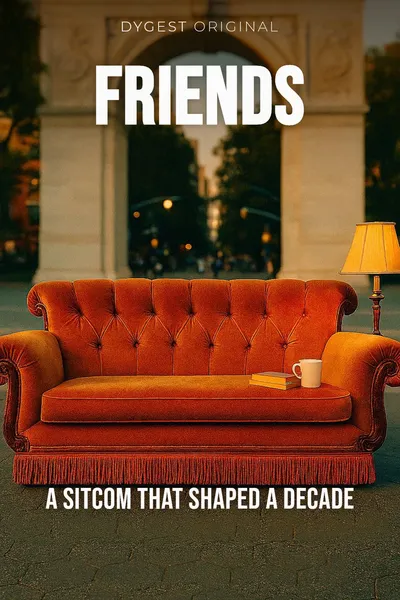
Friends
A sitcom that shaped a decade
Description
On September 22, 1994, NBC aired a half-hour comedy that had been through three titles — Insomnia Cafe, then Friends Like Us, then just Friends — about six people in their twenties who spent most of their time on a couch. The pilot drew a respectable audience and mixed reviews. Nobody at the network was betting the decade on it. What followed was ten seasons, 236 episodes, and a cultural footprint so wide that a coffee-shop set with an orange couch became a place millions of people felt they had been.
The premise was almost aggressively simple. No high-concept hook, no workplace, no family drama in the traditional sense — just a group of friends being the family you assemble in your twenties. And yet by the end of its run in May 2004, Friends had reshaped what a network sitcom could earn, what its stars could demand, and how a show could keep making money long after the last scene was shot. The cast negotiated as a single bloc, one of the more unusual labor stories in television, and it worked.
Two decades after it ended, the show did something stranger. It didn't fade. A generation that wasn't born when it aired found it on streaming, watched it on loop, and adopted it as background comfort. Which raises a question worth sitting with: how does a show built to be pleasant and universal hold up when the world it was pleasant for has moved on?
The question we’re asking : How did a deliberately simple sitcom become both a business phenomenon and a comfort object that outlasted its own era?What we’ll see : The making of the show, the machine it became, and what it looks like watched now, long after the couch went cold.
Table of contents
01Chapter 1 — Six actors and one very expensive handshake
The show was created by David Crane and Marta Kauffman, who pitched it to NBC in late 1993 as a comedy about that specific window of life when your friends matter more than anyone else. The network liked it. Casting took longer, and the group that eventually formed — Jennifer Aniston, Courteney Cox, Lisa Kudrow, Matt LeBlanc, Matthew Perry, and David Schwimmer — was assembled from actors at very different points in their careers. Aniston had been in several failed shows. LeBlanc reportedly had a few dollars to his name when he was cast. The chemistry that reads as effortless on screen was, by every account, the thing the producers had gambled on and gotten right.
What set Friends apart commercially wasn't the writing or the ratings, both of which were strong. It was what the six of them did with their leverage. By the third season, the cast realized they were more valuable together than apart, and they began negotiating as a unit — six salaries rising or falling in lockstep, nobody accepting a raise the others didn't get. It was an unusually disciplined arrangement for an industry that thrives on pitting talent against itself, and it held for the entire run.

02Chapter 2 — The apartment that never existed
Almost none of Friends was real in the way it felt real. It was shot on a soundstage at the Warner Bros. lot in Burbank, three thousand miles from the Greenwich Village it claimed to depict. Central Perk, the coffee house, was a set. The famous apartment — Monica's — was a set with a purple wall and a spare bedroom that would have cost a fortune in the actual New York the show only ever visited a handful of times. The gap between the fiction and the rent became a running joke about the series itself: nobody could afford to live like that, least of all a chef and a masseuse.
The show was taped in front of a live studio audience, which shaped everything about its rhythm. The pauses for laughter, the timing of a reveal, the way a joke was built to land in a room — all of it was calibrated to people sitting in bleachers on a Friday night. Tapings ran for hours. When a joke died with the audience, the writers, who often lingered on set, rewrote it on the spot and the cast performed it again. The polish came from that pressure, not from a script that arrived perfect.
03Chapter 3 — The last one, and the ones that never ended
The finale aired on May 6, 2004, and roughly 52 million Americans watched Rachel get off the plane. It was one of the most-watched television broadcasts of the decade, an event in the older sense — the kind of shared appointment that streaming would soon make nearly impossible. The show ended where it had always been heading: with the couples paired off, the apartment emptied, and the coffee-cup keys left on the counter. It was a clean, sentimental close, and it gave the audience exactly what it had spent ten years asking for.
But Friends didn't really end in 2004. Reruns had been syndicated since the late 1990s, and the show became one of the most reliable earners in television history, generating an estimated one billion dollars a year in later syndication and licensing at its peak. Warner Bros. had bet on longevity, and the bet paid off for far longer than anyone forecast. The series that cost a million dollars an episode to make in its final years kept minting money for the studio long after the sets were struck.
04Chapter 4 — A comfort object we can't quite defend
The thing about a show designed to be universal is that universality is dated the moment tastes shift. Friends was built to be pleasant, broadly relatable, unthreatening — a comedy that almost anyone could sit inside without friction. That was its commercial genius and, watched now, its most visible seam. A series that tried hard to be about everyone turns out to have been about a fairly narrow slice of everyone: six white professionals in one of the most diverse cities on earth, in a Manhattan that on screen has almost no one else in it.
When the cast reunited in 2021 for a special, several of them acknowledged the criticism directly, and Kauffman later said publicly that she regretted the show's lack of diversity and had put money toward addressing it. That admission is telling. It isn't that Friends was uniquely careless — it was mainstream, and mainstream in the 1990s meant a default that the show never thought to question. The blind spots weren't provocations. They were the assumptions of the room it was made in, preserved on tape.
05Conclusion
It's worth remembering what the show actually was before it became an industry and then a debate: six actors who decided they were worth more together than apart, on a set that pretended to be New York, telling a story about the years when your friends are your family. It ran ten seasons, ended on a plane, and then refused to leave. The couch went cold in 2004 and the show has barely stopped playing since.
Related books