
David Hockney
The painter who never stopped starting over
Description
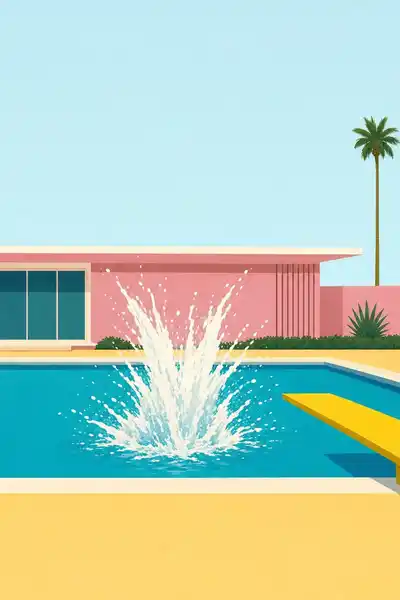
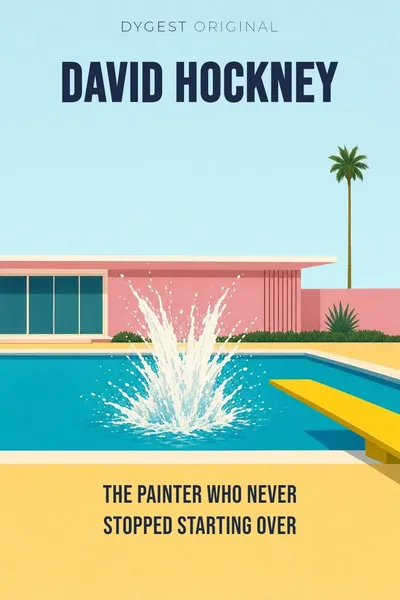
David Hockney died on June 11, 2026, at the age of 88, at his home in Normandy. The announcement went around the world in a matter of hours. The most famous British painter since Lucian Freud, one of the few living artists whose work had crossed the 90-million-dollar mark in his lifetime, the man who had been painting with an almost child-like obstinacy for seventy years, had just closed his eyes. Across social media, the first tributes showed what everyone remembers about Hockney: the California swimming pools of the late 1960s, A Bigger Splash from 1967, Portrait of an Artist (Pool with Two Figures) from 1972 — the latter sold for 90.3 million dollars in 2018 and still holding the record for the most expensive painting ever sold by a living artist.
Those blue pools under the Los Angeles sun have become so universal a calling card that they ended up overshadowing the rest of the work. Yet if Hockney stands apart among the major painters of the twentieth century, it is precisely because he never wanted to remain who people expected him to be. Seven decades of career, six radical technical reinventions, and a stubborn refusal of every posture that critics tried to pin on him — the British wonder boy of the 1960s, the California painter of the 1970s, the photography theorist of the 1980s, the Yorkshire colorist of the 2000s, the iPad pioneer of the 2010s, the Norman master of his final years.
This obstinacy in starting over, in constantly shifting the focus of his attention, is probably what distinguishes him most cleanly from his contemporaries. Where most great painters find their signature and refine it to perfection, Hockney spent his life running from his own. At every success, he changed. Every time critics thought they had caught him, he was already somewhere else.
The question we’re asking: what drove Hockney to keep starting over, when each period brought him commercial success and critical recognition, and what does this obstinacy say about a century of painting?
What we’ll see: the Bradford boy who wanted out, the California revelation and the pools, the photography critique that occupied two decades, and the final years — Yorkshire, iPad, Normandy — when the looking never stopped.
Table of contents
01Bradford, and a young man’s way out
David Hockney was born on July 9, 1937, in Bradford, Yorkshire, into a working-class family of five children. His father, Kenneth Hockney, was an accountant and a committed pacifist — a man who painted protest signs for demonstrations and who made clear to his son, from the very beginning, that images could have political use. His mother, Laura, was a strict Methodist and economically vigilant to the point that the entire childhood was spent watching every penny. Bradford, in the 1940s, was a wool-mill town: grey, rainy, and — this is what would stay with Hockney — chromatically poor.
The boy showed an unmistakable talent very early. At eleven he was admitted to grammar school by examination, which was the local gateway to university. At sixteen he chose the Bradford School of Art against everyone’s advice; his teachers had seen him as a future schoolmaster. Four years later he was accepted at the Royal College of Art in London, the most prestigious art school in the United Kingdom. He arrived there in September 1959 with a strong Yorkshire accent, peroxide-blond hair, and a self-assurance that his London classmates took some time to digest.

02Los Angeles, the pools, and the defense of painting
In January 1964, at twenty-six, Hockney flew to Los Angeles. He had no particular reason to go — he simply wanted to see. What he found there shaped the rest of his career. The California sun, the turquoise pools in the Hollywood hills gardens, the young men in swimming trunks lounging at the edge, the light that turned colors almost artificial — all of this was the chromatic opposite of Bradford, and within weeks Hockney understood he had found his subject. He moved to California nearly permanently, bought a house in the Mulholland Drive hills, and began the series of paintings that would make him known around the world.
The California pools occupied Hockney for eight years, roughly 1964 to 1972. A Bigger Splash (1967), painted in acrylic on a 2.4-meter square canvas, shows an empty pool and the water jet rising from a dive we cannot see. It is a study of the instant — the splash that would last less than a second in reality, captured in an image that will last centuries. Portrait of an Artist (Pool with Two Figures), painted in 1972, shows a clothed man standing at the edge of a pool, watching a swimmer underwater. This is the painting that sold for 90.3 million dollars in 2018 — at the time, a record for any living artist.
03The photography skeptic
Beginning in the late 1970s, Hockney left the pools and entered an obsession that would occupy fifteen years of his life: photography. More precisely, his deep dissatisfaction with what conventional photography does to seeing. A photograph, he wrote in several texts, fixes a single instant and a single point of view — as if the human eye looked without moving and without blinking. But the human eye does not work that way. It scans a scene, accumulates impressions, builds a representation gradually. Photography, for Hockney, was a view that lied about the nature of vision.
From this intuition came the joiners, his photographic collages of the 1980s. Hockney took dozens, sometimes hundreds of Polaroids of the same scene, from different angles and at different moments, and reassembled them like a mosaic. The result no longer resembled conventional photography — it was closer to a photographic Cubism, where multiple perspectives overlapped within the same image. Pearblossom Highway, composed of more than 800 Polaroids in 1986, was the most accomplished work of this period and now sits in the permanent collections of the Getty Museum.
04Yorkshire, iPad, Normandy: never stopping looking
In the mid-2000s, at nearly seventy, Hockney returned to the Yorkshire of his childhood. California had left him; or rather, he had finished painting it. He settled in Bridlington, on the English east coast, and began a new phase that surprised his followers: monumental landscapes of Yorkshire, painted en plein air, with colors so heightened they were a thousand miles from the grey the English had learned to resign themselves to. Bigger Trees Near Warter (2007), a work composed of 50 panels assembled into a 12-meter span, is one of the largest paintings ever made by a living artist. He treated the English forest the way he had treated the California pools: with frontal attention to color and light, stripped of irony.
It was also in this decade that Hockney began using the iPad. From 2009, he discovered the Brushes app, designed by an independent developer, and began painting directly on the tablet. What might have been a novelty for many artists his age became for him a major discipline. He produced entire series painted on iPad — The Arrival of Spring in Woldgate (2011), 51 drawings sent by email to his friends each morning of spring, capturing the same hedgerow under different light. It is a Monet from Giverny adapted for the smartphone era, and the procedure is now seriously studied in contemporary art schools as one of the first major adoptions of new technology by a recognized artist.
05Conclusion
What Hockney leaves to 2026 is neither a movement, nor a school, nor even a recognizable style. He refused to be the leader of anything, and he watched with a certain irony the manifestos his contemporaries kept signing. What he did leave was a posture: that of a painter who never accepted that any one style was permanently his. At the exact moments critics declared him « the painter of pools », « the painter of Yorkshire », « the painter of iPads », he was already elsewhere, looking at something else.