Art Deco
Machine-age ornament
Description
In the spring of 1925, Paris opened a fair on the banks of the Seine with a name almost nobody could say in full: the Exposition internationale des arts décoratifs et industriels modernes. It sprawled across the Esplanade des Invalides and both sides of the river, with pavilions of glass, lacquer and chrome that stayed up for six months and then came down. Fifteen thousand exhibitors, roughly sixteen million visitors, and a rule that everything on display had to be modern — no copies of old styles allowed. The event gave the look its eventual name, though the label "Art Deco" only stuck decades later, shortened from those arts décoratifs by historians looking back.
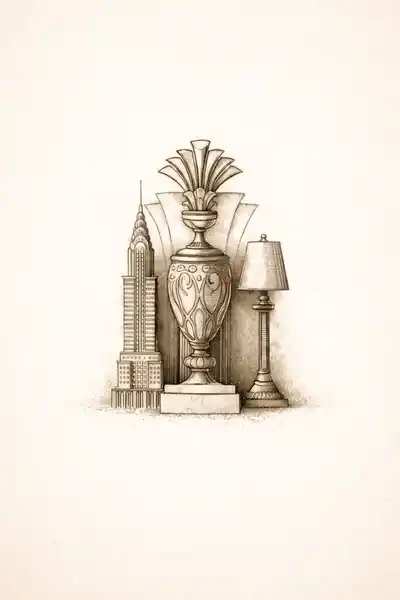
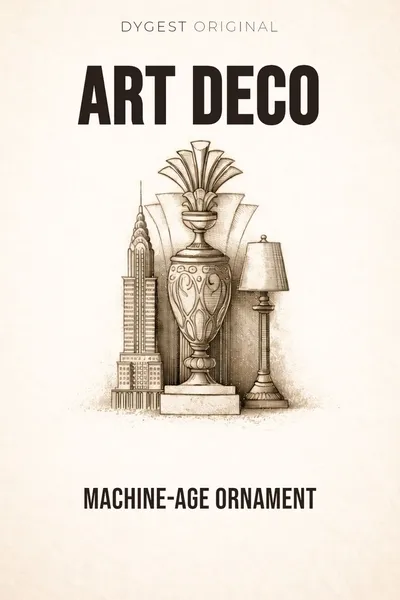
What the fair showed off wasn't a single invention. It was a sensibility already forming across furniture, jewelry, posters and buildings: sunbursts and zigzags, stepped silhouettes, exotic woods next to industrial steel. Within fifteen years the same vocabulary would climb the Chrysler Building in New York, wrap around cinema façades in Mumbai, and stamp itself on cigarette cases and gas stations from Shanghai to Napier. Few styles have ever traveled so far, so fast, or attached themselves so happily to both a millionaire's salon and a five-cent soda counter.
That reach is the puzzle. A style born in the most exclusive craft workshops of Paris somehow became the default look of mass-produced modern life — and did it while the world slid from the giddy 1920s into depression and toward war. Art Deco kept smiling through all of it, and that persistent optimism is worth sitting with.
The question we’re asking : How did a Paris luxury-craft moment turn into the global shorthand for the machine age?What we’ll see : Where the style came from, what it borrowed, how it spread across the planet, and what its confidence was really about.
Table of contents
01Chapter 1 — The exposition that named a style
The 1925 exposition had been planned for years — first floated around 1911, delayed by the First World War, and finally staged when France wanted to reassert itself as the world capital of taste. The organizers were explicit: this was about the arts décoratifs, the applied arts, furniture and glass and metalwork rather than paintings on gallery walls. And it was about being modern. Exhibitors could not simply reproduce Louis XV cabinets or gothic ironwork; the whole point was to show what design looked like now.
What visitors saw was a France doubling down on luxury craft even as it flirted with the machine. Émile-Jacques Ruhlmann's pavilion, the Hôtel du Collectionneur, displayed furniture in Macassar ebony inlaid with ivory, made by hand for buyers who could afford a small house instead. Nearby, the jeweler Cartier and the glassmaker René Lalique showed pieces of extraordinary finish. The dominant note was expensive, geometric, and confident.

02Chapter 2 — Everything old, made to look new
For a style so committed to being modern, Art Deco was a remarkable magpie. Its designers borrowed from nearly everywhere, then filed the edges into clean geometry. The result felt new precisely because it fused so many old sources that none of them dominated. Nothing about a stepped sunburst says which continent it came from — and that was the point.
The archaeology of the moment fed it directly. Howard Carter opened Tutankhamun's tomb in 1922, and a wave of Egyptomania swept design: lotus motifs, scarabs, pyramidal shapes, the stepped ziggurat that would later define skyscraper crowns. Aztec and Mayan architecture supplied more of those terraced profiles. African masks and textiles, seen through the same colonial-era lens that shaped Cubist painting, offered bold pattern and abstraction. Japanese lacquer technique gave the furniture its deep, mirror-like finish.
03Chapter 3 — From ocean liners to soda fountains
The Paris workshops made one-off pieces for the rich, but the look did not stay rich for long. Its geometry turned out to be perfect for reproduction. A sunburst carved by hand in ebony could be pressed into Bakelite, stamped in chrome, or silk-screened onto a poster for a fraction of the cost. The style that debuted as luxury craft was, structurally, ready-made for the assembly line — and the assembly line took it up eagerly.
America ran with it hardest. New York's skyline became its greatest showcase: the Chrysler Building, finished in 1930, crowned with radiating stainless-steel arches, and the Empire State Building the year after. The 1930s Rockefeller Center gave it a whole civic complex. Cinemas, hotel lobbies and diner interiors adopted the vocabulary because it read instantly as glamorous and modern, and because it looked good under electric light. Radio City Music Hall opened in 1932 as a temple to exactly this.
04Chapter 4 — The last ornament of the optimists
Step back from the sunbursts and what Art Deco really expressed was a bet about the machine — an optimistic one. The nineteenth century had feared industry, with William Morris and the Arts and Crafts movement recoiling from factory goods and pleading for a return to handwork. Art Deco made the opposite wager. It looked at chrome, glass, plastic and the assembly line and decided they could be gorgeous. It did not resist mass production; it dressed it up and sent it dancing.
That confidence was the style's real content. The zigzag and the streamline weren't just shapes; they were a mood, the belief that speed, electricity and manufacturing were carrying the world somewhere better. A skyscraper crowned like a ziggurat said progress could be monumental. A streamlined toaster said even the humblest household object deserved to look like it was moving toward the future. Art Deco was the aesthetic of a civilization briefly, genuinely thrilled by its own machines.
05Conclusion
The Paris fair came down in the autumn of 1925, its pavilions dismantled as planned, its exhibitors scattered back to their workshops. But the sensibility it crystallized kept moving — down the price ladder, across the oceans, up the sides of skyscrapers — for another fifteen years, until a war interrupted it and a plainer modernism replaced it. The name only caught up in the 1960s, arriving to label a style that had already lived and mostly died.
Related books