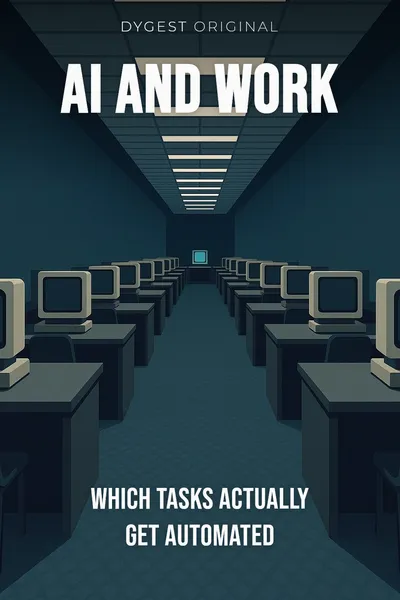
AI and Work
Which tasks actually get automated
Description
In 2013, two Oxford researchers, Carl Benedikt Frey and Michael Osborne, put a number on the anxiety that had been circling office conversations for years. Roughly 47 percent of American jobs, they wrote, sat in the high-risk category for computerization over the following decade or two. The figure traveled fast. It landed on magazine covers, in conference keynotes, in the opening slide of every consultant's deck about the future of employment. Half of all work, gone. It was the kind of number that ends an argument before it starts.
More than a decade later, the number has not come true — not in the way the covers suggested. American unemployment through the 2010s and into the 2020s stayed low, employment kept climbing, and the great job apocalypse never arrived on schedule. And yet anyone who has watched a colleague's role quietly dissolve, or seen a whole team's afternoon of tedium replaced by a script, knows something did change. The forecast wasn't wrong about the technology. It was working with the wrong unit of measurement.
That gap — between what the technology can do and what actually happens to a person's job — is where the real story of AI and work lives. The confusion runs through nearly every headline about robots taking over. Machines don't swallow occupations whole. They pick at them, task by task, and what's left over turns out to matter enormously.
The question we’re asking : When a machine can do part of what someone is paid to do, why does the job so rarely vanish the way the forecasts predict?What we’ll see : Why the honest unit of measurement is the task, not the job — and what that changes about who should actually be worried.
Table of contents
01Chapter 1 — The task is the unit, not the job
The trouble with "47 percent of jobs" is that a job is not one thing. It's a bundle. A radiologist reads scans, but she also talks to worried patients, consults with surgeons, weighs ambiguous cases against a patient's history, and signs her name to a decision someone will act on. A paralegal drafts, files, searches case law, calms clients, and catches the small errors that would embarrass a partner. Bundle enough of these together and you get an occupation. Automate one strand and you have not automated the occupation — you've changed the shape of someone's day.
This is the correction that a group of economists, led by David Autor at MIT, pressed against the alarmist forecasts through the 2010s. The right question, they argued, is not "can a machine do this job?" but "which tasks inside this job can a machine do, and what happens to the rest?" Once we ask it that way, the picture stops being binary. Most jobs turn out to be maybe thirty percent automatable, not zero and not a hundred — a partial erosion rather than a clean deletion.

02Chapter 2 — What machines find easy is what we find hard
Here's the counterintuitive part. The tasks most exposed to automation are rarely the ones we think of as low-skill. For decades, the safest assumption was that machines would take the manual, repetitive work first and leave the thinking to us. Generative AI has scrambled that order. The systems that can now draft a competent legal memo, write serviceable code, or summarize a research paper struggle to reliably fold laundry or fix a leaking pipe under a sink. The cognitive, credentialed work has turned out to be more exposed than the physical, improvised kind.
This has a name that predates the current wave: Moravec's paradox, after the roboticist Hans Moravec, who noticed in the 1980s that the things evolution spent millions of years perfecting — walking, grasping, perceiving a cluttered room — are the hardest to reproduce in a machine, while the things humans find effortful, like arithmetic or formal logic, come easy to a computer. What feels advanced to us is often computationally cheap. What feels trivial is often the deepest problem in the field.
03Chapter 3 — The occupations don't disappear, they get reshuffled
If tasks are the unit, then the honest way to read the labor market is to watch how they get recombined. When part of a role gets automated, the remaining tasks don't just sit there. They get rebundled into a new version of the job, or split off into a different one, or absorbed into someone else's day. The occupation label may stay the same while the work underneath it changes almost completely — which is why the raw employment count can look stable even as the ground shifts.
Consider what the current wave is doing to writing-heavy work. A marketing team that once needed five people to produce a steady volume of copy might now need three, because a model handles the first draft and the humans edit, direct, and decide. The occupation "copywriter" doesn't vanish from the statistics. But its center of gravity moves from generating text to judging it, and the number of people the work supports quietly contracts. That's not a robot apocalypse. It's a slow reweighting, and it's much harder to protest because no single day is the day the jobs died.
04Chapter 4 — When the map of skills gets redrawn
Step back from the ledger of jobs saved and jobs lost, and a more useful picture appears: automation is constantly redrawing the map of which human skills are scarce and which are cheap. Every task a machine absorbs pushes value toward the tasks it can't. When ATMs took the cash-handling, the value of a teller's warmth and sales judgment went up. When models take the first draft, the value of taste, direction, and accountability goes up. Automation doesn't so much destroy value as move it — and the people who thrive are the ones standing where it moves to.
This reframes what "exposure" really means. A job isn't safe or doomed; it's a portfolio of skills, some of which are appreciating and some depreciating at any given moment. The unsettling feature of the current wave is how fast it revalues skills that felt permanent. Fluent writing, competent coding, basic analysis — capabilities that took years to build and reliably commanded a salary — are becoming abundant. Abundance is good for whoever buys the skill and hard for whoever sold it. That's the quiet drama inside every calm employment chart.
05Conclusion
Frey and Osborne's number wasn't a lie; it was an answer to the wrong question. They measured which jobs contained automatable tasks and reported it as if the jobs themselves were on the block. A decade of stable employment and quietly transformed workdays showed the difference. Machines came for tasks, the tasks got rebundled, and the occupation labels mostly held while the work inside them turned over. The apocalypse arrived, but disguised as a reweighting nobody could point to on a calendar.
Related books