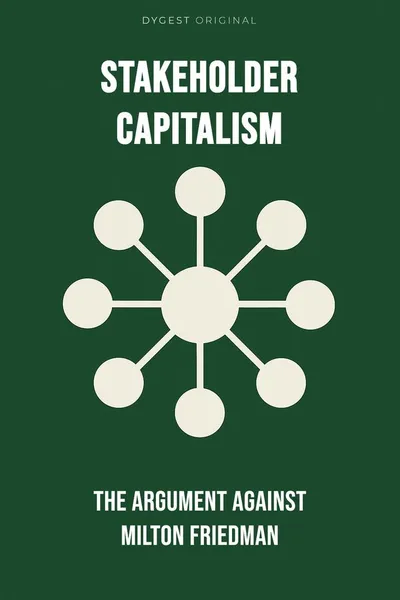
Stakeholder capitalism
The argument against Milton Friedman
Description
On September 13, 1970, The New York Times Magazine published an essay by Milton Friedman under the title The Social Responsibility of Business Is to Increase Its Profits. Corporate executives, Friedman argued, were employees of shareholders who owned the firm. Their job was to maximize the firm's value within the limits of law and ethical custom. Any activity that spent corporate money on social purposes — charity, environmental protection, community development — was using other people's money for the executive's preferred causes rather than returning it to owners. Friedman called this taxation without representation. The essay became the most influential short piece in the history of American corporate thought.
The Friedman doctrine dominated American corporate governance for roughly five decades. Business schools taught it. Corporate law was interpreted to align with it. Executive compensation was tied to shareholder returns. The rise of activist shareholders in the 1980s and the leveraged-buyout wave enforced it with financial discipline. By the mid-1990s, maximizing shareholder value was the default statement of corporate purpose. Any executive who argued for broader responsibilities was considered a soft-headed failure of strategic focus, or worse, accused of breach of fiduciary duty.
The contemporary challenge runs under the label stakeholder capitalism — the argument that corporations owe obligations not just to shareholders but to the broader set of groups affected by their decisions. Employees, customers, suppliers, communities, future generations, the natural environment itself. The framework was articulated most visibly in the 2019 Business Roundtable statement signed by nearly two hundred American CEOs, committing their companies to broader purpose beyond shareholder return. Whether the statement was a genuine shift in practice or a rhetorical gesture with limited operational content is the live question.
● The question we're asking: what is the stakeholder-capitalism argument, and has it actually displaced the Friedman doctrine?
● What we'll see: the Friedman framework, the critique that produced it, the contemporary stakeholder movement, and what has and has not changed.
Table of contents
01The Friedman framework
Friedman's essay was not the first shareholder-primacy articulation but was the most influential. It had several strands often conflated in the popular version. The first was legal. Corporate executives are legally agents of shareholders, and diverting corporate funds to unauthorized purposes exceeds executives' legitimate authority. The legal argument was strongest in the American tradition, where fiduciary duty to shareholders was clearly established. It was less clear in Germany, Japan, and continental Europe, which already had systems recognizing broader stakeholder obligations.
The second strand was economic. Markets are more efficient at allocating resources than corporate discretion. If shareholders received maximum returns, they could direct those returns toward whatever social purposes they valued through charity, investment, or political action. Concentrating social-purpose decisions in corporate executives produced worse outcomes than distributing them to shareholders, because executives had no particular expertise or accountability for those questions. The efficiency argument was central to why Friedman believed shareholder primacy was not just legally required but socially optimal.

02The critique that produced the alternative
The critique accumulated over decades from several directions. The academic critique, associated with R. Edward Freeman's stakeholder theory from the 1980s, argued that corporations had always had obligations to a broader set of groups than shareholders, that the shareholder-primacy claim was historically inaccurate, and that corporate performance required considering the full set of stakeholders. Freeman's 1984 book Strategic Management: A Stakeholder Approach established the analytical vocabulary later stakeholder capitalism would use, even as it remained a minority position in business-school curricula for decades.
The empirical critique pointed to patterns of corporate behavior under the Friedman framework that were socially damaging in ways the framework could not acknowledge. The hollowing-out of manufacturing regions as firms offshored production. The degradation of employee compensation as labor was treated as a cost to minimize. The accumulation of environmental harms external to corporate accounting. The concentration of wealth at the top of the income distribution while productivity gains stopped flowing to workers. By the 2010s, the critique had accumulated enough mass that the framework's dominance began to weaken.
03The contemporary stakeholder movement
The 2019 Business Roundtable statement was the most visible moment in the shift away from strict shareholder primacy. The statement, signed by CEOs of major American corporations, committed their firms to serving customers, investing in employees, dealing fairly with suppliers, supporting communities, and generating long-term value for shareholders — with shareholders listed last rather than first. The rhetorical reordering was significant. The operational consequences have been harder to pin down. Subsequent studies of whether signatories actually changed their practices in the years after the statement have produced mixed results; some firms have genuinely shifted, some have continued operating in the shareholder-primacy mode while using stakeholder language in external communications.
The ESG movement — Environmental, Social, and Governance investing — was the financial-market expression of the stakeholder shift. ESG funds, which direct investment toward firms that score well on stakeholder-oriented metrics, grew from niche status in the early 2010s to trillions of dollars under management by the early 2020s. The ESG framework was intended to align investor incentives with stakeholder-oriented corporate behavior, on the theory that better ESG performance would correlate with better long-term returns. Whether this correlation actually holds has been contested. Various studies have produced different results depending on methodology, and the ESG movement has faced substantial backlash from both the political right (arguing that ESG is a left-wing imposition on shareholders who wanted financial returns) and the political left (arguing that ESG is greenwashing that provides rhetorical cover for continued shareholder-primacy practice).
04What has and has not changed
What has changed substantially is the rhetorical landscape. CEOs in 2026 routinely speak in stakeholder terms in ways that would have been unusual twenty years ago. Corporate annual reports now include ESG metrics alongside financial ones. Business-school curricula have shifted to include stakeholder-oriented frameworks alongside the traditional shareholder-value material. The general climate of corporate discourse has moved away from the stark Friedman framing. This is a real change, even if its operational significance is contested.
What has not changed fundamentally is the underlying incentive structure of the American corporate economy. Executive compensation remains overwhelmingly tied to stock price. Activist investors continue to pressure firms for shareholder-oriented changes, often successfully. Quarterly earnings reporting continues to focus management attention on short-term financial metrics. The legal framework continues to emphasize fiduciary duty to shareholders. The institutional machinery that operationalized the Friedman doctrine through the 1980s and 1990s remains largely in place, and the rhetorical shift has not yet produced a corresponding structural shift. The question is whether the rhetoric will eventually drive structural change or whether the structures will progressively pull the rhetoric back toward the old framing.
05Why is still matters
The stakeholder-versus-shareholder argument matters because it is the live version of a question that has been argued about since the emergence of the modern corporation in the nineteenth century. What are corporations for? Who has legitimate claims on their decisions? How should the power that large corporations inevitably accumulate be accountable to the broader society in which they operate? The specific contemporary vocabulary is new, but the underlying question is not. The way the current generation answers it will shape how large corporations actually behave for the next several decades.
Related books