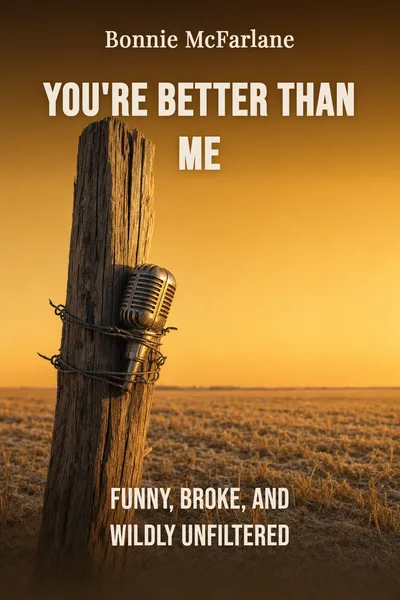
You're Better Than Me
Funny, broke, and wildly unfiltered
Description
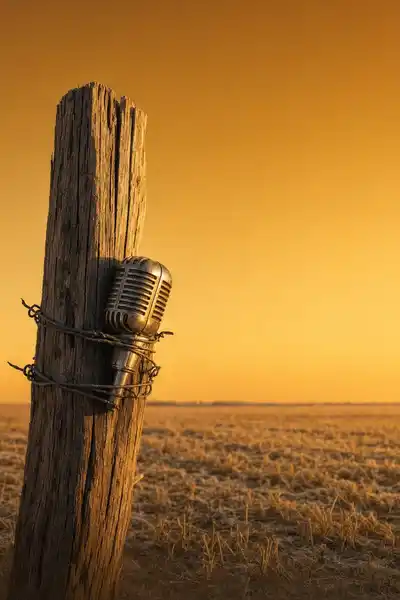
Bonnie McFarlane grew up on a farm in Alberta, Canada, the kind of place where the nearest town was a rumor and the livestock outnumbered the conversations. She was not a natural fit for it. She was a girl who noticed things, said the wrong ones out loud, and figured out early that being funny was a way to survive a room that hadn't asked for her opinion. The memoir she eventually wrote, "You're Better Than Me," opens from inside that mismatch — a kid who felt like the wrong species in her own family, filing away the material she'd use decades later.
What the book tracks is the distance between that farm and the comedy clubs of New York and Los Angeles, where McFarlane spent years grinding through open mics, bad rooms, and the particular indignity of being a woman told, repeatedly and to her face, that women aren't funny. She married a comedian, Rich Vos, raised a daughter, made a documentary asking that exact question, and kept writing jokes through all of it. The memoir is not a highlight reel. It's closer to a confession told fast, before anyone can stop her.
The title is a dare and a shrug at once. McFarlane isn't asking to be admired; she's handing over the unedited version and letting us decide what to do with it. The book sits in the lineage of comedians who write themselves down honestly enough to sting — funny, broke, and refusing to clean up the parts that don't flatter.
The question we’re asking : How does a comedian turn a life of not fitting in into a memoir that stays funny without lying about the cost?What we’ll see : A farm kid becomes a comic the hard way, runs into the wall marked "women aren't funny," and writes it all down without sanding off the edges.
Table of contents
01Chapter 1 — A farm girl walks into a punchline
The farm is where the book starts, and it's where the sensibility gets built. McFarlane describes an Alberta childhood that reads less like nostalgia than like field notes from a girl who never quite belonged to the landscape around her. There were animals, chores, siblings, and a persistent sense that she was watching her own life from a slight remove, cataloguing it. That remove is the comic's basic equipment — the ability to stand half a step outside a moment and notice what's absurd about it — and she had it before she had a word for it.
She was, by her own account, a difficult child in the way that funny people often are: too observant, too willing to say the thing everyone was thinking and nobody wanted said. Being the odd one in a family teaches a specific skill, which is how to make discomfort land as a joke instead of a fight. McFarlane doesn't romanticize this. She was lonely, she was broke, and the farm did not hand out prizes for wit. But the instinct to convert awkwardness into a bit was already running.

02Chapter 2 — The long apprenticeship in bombing
Stand-up, as McFarlane tells it, is mostly failing in public until you fail slightly less. The stretch of the book covering her early years in comedy is an education in how unglamorous the pursuit actually is. Open mics in half-empty rooms. Sets that die. Drives to gigs that barely cover gas. The romantic idea of the comedian as a fearless truth-teller collapses into the reality of a person standing in front of strangers who would rather be anywhere else, trying to earn one laugh before the light goes on.
She's clear-eyed about the money, or the lack of it. Broke is not a metaphor in this book; it's a recurring condition, the low hum under every ambition. Comedy pays badly for a long time, and it pays worse if you're not the shape the industry expects a comic to be. McFarlane records the humiliations without self-pity — the terrible bookings, the condescending club owners, the sense that she was auditioning for permission to keep doing the one thing she was good at.
03Chapter 3 — The woman problem, and the joke about it
The question McFarlane could not escape is the one she eventually made a film about: are women funny? She heard it stated as fact, over and over, by men in comedy who believed it and by audiences primed to expect less. The memoir treats this not as an abstract grievance but as a working condition — a headwind she performed against every night, on top of the ordinary difficulty of being funny at all.
Her documentary, released in 2014 under a title that repeats the insult back at the people who'd used it, put the question to comedians directly. The book's account of making it is less interested in winning the argument than in showing how tiring the argument is to keep having. To be a female comic in that era was to be a category before you were a person, evaluated against a bar that men never had to clear. McFarlane's response is characteristic: she doesn't demand to be taken seriously so much as she keeps being funny in front of people who'd decided she couldn't be.
04Chapter 4 — What a memoir refuses to smooth over
Most memoirs, especially by people in show business, quietly promise redemption. The mess gets organized into a lesson, the struggle pays off in wisdom, and the reader closes the book feeling that suffering was, in the end, worth it. "You're Better Than Me" declines the deal. McFarlane's life does not resolve into a moral. She's still funny, still frank about being broke, still the outsider she was on the farm — just older, with more material.
This refusal is the book's quiet argument about what honesty costs a comedian. A joke works because it's true faster than a polite person would admit. Stretch that instinct across a whole memoir and you get a writer who can't offer the tidy arc without betraying the very thing that makes her funny. The self-deprecation isn't a bid for sympathy; it's a discipline. She keeps herself in the frame as flawed because the alternative — the sanitized, inspirational version — would be a lie, and lying is the one thing a good comic can't afford on the page.
05Conclusion
The farm girl who never fit her own family never quite stopped being that person. By the end of the memoir, McFarlane is a working comedian, a wife, a mother, and a documentarian who put her career's central insult in a movie title — but she's still writing from the outside of the room, still noticing what's absurd, still declining to pretend it added up to a neat lesson. The book closes about where it opened: on a woman who converts not-belonging into a bit, and does it well enough to make a life of it.
Related books