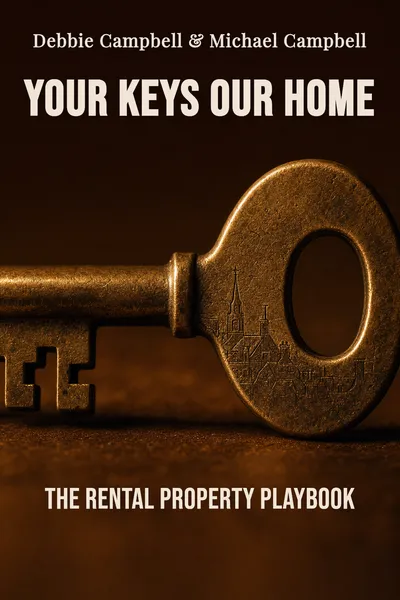
Your Keys Our Home
The rental property playbook
Description
In 2013, Debbie and Michael Campbell were in their early sixties, recently retired, and about to do something most people their age were doing in reverse. Instead of settling into a paid-off house in Seattle, they sold nearly everything they owned, kept two suitcases each, and started living full-time in other people's homes — apartments in Paris, cottages in Mexico, flats in Buenos Aires — booked one after another through short-term rental sites. They called themselves the Senior Nomads. Having slept in well over a hundred rentals, they realized they had accidentally become experts in what makes a stay work, and what quietly ruins it.
That vantage point is what makes their book unusual. Most guides to renting out a vacation property are written by owners talking to other owners, all facing the same direction. The Campbells flipped it. Having handed their keys to strangers and taken strangers' keys in return, hundreds of times, they know exactly which welcome note lands, which listing photo lies, which missing coffee filter turns a five-star review into a three. "Your Keys Our Home" reads less like a spreadsheet of tips and more like a debrief from someone who has slept on the other side of the transaction.
The short-term rental market they describe has since become enormous — millions of listings, a routine line item in how families travel. Behind each listing is an owner trying to answer the same practical questions the Campbells did, in whatever order the problems arrive. This book is their attempt to put those questions in a sensible order and answer them from experience rather than theory.
The question we’re asking : How do you turn a house you love into a rental that strangers will love too — and pay to come back to?What we’ll see : How two full-time travelers translated a thousand nights as guests into a working method for owners on the other side of the door.
Table of contents
01Chapter 1 — The couple who gave up their own address
The Campbells did not set out to write a hosting manual. They set out to travel cheaply and indefinitely, which for a retired couple meant renting other people's homes rather than paying hotel rates night after night. What they discovered, roughly a hundred stays in, was that they had developed an almost involuntary checklist. Walking into a new apartment, they could tell within minutes whether the owner had thought about the guest or just listed a space and hoped. That instinct is the book's real engine.
Their argument starts from a reframe that sounds small but changes everything downstream. The moment you rent your home to a stranger, it stops being your home in the way you experience it. It becomes a product — one that competes, on a screen, against dozens of nearly identical products a few streets away. The owner who keeps thinking of it as "my place, that people happen to stay in" tends to make the errors the Campbells kept encountering: the closet full of the owner's clothes, the drawer you're told not to open, the framed family photos that make a guest feel like an intruder.

02Chapter 2 — The listing is the first handshake
Before a guest ever turns your key, they meet your listing — and the Campbells treat that listing as the single highest-leverage thing an owner controls. A booking is a decision made almost entirely on photographs and a few paragraphs of text, by someone comparing you against a scrolling wall of alternatives. The stay might be wonderful, but if the listing doesn't earn the click, the stay never happens.
Photographs come first because they do most of the work. The recurring mistake, they say, is dark, cramped, phone-snapped images that make a perfectly nice apartment look like a place someone is trying to unload. Shoot in daylight, open the curtains, tidy every surface, and show the rooms a guest actually cares about — where they sleep, where they cook, the view if there is one. A bright kitchen sells better than a beautiful ceiling nobody photographs from a useful angle. The Campbells, having been lured and disappointed by flattering photos themselves, add the counterweight: never show what isn't there. The photo that oversells is the photo that guarantees a bad review.
03Chapter 3 — Hospitality is the whole business
If the listing gets the guest through the door, hospitality is what decides whether they leave a review that brings the next one. This is the part of the book where the Campbells' years as guests pay off most directly, because they can name the specific small failures that sour a stay — and they are almost never the big things.
Cleanliness is non-negotiable and comes first, always. A single hair on a pillow, a ring in the tub, a fridge that smells of the last guest's leftovers — these register instantly and poison everything else. The Campbells argue that the standard has to be hotel-level regardless of the price, because guests judge cleanliness in absolute terms, not relative to what they paid. This is usually the moment an owner realizes they need a reliable cleaner between every stay, and that skimping there is the false economy that costs the most.
04Chapter 4 — The platform is the landlord now
Step back from the tactics and a larger shift comes into view, one the Campbells lived from both sides. The short-term rental economy didn't just give owners a new income stream; it rewired what it means to own a home at all. A vacation property is no longer only a place you go — it's a small business whose customers, pricing, reputation, and rules are largely mediated by companies like Airbnb, VRBO, and HomeAway. The owner holds the deed, but the platform increasingly sets the terms.
The clearest sign of this is the review system, which the book treats as the true currency. Trust between total strangers — a homeowner and someone who found them on a phone — used to be impossible to establish at scale. The platforms manufacture it through ratings that follow you everywhere. A run of five-star reviews lifts your listing and lets you charge more; a couple of bad ones can quietly bury you. Every hospitality choice in the book is, underneath, a move in that reputation game. The owner isn't just pleasing a guest; they're feeding an algorithm that decides who sees them next.
05Conclusion
Debbie and Michael Campbell wrote this book from an unusual place: still homeless by choice, still handing back keys every few weeks, still slipping into other people's kitchens and noticing what was missing. That perpetual guest's view is what saves the book from being a checklist. They know what a good stay feels like from the inside, and they translated that feeling into the concrete decisions an owner makes — the photos, the price, the spotless bathroom, the coffee on the counter, the quick reply to the anxious text.
Related books