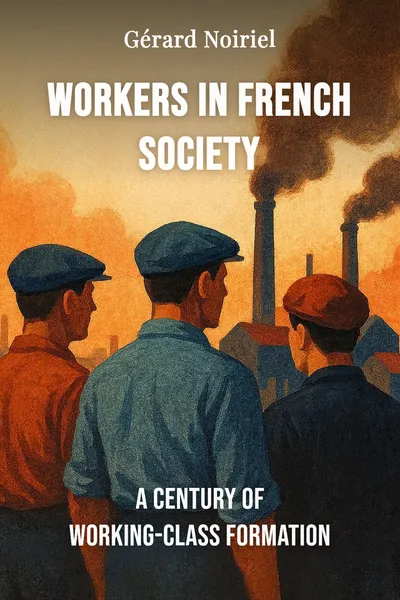
Workers in French Society
A century of working-class formation
Description
In 1876, the French census counted a country still overwhelmingly rural and agricultural. Fewer than a third of its people lived in towns of any size, and the word ouvrier — worker — covered a bewildering range: a weaver at home in the Nord, a foundry hand in Le Creusot, a seasonal mason from the Limousin who spent half the year in Paris and the other half tending fields. There was industry in France, but there was not yet, in any settled sense, a working class. What we picture when we say the words — the union card, the factory gate, the red flag, the neighbourhood that votes together — did not exist as a thing one could simply point to. It had to be made.
Gérard Noiriel spent his career arguing that this making was slow, uneven, and far from inevitable. The historian, himself the son and grandson of workers, set out to trace how a scattered mass of laborers — French peasants leaving the land, Italians and Poles and Belgians crossing the border, Algerians arriving between the wars — was gradually shaped into something that could think of itself as a single group with shared interests. It is a story with no clean beginning and, as it turns out, an ending nobody quite planned.
The temptation is to read the French working class backward, as though it were always there, waiting to awaken. Noiriel resists that. He treats the class as an achievement — something built by migration, by the rhythms of the factory, by institutions and struggles that took the better part of a century to cohere. And once we see it as built rather than given, a harder question opens: what happens to such a thing when the conditions that assembled it fall away?
The question we’re asking : How did a scattered mass of French peasants and foreign migrants become a working class that could recognize itself?What we’ll see : How industry, migration and a slow web of institutions assembled a class — and what remained of it once the factory world receded.
Table of contents
01 Chapter 1 — A class that had to be assembled
The starting point of Noiriel's account is a refusal. He declines to assume that a working class existed simply because factories existed. Through most of the nineteenth century, French industry ran on a patchwork of arrangements that had little in common with each other. There were the great mines and mills, yes, but there was also an enormous world of domestic work, small workshops, and rural manufacturing that blurred the line between peasant and laborer. A family might weave for a merchant in winter and harvest in summer. To call all of these people a single class was, at the time, an act of political imagination more than a description of fact.
What kept the class from forming, in Noiriel's reading, was above all instability. Nineteenth-century industrial workers moved constantly — between towns, between trades, between the factory and the farm. Turnover in the big plants was staggering; a worker rarely stayed in one place long enough to build the kind of durable ties that a shared identity requires. People did not so much belong to a working class as pass through working-class conditions on their way somewhere else, or back to where they had come from.

02 Chapter 2 — The great migration into the factory
The engine of the story is movement of people, and here Noiriel makes his most distinctive contribution: the French working class was, from the outset, a class of immigrants. Not only foreign immigrants — though France drew enormous numbers of them, more per capita than the United States in some decades — but internal migrants too, French peasants uprooted from the countryside and deposited into industrial towns where they were often as foreign as any Belgian or Italian. The factory did not draw on a settled local population. It drew on people torn loose from somewhere else.
The foreign share was decisive because French birthrates were low and industry's appetite for labor was not. From the late nineteenth century onward, employers reached across the borders: Belgians and Italians first, then Poles recruited by the tens of thousands for the mines and steelworks of the north and east after the First World War, then North Africans. By the 1930s foreigners made up a substantial fraction of the industrial workforce in whole regions. The mine, the blast furnace, the assembly line were staffed by people who often did not share a language, a religion, or a nation.
03 Chapter 3 — When the workers finally became French
The turning point, in Noiriel's account, is stabilization — the moment when workers stopped moving and started staying. Several things converged to make this possible, mostly in the first half of the twentieth century. Large firms, tired of ruinous turnover, began to fix their workforces in place with company housing, pensions, family allowances, and the whole apparatus of paternalist welfare. The state extended social protections. War and economic crisis, paradoxically, tied people down. Slowly, the worker who had passed through the factory became the worker who lived his whole life beside it.
Once workers settled, everything else could take root. Neighbourhoods became durable. Children followed parents into the same plants. Unions could recruit members who would still be there next year, and the great confederations grew into permanent forces. The Communist Party, from the 1930s onward, built dense local networks — sporting clubs, newspapers, festivals, town halls it controlled — that wove the scattered individual worker into a visible community with its own culture and its own memory. This was the red belt around Paris, the mining basins that voted as one. The class had, at last, an address.
04 Chapter 4 — The trades that held the whole thing together
Step back from the chronology and the deeper argument comes into view: a class is not a thing that exists, but a relationship that has to be continuously produced. Noiriel's whole method is a warning against treating 'the workers' as a natural category with a fixed essence. What we call the French working class was held together by an intricate web — the stable factory, the union, the party, the neighbourhood, the shared trade passed from father to son — and it lasted exactly as long as that web held. The identity was real, but it rested on infrastructure, not on some timeless proletarian nature.
This matters because it changes how we read the class's decline. When the factories closed, the mines shut, and the industrial regions emptied out in the last decades of the twentieth century, it was not merely jobs that vanished. The entire apparatus that had manufactured the shared identity came apart. Without the plant there was no daily common experience; without stable employment the party cells and unions withered; without the trade there was nothing to hand down. The class did not so much lose a battle as lose the conditions of its own existence.
05 Conclusion
We began with a census that could not quite name what it was counting — ouvriers scattered across farms, workshops, and mines, with no settled class among them. It took roughly a century of migration, factory discipline, and patient institution-building to assemble those scattered people into a working class that could recognize its own face: organized, rooted, capable of turning peasants and foreigners alike into a single 'we.' Noiriel's achievement is to show that this was made, not found — an artifact of a specific industrial moment rather than a permanent feature of French society.
Related books