
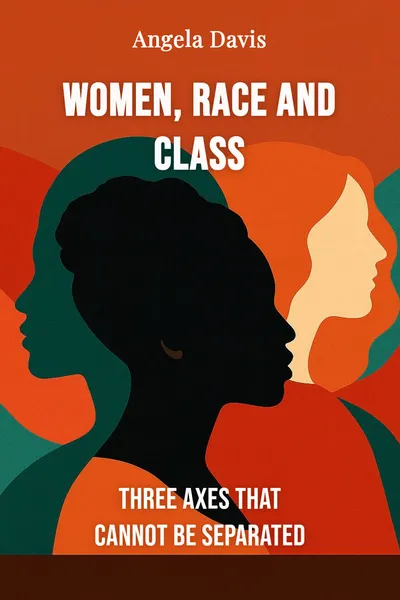
Women, Race and Class
Three axes that cannot be separated
Description
In 1971, while awaiting trial in a California jail on charges that could have sent her to the gas chamber, Angela Davis began working out the argument that would become a book. She was already a philosopher trained in Frankfurt and San Diego, already a Communist, already famous enough that her acquittal a year later made international news. But the book she published in 1981, Women, Race and Class, is not a memoir of the cell. It is a history — a hard, close reading of American feminism from the plantation to the present, told from the vantage point of the people that history usually leaves as a footnote.
The claim she builds is deceptively simple. Race, gender and class are not three separate oppressions that a Black working woman happens to suffer one after another. They arrive together, they reinforce one another, and any movement that tries to fight one while ignoring the other two ends up serving somebody. Davis proves this not by theorizing but by going back through the record: the abolition meetings, the suffrage conventions, the strike lines. The pattern she finds is uncomfortable, especially for the movement she is writing inside of.
What makes the book land is that Davis refuses to let anyone be simply a hero or a villain. Susan B. Anthony fought for women and, at a decisive moment, cut Black men loose to do it. The point is not to cancel anyone. It is to show how a movement that speaks for "women" keeps quietly meaning some women, and to ask what a feminism built the other way around might look like.
The question we’re asking : Why did a movement fighting for women's liberation keep excluding the women who needed it most?What we’ll see : We follow abolition, the vote and labour braided together across a century, and watch where mainstream feminism kept drawing its lines.
Table of contents
01 Chapter 1 — The women the abolitionists forgot to count
Davis opens where American feminism itself began: in the fight against slavery. Many of the white women who became the first organized feminists learned to speak in public, run meetings and write manifestos inside the abolitionist movement. The Grimké sisters, Lucretia Mott, Elizabeth Cady Stanton — they discovered their own political voice while demanding freedom for enslaved people. The connection was real, and Davis honours it. Fighting one bondage taught them to see another.
But she insists on a figure the celebratory version skips over: the enslaved woman herself. Under slavery, Davis argues, the categories that structured white women's lives simply did not apply. The enslaved woman was not a housewife shielded from the market; she worked the fields alongside men, was flogged like them, and was valued as a breeder of more property. Where the ideology of the era told white women their place was domestic and delicate, Black women were forced into a brutal equality of labour — and then denied any protection that equality might have earned.

02 Chapter 2 — When the vote split the movement in two
The alliance between Black liberation and women's rights held, more or less, until the end of the Civil War. Then it broke — and Davis treats the break as the hinge of the whole story. After emancipation, Congress moved to enfranchise Black men through what became the Fourteenth and Fifteenth Amendments. For the first time the word "male" was about to enter the Constitution in connection with voting, and women, Black and white, were left out.
The reaction of leaders like Elizabeth Cady Stanton and Susan B. Anthony was, Davis shows, a betrayal dressed as principle. Rather than argue for universal suffrage, they turned against the amendments and against Black men's votes. Their rhetoric curdled. Stanton warned of "Sambo" and of ignorant former slaves making laws for educated white women. Anthony declared she would sooner cut off her right arm than work for the ballot for the Black man and not the woman. The feminism that had been born in abolition now positioned itself in open competition with Black freedom, and it reached for racism to do so.
03 Chapter 3 — The rape charge and the myth it protected
The book's later chapters turn to a subject Davis handles with unusual force: rape, and the way accusations of it were weaponized against Black men after slavery ended. The lynch mob almost always justified itself with the claim that a Black man had assaulted a white woman. Davis lines up the evidence — much of it gathered decades earlier by Ida B. Wells — showing that the vast majority of lynchings had nothing to do with any such charge. The myth of the Black rapist was, she argues, a political tool: a way to terrorize a newly free population and to keep white men in control of both Black labour and white women.
Here the three axes lock together again. The myth kept Black men in a state of lethal vulnerability, kept white women confined inside a story of fragile purity that required white male protection, and kept the whole racial order of the post-slavery South intact. It was, at once, a lie about race, a cage for gender, and a discipline over labour. Davis refuses to let anyone treat it as a matter of individual crimes; it was infrastructure.
04 Chapter 4 — One struggle, three names
Step back from the episodes and Davis's larger argument comes into focus. Mainstream feminism, across a century and a half, kept building itself as an addition problem. It began with the concerns of relatively privileged white women and then, when pressed, tried to add on the concerns of Black women, poor women, working women — as an appendix, a special case, a chapter near the end. Davis's whole method is to refuse the addition. The Black working woman is not a complication of feminism; she is where a real feminism would have to start.
Because if you start there, the priorities change. A movement that begins from the woman who cleans other people's houses cannot treat the vote as its ceiling or the corner office as its dream. It has to talk about wages, about the value placed on domestic and care work, about who gets to stay home and who never could. Davis reserves particular scepticism for the strand of feminism that celebrated escaping housework for a career, since for Black women in America paid domestic labour in white homes had long been not liberation but the trap itself. Freedom from housework meant one thing to the mistress and something very different to the maid.
05 Conclusion
Davis finished the book a free woman, but the history she assembled is not a story with a resolution. It is a diagnosis. From the plantation to the suffrage convention to the anti-rape campaigns of her own decade, she traces the same recurring move: a movement speaks in the name of women, reaches a moment of pressure, and quietly narrows the word to mean the women with the most to gain and the least to lose. Sojourner Truth standing in Akron and Ida B. Wells counting the dead are the figures who kept refusing that narrowing, and Davis writes to put them back at the centre.
Related books











