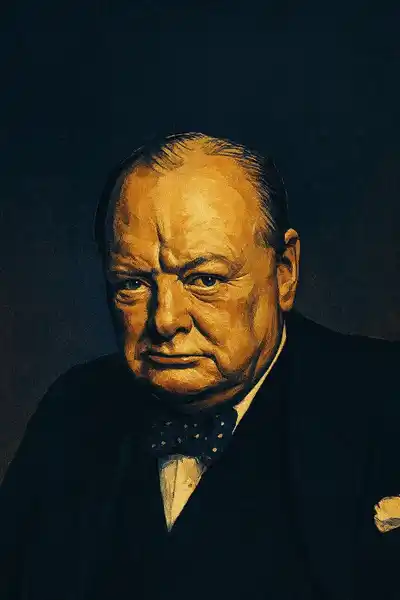
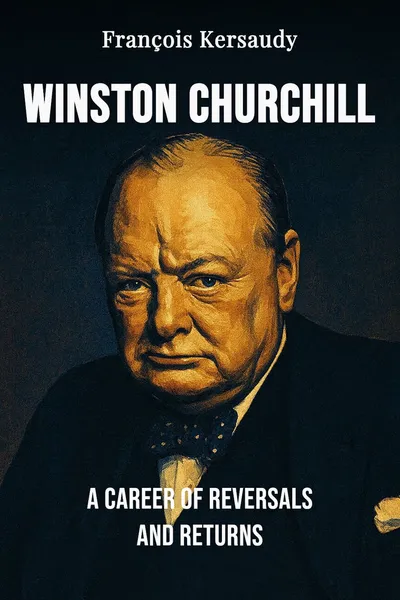
Winston Churchill
A career of reversals and returns
Description
On May 10, 1940, a sixty-five-year-old politician most of his colleagues considered finished became Prime Minister of the United Kingdom. He had crossed the floor of the House of Commons twice, changing party once and then changing back. He had been blamed for a military catastrophe that cost tens of thousands of lives, been thrown out of government, spent most of the 1930s shouting warnings that almost nobody wanted to hear. When King George VI asked him to form a government, it was because the alternatives had run out — not because Winston Churchill was the obvious choice. He was the choice that was left.
François Kersaudy, a French historian who spent decades in the Churchill archives, tells this life as a long chain of reversals rather than a straight climb to greatness. The man who saved 1940 had, by then, already failed at almost everything a public career can fail at. He had switched sides, burned bridges, backed the wrong horse, misjudged the mood of the country over and over. His obituaries had, in a sense, been half-written for years. And then, at an age when most men retire, he was handed the one job history had apparently been keeping for him.
That is the puzzle Kersaudy sits with. Not the war leader we know from the newsreels, cigar and V-sign, but the forty preceding years that produced a résumé no selection committee would touch. The interesting thing is not that Churchill triumphed. It is that the triumph was built out of the same traits that had ruined him — the obstinacy, the appetite for risk, the refusal to read the room. We tend to remember the finale and forget the four decades of near-misses that made it possible.
The question we’re asking : How does a career defined mostly by failure end up as the one that mattered most?What we’ll see : A life told through its defeats, its exiles and its wrong turns — right up to the single moment that made sense of them all.
Table of contents
01Chapter 1 — The boy who had to prove something
Winston Churchill was born in 1874 at Blenheim Palace, grandson of a duke, son of a rising Tory politician named Lord Randolph Churchill. It sounds like the start of an easy life. Kersaudy shows it was the opposite. His father was distant and dismissive, convinced the boy was slow and destined for mediocrity; his mother, the American-born Jennie Jerome, was dazzling and largely absent. Winston grew up starved of the one thing he wanted most, which was his father's approval, and he never really got it — Lord Randolph died in 1895, at forty-five, his own promising career already in ruins.
That wound, in Kersaudy's reading, drives everything after. The young Churchill was a poor student, stubborn, more interested in tin soldiers than Latin. He scraped into the military academy at Sandhurst on his third attempt. But he had discovered an appetite that would define him: he wanted to be where things happened, and he wanted the world to notice. As a young cavalry officer he engineered postings to every war he could reach — the North-West Frontier of India, the Sudan, where he rode in one of the last great cavalry charges at Omdurman in 1898.

02Chapter 2 — The man who was always wrong at the wrong time
The rise was fast. By 1911 Churchill was First Lord of the Admiralty, running the Royal Navy, still not forty. He had already done the unthinkable once, crossing from the Conservatives to the Liberals in 1904 over free trade — a defection his old party never forgave. He was brilliant, restless, and everywhere, pushing naval reform, social insurance, the conversion of the fleet from coal to oil. To watch him in these years, Kersaudy notes, is to watch a man who seems bound for the very top, and soon.
Then came Gallipoli. In 1915, with the First World War frozen into the trenches, Churchill championed a bold flanking stroke: force the Dardanelles straits, knock the Ottoman Empire out of the war, open a route to Russia. The idea had a kind of strategic elegance. The execution was a disaster. The naval attack failed, the landings bogged down, and the campaign became a slaughter that cost roughly a quarter of a million Allied casualties before the survivors were evacuated. Churchill was not solely to blame — the plan was starved of resources and mishandled by others — but he was the public face of it, and he was destroyed.
03Chapter 3 — Ten years in the wilderness
In 1929 the Conservatives lost power, and Churchill lost his place in the front rank of politics. He would not hold office again for a decade. Kersaudy calls these the wilderness years, and they were as bleak as the name suggests — a former Chancellor, past fifty, sitting on the back benches, listened to politely and heeded almost never. Most observers assumed his career was simply over. He had been at the top and he had fallen off, and men rarely climbed back at his age.
He did not go quietly, but he often went wrongly. He broke with his own party leadership over India, opposing even modest steps toward self-government with a ferocity that struck many as reactionary and out of date. In 1936 he backed King Edward VIII during the abdication crisis, misreading the national mood so badly that he was shouted down in the Commons. Each of these stands cost him credibility he could not spare. By the mid-1930s a great many people had concluded that Churchill's judgement, whatever his gifts, simply could not be relied on.
04Chapter 4 — The hour that redeemed the record
When Churchill became Prime Minister in May 1940, France was collapsing and Britain stood essentially alone. What Kersaudy insists on is that the man for this moment could only have been the man the previous forty years had produced — flaws included. The refusal to compromise that had wrecked him over India and the gold standard was precisely what the country now needed in a leader who would not negotiate with Hitler. In the last week of May 1940, with the army trapped at Dunkirk and senior colleagues pressing him to explore terms through Italy, Churchill's stubbornness became a national asset. He said no, and he made the no stick.
The point is not that the war years cancelled the failures. It is that they were cut from the same cloth. The appetite for risk that had sent men to die at Gallipoli was the appetite that let him gamble on holding out through the summer of 1940. The relentless self-belief that had made him insufferable in the wilderness was what allowed him to broadcast defiance to a frightened population and be believed. The very qualities that made Churchill an unreliable minister in ordinary times made him the right instrument for an extraordinary one.
05Conclusion
The 1945 defeat did not end him — Churchill returned as Prime Minister once more in 1951, an old man presiding over a shrunken empire, before finally retiring in 1955. He died in 1965, given a state funeral of a kind Britain reserves for its monarchs. By then the failures had been folded neatly into the legend, the way we tend to fold the awkward parts of any great story into the shape we prefer to remember. Kersaudy's achievement is to unfold them again.
Related books