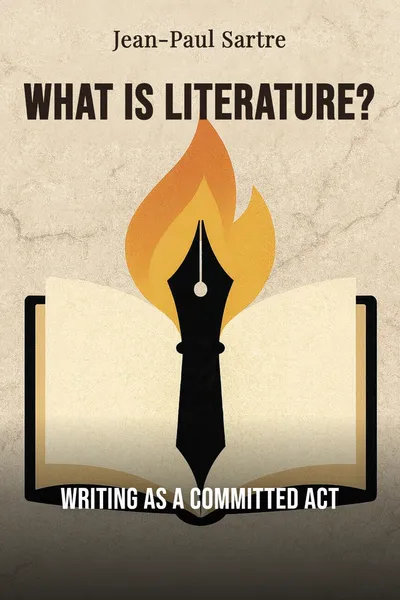
What Is Literature?
Writing as a committed act
Description
In 1947, in the pages of his own review Les Temps modernes, Jean-Paul Sartre published a long essay under a question that sounds almost naive: Qu'est-ce que la littérature? He was already famous — for Being and Nothingness, for the plays, for the cafés where existentialism had become a kind of weather. But the essay came out of a fight. Critics on the right accused him of degrading literature into political tract; some on the left thought he wasn't political enough. So he did the thing a philosopher does when cornered. He went back to the beginning and asked what writing even is.
The answer he built runs against a very old and very flattering idea — the idea that the writer serves only Beauty, that art floats above the grubby business of taking sides, that the true poet is a kind of priest of pure form who owes nothing to his century. Sartre found that comforting picture both false and, in the France that had just lived through Occupation and collaboration, faintly obscene. A writer, he argued, is someone who has chosen to reveal the world by naming it — and to name a thing is already to have decided something about it.
From that starting point he draws a conclusion that made a lot of people uncomfortable and still does: literature is a committed act, whether the writer admits it or not. The book that thinks it is saying nothing is saying plenty. And the reader, far from being a passive consumer, is quietly enlisted as an accomplice. What follows is Sartre's case for what he called littérature engagée — engaged literature — and for the strange freedom that binds the one who writes to the ones who read.
The question we’re asking : What does it actually mean to write, if a book is never innocent?What we’ll see : How Sartre separates prose from poetry, turns writing into an action, and ends up handing the writer a responsibility that can't be refused.
Table of contents
01Chapter 1 — The difference between a word and a color
Sartre begins by clearing away a confusion that had, he thought, poisoned the whole debate: the habit of lumping every art together and demanding that the novelist be as pure and useless as the painter. The painter, he grants, really does work with matter. A patch of yellow in a Tintoretto is not a sign that points to grief; it is a thing, present, that produces its effect the way a storm produces cold. The composer's notes mean nothing outside themselves. Ask a painter to be committed and you have misunderstood what paint is.
But the writer of prose works with something entirely different. Words are not things to be contemplated; they are tools that point beyond themselves. When we read a sentence we do not linger on the shape of the letters — we look through them at what they designate, the way we look through a windowpane at the garden. Prose is transparent. Its whole nature is to send us somewhere else, toward the world it names, and naming is never neutral. To call a man a Jew, a collaborator, a hero, a boss, is already to have taken up a position in the human landscape.

02Chapter 2 — Prose is a way of acting
If words point at the world, then to write is to reveal, and to reveal is to change. Sartre's key idea here is deceptively simple: the writer discloses a situation, and once a situation is disclosed, no one can go on pretending not to see it. Naming an injustice strips it of the alibi of ignorance. The reader who has read cannot un-know. In that sense the writer is like a man who tears the wall off a house — everyone inside is suddenly exposed, and exposure is already a form of pressure to act.
This is what he means by commitment, and it is worth insisting on how modest it looks up close. He is not asking novelists to write propaganda or to end every chapter with a slogan. He is describing what prose does by its nature. The writer chooses what to reveal, and every choice of subject, every silence, is a decision about which parts of the world will be lifted into the light. The author who writes a charming novel about nothing has decided that nothing is what deserves attention. That, too, is a stance — usually the stance of the comfortable.
03Chapter 3 — No one writes for slaves
Halfway through, the argument turns from writing to reading, and this is where it becomes genuinely surprising. A book, Sartre insists, does not exist on the shelf. It is a strange object that comes into being only through the reader's activity; the writer supplies the marks, but the reader supplies the images, the tempo, the world. Reading is a directed creation. The author and the reader make the book together — the writer cannot read his own work into existence, and the reader cannot invent the text. Each needs the other's freedom.
And freedom is the pivotal word. To read, Sartre argues, I must lend my freedom to the book, trusting the author, agreeing to be moved. In return, the writer must respect mine; he cannot force me, only appeal to me. Literature therefore rests on a pact of two freedoms recognizing each other. This is why he arrives at his most famous formula: one does not write for slaves. The very act of addressing a reader treats that reader as free, as someone who could put the book down, who is being asked rather than commanded.
04Chapter 4 — The freedom of a Sunday reader
Having built his theory of writing and reading, Sartre steps back to ask the question that gives the essay its bite: for whom, exactly, does a writer write? And the answer is never humanity in general. A book is always addressed to actual readers, living in a particular society, at a particular hour of history, with particular things they are ready to hear and particular things they refuse to see. The writer works inside a situation he did not choose, speaking a language already loaded with the conflicts of his moment. There is no timeless audience and no timeless book.
This is the part of the argument that dates the writer to his century, and Sartre embraces it. He surveys the history of French letters precisely to show how each generation of writers depended on, and quarreled with, a specific reading public — the salons, the bourgeoisie, the emerging masses. A writer's freedom is not the freedom to float above his age; it is the freedom he exercises inside it, with the readers he actually has and the ones he is trying to reach. To ignore that situation is not to escape it but to serve it blindly.
05Conclusion
So the naive question turns out to have a demanding answer. To write in prose, for Sartre, is to name the world for free readers who cannot un-know once they have read — which means the writer is always doing something, always intervening, always answerable. The dream of an art suspended above its time was never modesty; it was a way of pretending the rifle wasn't loaded. Strip away that alibi and literature stands revealed as a pact between two freedoms, made in a definite society, at a definite moment, about a world that could be otherwise.
Related books