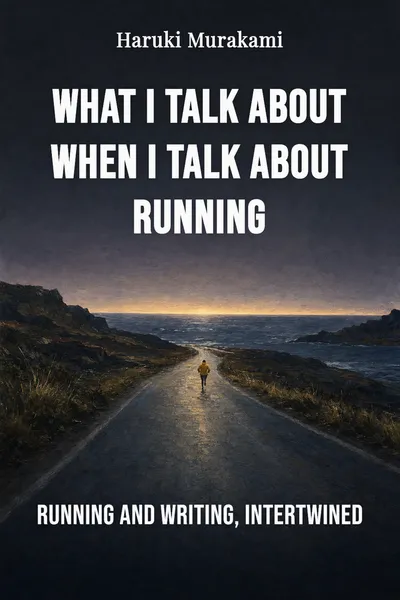
What I Talk About When I Talk About Running
Running and writing, intertwined
Description
Sometime around 1982, Haruki Murakami sold the Tokyo jazz bar he had run for years, moved to the countryside, and started living as a full-time novelist. He had just published two short novels and was about to attempt something longer and more demanding. He was in his early thirties, sitting at a desk all day, smoking heavily, gaining weight. So he did something that had nothing obvious to do with fiction: he began to run. Not for a season, not as a phase. He kept at it for decades, logging thousands of miles, entering a marathon nearly every year, and eventually finishing races most people never attempt.
In 2007, a quarter-century into the habit, he wrote a slim book about it. He borrowed his title from a Raymond Carver story, "What We Talk About When We Talk About Love," and bent it toward his own subject. The result is not a training manual and not quite an autobiography. It is a set of reflections, written in the runner's rhythm, about what it means to do the same solitary thing every day for years — and about how that daily labor connects, more tightly than anyone would guess, to the work of writing novels.
Murakami is careful never to claim the two are the same. He is not offering running as a metaphor for creativity, or creativity as a reward for fitness. He is describing, plainly, a life in which the road and the desk have grown into each other, until it is hard to say where the physical discipline ends and the artistic one begins.
The question we’re asking : What does one of the world's most private novelists learn about writing by spending his mornings running alone?What we’ll see : How a jazz-bar owner became a runner, why the road taught him more about novels than any writing lesson, and what he found when the body finally started to argue back.
Table of contents
01 Chapter 1 — The novelist who decided to run
Murakami tells the origin story without drama. Running a bar meant late nights, cigarettes, and a body that did whatever the work demanded. When he chose to write full-time, the physical arithmetic changed. Sitting alone at a desk for hours is sedentary and, in its own way, taxing. He needed a form of exercise that fit a solitary temperament — nothing that required a team, a court, or an opponent. Running asked for none of that. All it needed was a pair of shoes and a road, and he could do it whenever he wanted, at his own pace, answering to no one.
That last part matters more than it first appears. Murakami is, by his own admission, someone who prefers solitude, who is not built for group activity and never has been. Running suited the person he already was. He describes the pleasure of it not as exhilaration but as a kind of quiet — the sound of his own breathing, the road unspooling ahead, a private space no one else could enter. For a man whose job is to spend long stretches alone inside his own head, the run became a second place to be alone, this time with the body doing the thinking.

02 Chapter 2 — The discipline that writing borrows from the road
The heart of the book is the claim that almost everything Murakami knows about writing novels, he learned by running — or at least learned in the same place, at the same time, by the same means. Writing a novel, he explains, is not primarily a matter of talent. Talent, if you have it, is fixed; you cannot will more of it into existence. What you can develop are the two qualities that keep talent from going to waste: focus and endurance. Both are trainable, and both are trained exactly the way muscles are — through repetition that borders on the tedious.
Focus, for Murakami, is the ability to pour all of one's limited attention onto the task at hand. Endurance is the ability to keep doing that day after day, for the months or years a long book requires. He compares the writing of a novel to a long-distance race rather than a sprint. Nobody finishes a marathon on enthusiasm; you finish because you have taught your body, over many quiet mornings, to keep moving when there is no reason left to. He built his writing life on the same principle. He sits at the desk for the same hours each morning whether or not the words come, because showing up is not a mood — it is a practice.
03 Chapter 3 — Marathon, ultramarathon, and the limits of the body
The book's most physical chapters are also its most humbling. Murakami describes running an ultramarathon of 62 miles around Lake Saroma in Hokkaido — a distance that pushes the body somewhere ordinary training does not reach. He recounts the stages of it with unusual precision: the early confidence, the growing pain past the marathon mark, the point where his legs simply refused and he had to talk himself forward step by step. Somewhere in the final stretch he passed into a strange calm, a state where he seemed to be watching himself run from a small distance. He finished, but he came away changed, and not entirely for the better.
After that race he found himself in what he calls a runner's blues — a lingering flatness, a loss of the old enthusiasm. He had gone past a wall, and something on the other side of it had quietly gone out. It is one of the most candid passages in the book, because it refuses the tidy story in which effort is always rewarded and every limit crossed makes you stronger. Sometimes crossing the limit takes something from you that does not come back the same way.
04 Chapter 4 — A memoir that refuses to be about triumph
Step back from the mileage and the marathons, and the book turns out to be an argument about how a creative life actually gets made — an argument delivered almost entirely by example rather than by statement. The dominant cultural story about artists favors the flash: the prodigy, the breakthrough, the doomed genius who produces everything in a few incandescent years. Murakami spends 175-odd pages quietly dismantling that story, not by attacking it but by describing an alternative so unglamorous it barely reads as heroic.
His alternative is endurance. The novels people admire were not conjured; they were accumulated, one disciplined morning at a time, over a working life that he protected the way an athlete protects a body. What the running makes visible is the ordinary labor that the finished books usually hide. A reader sees the novel, polished and whole. What the reader does not see is the decades of showing up, the refusal to burn out, the deliberate choice to be a long-distance writer rather than a sprinter. The road is where that invisible work becomes literal, measurable in miles.
05 Conclusion
Murakami has said he would like his gravestone to read that he was, at least, a writer and a runner who never walked. The line captures the whole book. He is not claiming to have been the fastest, or the most gifted, or the most decorated in either pursuit. He is claiming to have kept going — through the countryside mornings, the marathon every year, the ultramarathon that hollowed him out, the slow years when the clock stopped cooperating. The running and the writing never really became metaphors for each other. They became the same habit, practiced with two different tools.
Related books