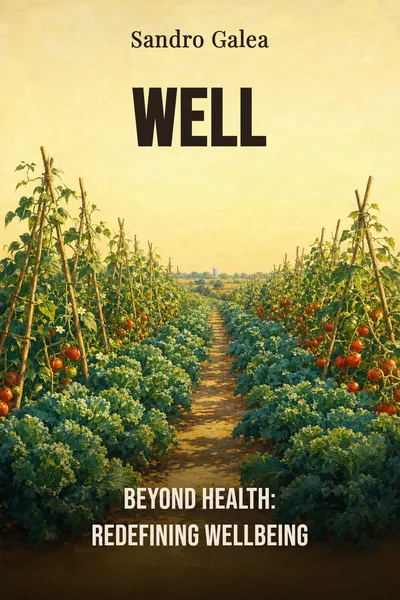
Well
Beyond health: redefining wellbeing
Description
The United States spends more on medical care than any nation in history — roughly $4 trillion a year, close to a fifth of its entire economy. By the logic most of us carry around, that should make Americans among the healthiest people on earth. They aren't. Life expectancy in the US has lagged behind that of comparable wealthy countries for years, and in the late 2010s it actually started to fall. Sandro Galea, a physician and epidemiologist who has spent his career running schools of public health, keeps returning to that mismatch. All that money, all that technology, all those hospitals — and the needle barely moves.
His book Well takes the mismatch as its starting point and turns it into an argument. We have confused two things that feel identical but aren't: medicine and health. Medicine is what happens after we get sick — the scan, the prescription, the surgery. Health is the deeper condition that determines whether we get sick in the first place, and it's shaped long before any of us sees a doctor. Galea's claim, built across the book, is that we've poured our resources into the first thing while quietly neglecting the second, and that the neglect is the reason the spending doesn't buy us what we expect.
That reframing sounds simple until we start following where it leads. If health is made mostly outside the clinic, then the things that keep us well are not the things we usually think of as medical at all — and the choices that matter most are not the ones we make in a waiting room.
The question we’re asking : If we already spend more than anyone on medicine, why aren't we the healthiest — and what have we been measuring wrong?What we’ll see : How a public-health scientist pulls wellbeing apart from medical care, and traces it back to the places we'd never think to look.
Table of contents
01 Chapter 1 — The gap between medicine and health
Galea likes to open with a thought that unsettles people who work in hospitals: most of what makes us healthy has nothing to do with what happens in hospitals. He isn't dismissing medicine. Emergency care saves lives, antibiotics cure infections, a good surgeon is worth every hour of training. But when researchers try to estimate how much of a population's health can be traced to medical care itself, the figure that keeps coming back is modest — somewhere around ten to twenty percent. The rest is made elsewhere.
The distinction he draws is between treatment and cause. Medicine is extraordinarily good at intervening once something has gone wrong. It is far less able to change the conditions that made things go wrong to begin with. A cardiologist can open a blocked artery with genuine skill; nothing in that procedure touches the decades of diet, stress, air quality, income and neighborhood that produced the blockage. We celebrate the rescue and ignore the slow story that made the rescue necessary.

02 Chapter 2 — The forces that made us before the doctor did
So what is upstream? Galea gathers it under a phrase public-health people use constantly and the rest of us rarely hear: the social determinants of health. The label is dry, but the idea is not. It means that our wellbeing is written, to a striking degree, by things that have no obvious medical character at all — where we were born, how much money our parents had, whether our street has trees or traffic, whether the water is clean, whether we feel we belong somewhere.
He walks through them one by one, and the cumulative effect is persuasive. Take place. Two children born a few miles apart in the same American city can face a gap in life expectancy of a decade or more, not because one has better genes but because one grows up with parks and grocery stores and the other with pollution and food deserts. Take money. Income turns out to be one of the strongest predictors of how long and how well we live, and the relationship holds far up the ladder, not just at the bottom.
03 Chapter 3 — Why we keep spending on the wrong thing
If the evidence is this clear, why do we keep pouring money into the narrow part of the picture? Galea spends real energy on this question, because the imbalance is not an accident. The US devotes the overwhelming majority of its health budget to treatment and only a sliver to prevention and the conditions that produce health in the first place. The ratio is lopsided in a way that no amount of new technology can fix.
Part of the answer is that medicine is visible and dramatic, while prevention is invisible and undramatic. A life saved on an operating table is a story with a face. A heart attack that never happened because a neighborhood built sidewalks and a workplace paid a living wage is a non-event — impossible to photograph, difficult to credit, easy to defund. We reward the rescue we can see and starve the prevention we can't.
04 Chapter 4 — What a country actually chooses when it chooses health
Step back from the clinics and the budgets and Galea's argument arrives somewhere uncomfortable: health, in the end, is political. Not partisan — political in the older sense, meaning it belongs to the shared decisions a community makes about how to live together. If our wellbeing is built out of housing, income, clean air, safe streets and human connection, then every policy touching those things is a health policy, whether we label it that way or not. A minimum wage is a health measure. A zoning law is a health measure. So is a decision about who gets to breathe clean air and who lives beside the highway.
This is the quiet reversal at the heart of Well. We tend to picture health as the most private thing we own, a possession we manage alone with our doctor. Galea keeps showing that it is one of the most collective things there is — the sum of a thousand choices made above our heads, by governments and companies and institutions, long before we're old enough to consent. The person who ends up sick did not simply fail to take care of themselves. They were, in part, cared for or neglected by the society they were handed.
05 Conclusion
The mismatch Galea opened with — the richest medical system on earth producing middling results — stops looking like a puzzle by the end of the book. It looks like a category error. We have been trying to buy health at the pharmacy counter when most of it was decided in the neighborhood, the paycheck, the friendships and the policies that shaped a life long before any symptom showed up. The repair shop is superb. The problem was always the road.
Related books