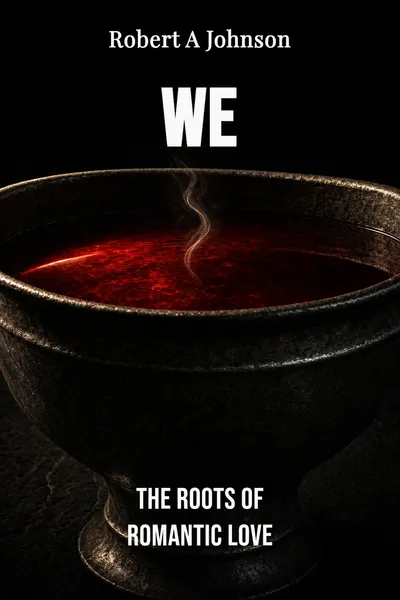
We
The roots of romantic love
Description
Somewhere in twelfth-century France, a poet set down the story of a knight named Tristan who drinks a potion meant for someone else and falls, irreversibly, for Isolde — a woman promised to his king. What follows is longing, secrecy, exile, and a death that reunites the lovers only in the grave. The tale spread across Europe in dozens of versions, and it never really left. Robert A. Johnson, the Jungian analyst who wrote the slim 1983 book "We," argues that this medieval romance is not a quaint artifact. It is, he says, the blueprint of how we still love — the source code running quietly under every modern relationship that begins with the feeling of being swept away.
That claim sounds large until you notice how ordinary its symptoms are. The certainty that one person will complete us. The ache when they don't. The sense, months or years in, that the magic has drained out and something must have gone wrong. Johnson takes these familiar sensations and traces them back to a story most of us have never read but all of us seem to know by heart. Romantic love, in his account, is not a timeless human universal but a specific inheritance — one with a birthdate, a geography, and a shape we keep reenacting without meaning to.
What interests him is less where it came from than what it costs, and whether the cost can be paid down. Johnson reads Tristan not to explain it away but to make sense of the strange weight we place on the beloved — and to ask whether there is a way to keep the love while surviving the illusion.
The question we’re asking : Why does the intoxication of falling in love so reliably curdle, and what did the Tristan legend understand about it that we forgot?What we’ll see : How a medieval myth quietly wrote the rules of modern romance, what we ask of a lover that no lover can give, and where a plainer kind of love begins.
Table of contents
01 Chapter 1 — The story we didn't invent
Johnson opens with a distinction most of us blur without noticing: romantic love and love are not the same thing. Romantic love is the specific experience of being "in love" — the intoxication, the sense that this person is not one human among many but the answer to something, the conviction that ordinary life has finally been redeemed. We treat this state as natural, as old as the species. It isn't. Johnson, drawing on Jung and on the cultural historian Denis de Rougemont, dates it to a particular moment: the courtly love of medieval Europe, where a knight's devotion to an unattainable lady became the highest ideal a man could hold.
The Tristan legend is the fullest expression of that ideal. The two lovers drink a potion, and from that instant they belong to a passion larger than themselves — a passion that thrives precisely because it cannot be fulfilled. Tristan and Isolde are happiest apart, sustained by longing; the few times they might actually live together, the story pulls them back into separation. Johnson reads this as the secret truth of romantic love: it is in love with love itself, with the intensity of yearning, more than with any real, breathing person.

02 Chapter 2 — When the beloved becomes a god
If romantic love is a story, what is it a story about? Johnson's answer is the heart of the book, and it borrows a single Jungian term: projection. When we fall in love, he argues, we are not chiefly seeing the other person. We are seeing something in ourselves — an image we carry inside, luminous and half-divine — and we cast it outward onto a suitable human screen. Jung called the inner feminine image in a man the anima, the inner masculine image in a woman the animus. Romantic love is the moment that inner figure lights up and appears to walk toward us in the flesh.
This explains the strange grandeur of falling in love, the way the beloved seems to glow. What we are actually encountering, Johnson says, is a spiritual longing — a hunger that older cultures directed toward God, toward the sacred, toward the whole of life. In the modern West, having lost much of that religious container, we have nowhere to put the longing except into one other person. So the beloved is asked to be not a partner but a deity: to give life meaning, to heal old wounds, to make us whole. No human can carry that, and the myth knew it — which is why Isolde is always just out of reach.
03 Chapter 3 — The projection that has to fall
The predictable arc of romantic love, in Johnson's telling, is that the projection collapses. The intoxication cannot last, because reality wears it down. One morning the beloved is simply a person again — sometimes an irritating one. This is the phase most couples experience as failure, the moment when "we're not in love anymore" seems to describe an objective loss. Johnson calls it something else: the beginning of the actual relationship, and the hardest passage in it.
In the Tristan story this crisis is dodged. The lovers never have to withdraw their projections, because the myth kills them first, freezing the passion at its peak. That is the myth's warning as much as its beauty. If we insist on keeping the intoxication — chasing it through affairs, through fantasy, through serial new beginnings — we are choosing Tristan's path, loving the potion rather than the person. We stay loyal to the feeling and betray the human who was supposed to produce it.
04 Chapter 4 — Love, the plainer word
Step back from Tristan and a larger diagnosis emerges. Johnson thinks romantic love became so overwhelming in the West precisely because the West emptied out its other channels for the sacred. In cultures with living religious and communal forms, the hunger for transcendence has many outlets. Strip those away and the hunger doesn't vanish — it concentrates, and it lands on the nearest available target, which turns out to be the person we sleep beside. We have quietly asked marriage to do the work that once belonged to God, and then wondered why it buckles.
This is why he insists the problem is not too much love but a confusion about what love is for. Romantic love, he argues, is genuinely a spiritual experience wearing a personal disguise. The glow, the sense of the absolute, the feeling of meaning — these are real intimations, but they point inward and upward, not merely across the dinner table. When we mistake the messenger for the message, we crush the messenger. The other person cannot be both a human companion and a religion.
05 Conclusion
Tristan and Isolde die reaching for each other, and for eight centuries that ending has read as the summit of love. Johnson reads it as a diagnosis. The passion was so pure it could not tolerate a shared life; it needed the beloved perpetually out of reach, because what it truly loved was the reaching. The book's quiet argument is that we have been handed this story as instruction, and that we keep obeying it — falling, glowing, disenchanting, concluding we chose wrong, and setting off to fall again.
Related books