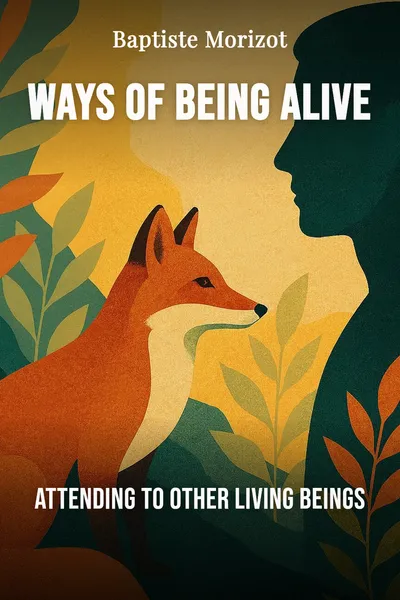
Ways of Being Alive
Attending to other living beings
Description
One winter morning in the mountains of the Haut-Var, in southeastern France, the philosopher Baptiste Morizot kneels in the snow over a set of tracks. Four pads, a wide stride, a clean line through the forest — a wolf passed here a few hours ago. Morizot is not a hunter, not a park ranger, not a wildlife biologist by training. He teaches philosophy at Aix-Marseille University. And yet he spends weeks each year following wolves across the French Alps, learning to read their prints the way one might learn a second language: haltingly at first, then with a growing sense that the forest has been talking all along.
That scene sits at the center of Ways of Being Alive, published in French by Actes Sud in 2020 as Manières d'être vivant and translated into English by Polity in 2022. It became something of a phenomenon in France, well beyond academic circles — carried by readers who felt the book named a discomfort they couldn't quite articulate. The argument is deceptively simple. We tend to describe the ecological crisis in numbers: species lost, hectares burned, degrees warmer. Morizot doesn't dispute the numbers. He suggests they miss something. Underneath the collapse of biodiversity, he argues, there is a quieter collapse — of our capacity to notice, to care about, to feel connected to the living beings around us.
He calls it a crisis of sensibility. And the wolf, hunted to extinction in France by the 1930s and returning on its own paws across the Italian border in the early 1990s, becomes his way in — not as a mascot for wilderness, but as a difficult neighbor we now have to figure out how to live beside.
The question we’re asking : What does it mean to attend to other living beings — and why does Morizot think our failure to do so is the crisis beneath the ecological crisis?What we’ll see : How a philosopher trades the language of loss for the practice of attention, and follows a returning wolf toward a strange new idea: diplomacy between species.
Table of contents
01Chapter 1 — A crisis of sensibility, not just of biodiversity
Morizot's starting point is a suspicion about how we frame the whole thing. When we talk about the environment, we talk like accountants — inventories of what remains, projections of what we'll lose. This isn't wrong, but he thinks it quietly reinforces the very distance that got us here. The living world becomes a stock to be managed, a backdrop to human affairs, a set of resources with a price and a depletion rate. And a world reduced to stock is a world we've already stopped paying attention to.
What has eroded, in his account, is something closer to a faculty. He borrows the phrase "crisis of sensibility" to name it. Over a few centuries, and especially in modern urban life, we have narrowed the range of beings we're able to perceive as fully alive, as having their own ways of experiencing the world. A forest becomes lumber or scenery. A river becomes a resource or a risk. The countless other creatures sharing our territory fade into an undifferentiated green blur we walk through without seeing.

02Chapter 2 — Reading the world as a text we forgot how to decipher
This is where tracking enters, and it's more than a picturesque hobby. For Morizot, following an animal's trace is a philosophical exercise disguised as a walk. A print in the mud is a sign left by a being pursuing its own purposes, and to read it you have to reconstruct those purposes — where was it heading, was it hunting or fleeing, alone or with others, calm or pressed. You're not just identifying a species. You're inferring a mind at work in the landscape, an intention that isn't yours.
He describes tracking as learning to read the world as a text that has always been written and that we simply forgot how to decipher. Every meadow is dense with these inscriptions. The tracker becomes a kind of interpreter, moving between the visible sign and the invisible life behind it, constantly testing hypotheses against the next clue. Sometimes you're wrong. The animal doubles back, the story you'd built collapses, you start again. That humility — the willingness to be corrected by the world — is part of the point.
03Chapter 3 — The wolf as neighbor, not symbol
The wolf is Morizot's central case, and he's careful about why. In French cultural imagination the wolf is almost pure symbol — the fairy-tale predator, the emblem of wild nature, or, on the other side, the livestock-killer that ranchers have every reason to hate. Both readings turn the animal into a screen for human projection. Morizot wants to peel the symbolism away and meet the wolf as what it actually is: a returning neighbor, moving into territory that people also use, with its own social life, its own hunting economy, its own politics within the pack.
The return is real and recent. Wolves recolonized France on their own, crossing from Italy into the Mercantour region in the early 1990s after being absent for roughly sixty years. Nobody reintroduced them; they walked back. And they walked into a landscape now full of highways, ski resorts, sheep, and people who had forgotten how to share ground with a large predator. The result is genuine conflict — flocks attacked, shepherds furious, a bitter public argument between those who want the wolf protected and those who want it gone.
04Chapter 4 — Diplomacy at the edge of the flock
The word Morizot lands on is diplomacy. It sounds almost provocative applied to animals — diplomacy implies negotiation between parties, and wolves don't sign treaties. But he means it more than metaphorically. A diplomat operates between groups whose interests genuinely differ, who won't simply merge, and who must nonetheless find workable arrangements for coexistence. That, he argues, is precisely our situation with the returning wolf, and with the living world more broadly. We are not going to eliminate the other side, and we are not going to fuse with it into harmony. We have to negotiate terms of shared use.
This reframing does real work. It moves past the exhausted opposition between exploiting nature and preserving it untouched — between the rancher who wants the predator dead and the purist who wants humans out of the picture entirely. Both imagine a world cleanly divided into human zones and wild zones. Diplomacy assumes the opposite: interests will keep overlapping, frictions will keep arising, and the task is to craft arrangements that let different forms of life persist alongside each other without one simply erasing the other.
05Conclusion
Back on the ridge in the Haut-Var, the tracks in the snow are still just tracks — four pads, a clean line, an animal that passed a few hours ago and is now somewhere over the next ridge, watching the valley in ways we'll never fully reconstruct. What changes, in Morizot's account, is not the wolf but the person reading its trace. To attend is to grant that the animal is a subject with a life of its own, moving through a territory it shares with us, neither villain nor emblem. The print stops being scenery and becomes an address, a message from a neighbor.
Related books