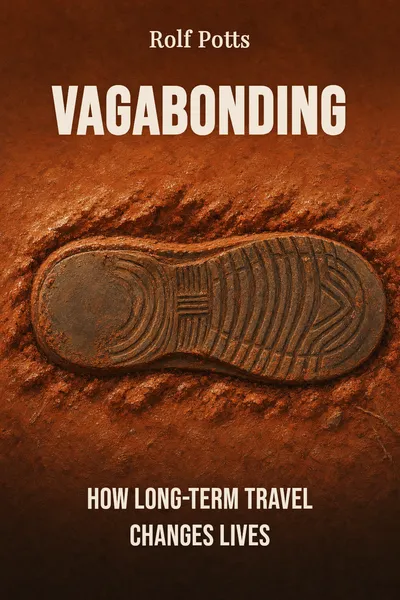
Vagabonding
How long-term travel changes lives
Description
In 2003, a travel writer named Rolf Potts published a slim book with an old-fashioned title borrowed from turn-of-the-century tramps and wanderers. Vagabonding wasn't a guidebook. It didn't tell you which hostel in Bangkok had the cheapest beds or how to haggle for a rug in Marrakech. It made a stranger, larger claim: that taking a long stretch of unstructured time to travel — weeks, months, sometimes years — was one of the sanest, most affordable, most life-altering things a person could do, and that almost nobody does it because we've been taught to believe we can't afford it. Two decades later the book has quietly become a cult object, passed hand to hand, the sort of thing readers say rearranged how they think.
Potts had done the thing himself. In the late 1990s he saved a few thousand dollars teaching English in Korea, then spent eight months wandering Southeast Asia, and later drifted across dozens of countries with no fixed itinerary and no return ticket. What struck him wasn't the exotic scenery. It was how ordinary the whole enterprise turned out to be, and how much of the difficulty had been in his own head — the assumption that long travel belonged to the rich, the young with no obligations, or the reckless. He came home convinced the real obstacle was not money or logistics but a way of seeing.
That's the through-line of the book, and it's why Tim Ferriss, who wrote a later foreword, kept it in his personal top ten: one long trip, taken right, doesn't end when you land. It leaves a residue. It changes the arithmetic of what a life can hold, and it teaches a way of moving through the world that outlasts any single journey.
The question we’re asking : What does Rolf Potts actually mean by vagabonding, and how does a long trip reshape the person who takes it?What we’ll see : How one writer turned wandering into a philosophy of time, money, and coming back different.
Table of contents
01Chapter 1 — Time is the only currency that matters
The book opens by picking a fight with a belief most of us hold without examining it — that long-term travel is expensive, and therefore something we'll do later, when we're richer. Potts turns this on its head. The real cost of vagabonding, he argues, isn't measured in dollars. It's measured in time, and time is the one resource we treat as if we had none to spare, even though it's the only one that's truly ours.
His accounting is deliberately unglamorous. Long travel done simply — buses instead of flights, guesthouses instead of hotels, street food instead of restaurants — often costs less per day than staying home with rent, a car, and the small constant leaks of a consumer life. What we call the cost of travel is usually the cost of trying to travel without changing our habits, dragging the expensive version of ourselves along. Strip that away and a year abroad can cost what a modest year at home costs.

02Chapter 2 — The long road starts at home
Having reframed the cost, Potts turns to the part nobody finds sexy: the months before departure, when a trip is still just an idea competing against every reason to stay. This is where most vagabonding ends, quietly, before it begins. So he treats preparation not as logistics but as a slow act of simplification — earning the money, yes, but more importantly shedding the weight that keeps us tethered.
The earning phase he describes without shame. You take extra work, you cut spending, you sell what you don't need. What's striking is how he frames it as already part of the journey. Learning to live on less at home is the rehearsal for living on less on the road, and it starts to loosen the grip of things you thought you couldn't do without. The car, the subscriptions, the reflex to fill a free afternoon by buying something — travel begins the day these start to feel optional.
03Chapter 3 — On the road, the plan is not to have one
When the trip finally starts, Potts's advice runs against every instinct trained by short vacations. Don't rush. The temptation, with limited time, is to cram — five countries in three weeks, a photograph in front of each landmark. Long travel inverts this. With months ahead, you can afford to stay, to let a place become familiar, to have the kind of slow days where nothing happens and the real texture of a country finally shows up.
This is where his idea of adventure gets unglamorous in a useful way. Adventure, in the book, isn't skydiving or crossing a desert. It's the willingness to walk into uncertainty — to take the local bus with no clear destination, to accept an invitation from strangers, to change plans because something better appeared. The interesting things happen in the gaps between intentions. An itinerary too tightly held leaves no room for the country to hand you what you didn't know to ask for.
04Chapter 4 — Coming back is the harder trip
What lifts Vagabonding above a how-to manual is that Potts refuses to end the story at the airport. The return, he insists, is the strange part — the part travelers rarely warn each other about. You come home changed, but home hasn't changed, and the gap between the two can feel like grief. Friends ask how the trip was and expect a two-minute answer. The self that learned to live on almost nothing, to move slowly, to pay attention, now has to fit back into a life built for a person who no longer quite exists.
Here the book's real argument surfaces. Vagabonding was never only about travel. It was about a way of being that the road makes obvious but that doesn't require a passport. The freedom Potts describes — spending time deliberately, wanting less, staying open, treating the ordinary with attention — is available on a Tuesday in your own town. The trip is a training ground, not the destination. The point is to bring the traveler's eyes home and refuse to switch them off.
05Conclusion
Rolf Potts wrote Vagabonding after coming home from years of drifting and finding that the trip refused to stay in the past. The book that resulted isn't a list of destinations; it's a sustained case that long, unstructured travel is affordable, unglamorous, occasionally miserable, and one of the few reliably transformative things an ordinary person can still choose to do. Its practical advice — earn the time, simplify, slow down, stay open — all leans on a single reframing: that the scarce resource was never money but the willingness to spend our own hours on our own terms.
Related books