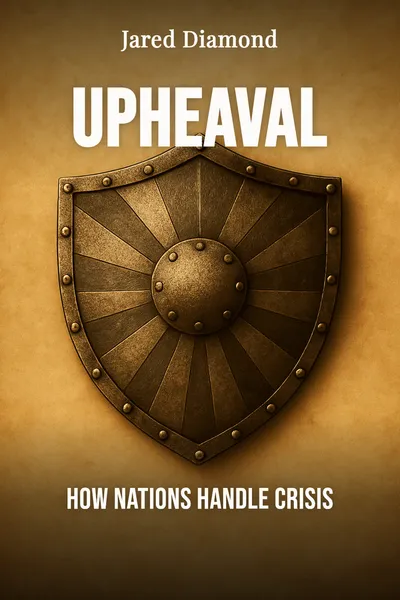
Upheaval
How nations handle crisis
Description
In 2019, at eighty-one, Jared Diamond published a book about national crises that opens somewhere unexpected: a therapist's office. The author of Guns, Germs, and Steel — the man who explained why some continents got rich and others didn't across thirteen thousand years — begins Upheaval not with empires but with individuals in acute distress. People whose marriage collapsed, whose career imploded, whose sense of who they were came apart in a single afternoon. Diamond had spent decades watching this in his own family and among friends, and he noticed something. Some people, handed a personal catastrophe, rebuilt. Others didn't.
From that observation he made a large and deliberately risky move. Crisis therapists, he found, had assembled a rough list of factors that predict whether a person navigates upheaval or drowns in it. Diamond took that list and asked whether it could be scaled up — whether the same criteria that separate a recovering individual from a stuck one might separate a nation that adapts to catastrophe from one that fractures. It is the kind of analogy that makes historians wince and general readers lean in.
The book is built as a set of case studies, nations Diamond knew firsthand, each caught in a moment when the old order stopped working and something had to give. He is not neutral about the results. Some countries in his account handled their upheaval with a clarity that reshaped them for the better; others made changes that never quite finished, or that papered over the wound. What he is after, underneath the histories, is a working checklist — and a warning about the ones every nation keeps failing.
The question we’re asking : Can the way an individual survives a personal crisis tell us anything real about how a whole nation survives its own?What we’ll see : How Diamond reads national catastrophes through the psychology of personal breakdown, and where the comparison holds — and where it strains.
Table of contents
01 Chapter 1 — The book that starts on a therapist's couch
Diamond's starting point is personal crisis, the kind a therapist sees daily. Someone arrives having lost the thing that organized their life, and they either find a way through or they don't. Diamond leans on the work of crisis therapists — he credits his wife, Marie, a clinical psychologist, and the model that emerged from an emergency counseling clinic in the 1960s — to argue that recovery isn't random. It follows patterns.
From that clinical literature he pulls a set of factors, roughly a dozen, that shape whether an individual comes out the other side. The first and most decisive is simply acknowledging that you're in a crisis at all. Denial keeps people stuck. Then comes accepting responsibility to do something rather than blaming circumstances; building a fence around the parts of your life that are failing so they don't contaminate the parts that still work; and, crucially, being honest about which of your traits can change and which are core.

02 Chapter 2 — Finland, Japan, and the art of selective change
Diamond's clearest success stories turn on selective change — keeping what works, altering what doesn't. His favorite is Finland, a country he knew well and returns to as the book's model case. In the Winter War of 1939-40, tiny Finland faced Soviet invasion and fought the vastly larger Red Army to a bloody standstill, losing territory but keeping its independence. What Finland did afterward is the interesting part.
Rather than nurse the grievance or fall into the Soviet orbit, postwar Finland performed a cold-eyed appraisal of its situation. It was a small democracy sharing a long border with a superpower. So it built a foreign policy — later mocked abroad as "Finlandization" — of scrupulously avoiding provocation of Moscow while staying an independent, capitalist democracy at home. Diamond reads this as an almost textbook run of his factors: honest self-assessment, a realistic sense of what could and couldn't be changed, and a refusal to let national pride override survival. Finns absorbed the humiliation of accommodation because they had correctly identified the alternative.
03 Chapter 3 — Chile, Indonesia, and the crises that never fully closed
Not every case in Upheaval resolves cleanly, and Diamond is drawn to the harder ones, where his factors show up incomplete. Chile is his most painful example, partly because he lived there before the collapse and watched a democracy he admired come apart. In 1973, a coup led by General Pinochet overthrew the elected Marxist president Salvador Allende, followed by a dictatorship that tortured and killed thousands. Diamond's discomfort is that he had believed Chile's strong democratic tradition made such violence unthinkable there. It wasn't.
What Chile lacked, in his reading, was compromise — the political version of honest, selective change. Left and right had grown so absolutist that neither would fence off shared institutions from the fight; each treated the other as an enemy to be destroyed rather than a rival to be negotiated with. The polarization made the democracy brittle. And the recovery, when it came, was incomplete: Chile returned to democracy in 1990, but only through a negotiated transition that left much of Pinochet's constitutional order intact, and the country still argues over the unfinished reckoning.
04 Chapter 4 — What a nation borrows from a broken person
The wager under all of Upheaval is that a person and a nation fail and recover in comparable ways — and it's worth sitting with why Diamond risks an analogy he knows specialists distrust. His answer is essentially practical. He isn't claiming a country has a psyche. He's claiming that the questions therapists learned to ask a person in freefall are unexpectedly good at exposing what a country does when its old arrangements stop working. Whether it lies to itself, whether it blames others, whether it can change one thing without changing everything.
The strongest version of his case is that these factors are not really psychological at all but structural, dressed in psychological language. "Honest self-appraisal" in a nation means a political culture that can name a problem out loud without it becoming treason. "Selective change" means institutions flexible enough to reform in parts. "Accepting responsibility" means a public discourse that doesn't route every failure through a foreign enemy. Read that way, the couch was only ever a device for making structural questions feel urgent and human.
05 Conclusion
Diamond ends where he began, with a checklist rather than a verdict. The nations that adapted — Finland facing the Soviets, Meiji Japan facing the West — shared a handful of habits: they admitted the crisis, accepted they had to act, changed boldly in some areas while defending a protected core, and borrowed from others without treating it as defeat. The ones that stalled had lost the capacity to compromise, or buried the wound instead of closing it. None of it was guaranteed by wealth or size; small Finland managed what larger, richer states have not.
Related books