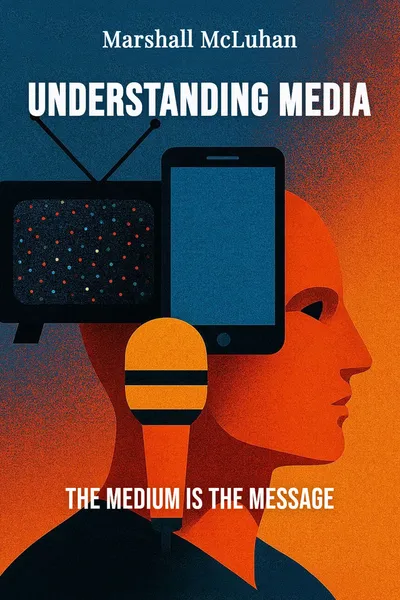
Understanding Media
The medium is the message
Description
In 1964, a professor of English literature at the University of Toronto published a book about electric light, railways, money, comic strips, and the atomic bomb — all in the same breath, all treated as the same kind of thing. His name was Marshall McLuhan, the book was called Understanding Media, and its central claim arrived in the first chapter as a sentence most readers have heard without reading the book: the medium is the message. It sounded like a riddle, and McLuhan did little to soften it. He meant it almost literally.
The idea cut against everything common sense tells us. We judge a television show by whether it's good or bad, a tweet by whether it's true or false, a book by what it says. The content is what we argue about. McLuhan's wager was that the content is the least important thing about any medium — a juicy piece of meat, as he put it, that the burglar carries to distract the watchdog of the mind. What actually changes us is not the program but the television itself: the new scale, pace, and pattern it introduces into how we live. The electric light, which carries no content at all, changes a night shift, a surgery, a ballgame — and that, for McLuhan, was the whole lesson in miniature.
Sixty years on, we live inside his argument more than any generation he could have imagined, scrolling feeds we judge by their posts while the scrolling itself quietly reorganizes our attention. It's worth going back to what he actually wrote, because the slogan has long since detached from the thinking underneath it.
The question we’re asking : When McLuhan says the medium is the message, what exactly is the message — and why is the content a decoy?What we’ll see : How a professor of literature came to read light bulbs and railways as the real agents of change, and what he thought they were doing to us.
Table of contents
01Chapter 1 — The content is a decoy
McLuhan builds his case on a deceptively plain example. The electric light is pure information, he writes, a medium without a message — unless someone uses it to spell out a brand name. Nobody studies electric light the way they study the content of a newspaper, and yet the light bulb has reshaped human life more thoroughly than almost any article ever printed in one. It abolished the old boundary between day and night, indoors and outdoors, work time and rest time. The point is that the effect had nothing to do with any message the light carried, because it carried none. The effect was the medium itself, entering a society and rearranging the rhythms of the people in it.
From there McLuhan makes his move: the content of any medium is always another medium. The content of writing is speech, the content of print is the written word, the content of the telegraph is print. We fixate on that inner layer — the words, the story, the argument — and miss the outer container that is doing the real work. This is why, he says, the content of a medium blinds us to its character. We're so busy evaluating what's on the screen that we never ask what the screen is doing to us.

02Chapter 2 — Hot and cool, and why it matters
Having argued that the medium is the message, McLuhan needs a way to tell media apart — and the distinction he reaches for is one of the stranger ideas in the book. He sorts media into hot and cool. A hot medium is high in definition: it floods one sense with data and leaves little for the audience to fill in. A photograph is hot, a cartoon is cool. Radio is hot, the telephone is cool. Print is hot, speech is cool. The vocabulary feels arbitrary at first, and McLuhan half-admits it is a provisional tool, but he puts real weight on it.
The payoff is in a single word: participation. Because a cool medium gives us so little, it demands that we complete it, pulling us in, making us work to fill the gaps. A hot medium does the work for us and leaves us relatively passive. This is why, McLuhan argues, the same content lands completely differently depending on the temperature of its carrier. He claims the televised Kennedy–Nixon debates of 1960 are a case in point: a cool medium, television, favored the cool, understated Kennedy, while the hotter, harder-selling Nixon came across better on radio. The content of the debate was identical. The medium decided who won.
03Chapter 3 — Every medium extends a part of us
The book's subtitle is The Extensions of Man, and it carries the second half of McLuhan's argument. Every medium, every technology, is an extension of some human faculty, a part of the body or nervous system pushed out into the world. The wheel extends the foot. Clothing extends the skin. The printed book extends the eye. And electric technology — this is his great leap — extends not a single organ but the central nervous system itself, wrapping the whole globe in a web of instant connection. The tools are not neutral add-ons. They are us, projected outward and amplified.
This reframes what a medium does. When we extend a faculty through a technology, we also alter the balance among our senses — the ratio, McLuhan calls it, between seeing and hearing and touching. Oral cultures, tuned to the ear, live in a world of simultaneous, surrounding sound. Print, by pouring experience through the eye in uniform lines of type, trained Europe into a new kind of linear, sequential, detached thinking. It encouraged individualism, specialization, the ability to act without reacting. For McLuhan the phonetic alphabet and the printing press didn't just record thought. They reorganized the Western sensorium and, with it, the Western self.
04Chapter 4 — The numbness that lets it happen
If the medium is really the message, one question hangs over the whole book: why don't we see it? McLuhan's answer is the quiet center of Understanding Media, and it is not flattering. We don't notice what media do to us because the very process that reshapes our senses also anesthetizes them. He reaches for the myth of Narcissus, reminding us that Narcissus did not fall in love with himself — he failed to recognize his own reflection as an extension of himself, and was numbed by it. We do the same with our technologies, mistaking the extensions of our own nervous systems for an outside world we merely observe.
This numbness, for McLuhan, is not a weakness to be scolded but a defense mechanism. Any extension of ourselves is a kind of self-amputation, and the nervous system protects itself from the shock by going numb precisely at the point of extension. That's why the effects of a new medium are so hard to perceive from inside it: the medium that is changing us is also the one dulling our ability to notice the change. We feel the content vividly and the form not at all, which is exactly the trap the burglar's meat was meant to set.
05Conclusion
McLuhan started with a light bulb that carries no message and still changes everything, and that image holds the whole argument. The content we fight about — the show, the post, the headline — is the decoy. The real event is the medium entering our lives and quietly resetting the scale, the pace, the balance of our senses, extending some faculty outward and numbing us to the trade. Hot or cool, the medium pulls our nervous system into a new shape, and the shape is the message.
Related books