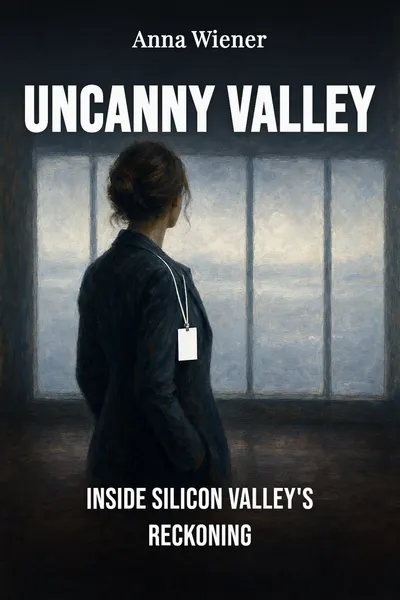
Uncanny Valley
Inside Silicon Valley's reckoning
Description
Around 2013, a twenty-five-year-old assistant at a small literary agency in New York was earning roughly $29,000 a year and watching her friends drift toward something that felt, at the time, like the future. Anna Wiener had wanted to work with books since she was a child. She was good at it. She was also broke, restless, and quietly convinced that the industry she loved was contracting around her. So she did what a lot of ambitious, uncertain people her age were doing: she looked west, toward the companies that seemed to be printing money and meaning at the same time.
Within a couple of years she had left publishing entirely, moved to San Francisco, and taken a job in customer support at a fast-growing data-analytics startup — one of those companies everyone in tech knew and nobody outside it could quite explain. She arrived in the middle of a boom that was rewiring the city: the free lunches, the equity packages, the men in their late twenties who talked about changing the world while building tools to track everyone in it. She was inside now. She just wasn't sure what she was inside of.
That gap — between the industry's story about itself and what it actually did all day — is the spine of her memoir, Uncanny Valley, published in 2020. Wiener writes as someone who wanted to belong, got what she wanted, and slowly realized what it cost. Hers is not an exposé from the outside. It's the far stranger view from a desk in the middle of the thing.
The question we’re asking : What does a boom look like from the inside, when you're close enough to enjoy it and just far enough to doubt it?What we’ll see : A young woman's move into the tech industry at its most self-assured, and the slow souring of a promise she never quite believed.
Table of contents
01 Chapter 1 — Twenty-five, broke, and looking for meaning
Wiener frames her departure from publishing not as a bold pivot but as a kind of surrender to gravity. She was underpaid, undervalued, and watching an entire generation of educated millennials arrive at the same conclusion at roughly the same moment: the industries they'd been raised to want were shrinking, and the money — and, more seductively, the sense of relevance — had migrated somewhere else. Tech wasn't just hiring. It was promising that work could matter again, that a job could be a mission. For someone stuck and a little lost, that pitch landed hard.
Her first move was a brief, doomed stint at an e-reading startup in New York, a company that wanted to do for books what streaming had done for music. It failed the way most of them do, quietly and expensively. But it gave her the vocabulary and the appetite. So when the offer came to move to San Francisco and join a data-analytics company as a customer-support rep, she took it, even though the role was junior and the product opaque and she was, by her own admission, faking a fluency she didn't have.

02 Chapter 2 — The syntax of a world that ran on data
Wiener has an ear for the way the industry talked, and she uses it like a scalpel. The prose in Uncanny Valley is famous for how precisely it renders tech-speak — the frictionless, the seamless, the deeply passionate, the down for whatever. People didn't have conversations; they had one-on-ones. They didn't disagree; they had healthy debates. The language was engineered to sound open while foreclosing dissent, and she noticed that the words were doing quiet ideological work long before she could say what that work was.
Her job put her at the exact seam between the company and its customers, which meant she saw what the product actually did. The startup sold analytics tools that let other companies track, in granular detail, how users behaved inside their apps — every tap, every hesitation, every scroll. On the support side, that meant her colleagues could, and sometimes did, look at individual users' data almost casually. The surveillance wasn't sinister in tone. It was cheerful, ambient, treated as a feature. That was the unsettling part.
03 Chapter 3 — The camaraderie that was also a leash
One of the book's sharpest observations is that startup culture didn't demand loyalty so much as it manufactured it. The perks — the catered meals, the offsites, the equity that might someday be worth something — were not really generosity. They were a way of dissolving the boundary between life and work until leaving the office at a reasonable hour felt like a small betrayal. People spoke of their companies as families, and Wiener registers both the warmth of that and the trap inside it. Families are hard to quit.
She watches founders acquire the bearing of minor royalty. The men running these companies were often young, often technically brilliant, and often convinced that their competence in one narrow domain qualified them to have opinions about everything. The confidence was total and unearned in equal measure, and the money flowing in only confirmed it. Around 2015 and 2016, as valuations ballooned and the industry's cultural power grew, that confidence began to look less like optimism and more like a governing philosophy nobody had voted for.
04 Chapter 4 — What the memoir refuses to let us forget
Step back from the ski trips and the speakeasy, and Uncanny Valley is really a book about complicity — the ordinary, non-villainous kind. Wiener was never the person designing the surveillance tools or setting the company strategy. She was in support, in a female-coded role, at the bottom of the status hierarchy. That distance is exactly what makes her testimony valuable. She wasn't in the room where the harm was decided. She was in the room where it was quietly maintained, and she took the paycheck, and she is unsparing about what that made her.
The book's lasting move is to refuse the two comfortable positions available to anyone writing about tech. It won't play the triumphant insider who cashed out and calls it vision, and it won't play the pure critic who was never tempted. Wiener occupies the uncomfortable middle: someone who saw the trouble coming, understood it well enough to name it, and stayed anyway, because the work was absorbing and the money was real and leaving is harder than knowing. That honesty implicates a whole generation of educated young people who poured into the industry for the same mix of reasons.
05 Conclusion
The woman who left publishing at twenty-five for a support job she barely understood came out the other side with something the industry rarely produces: a clear-eyed account of what it was like to be there while it happened. Wiener eventually left operational tech work for writing, and Uncanny Valley reads like the report she could only file once she was out. It doesn't pretend she was a victim, and it doesn't pretend she saw everything coming. It just refuses to look away from her own place in the picture.
Related books