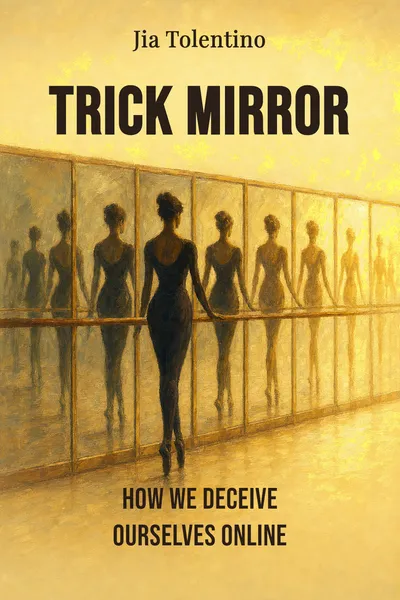
Trick Mirror
How we deceive ourselves online
Description
In her early twenties, Jia Tolentino wrote most of her days into being on the internet before she was fully awake, and she knew it. By the time her first book arrived in 2019, she had already lived through a strange sequence of American initiations: a childhood in a Houston megachurch, a teenage stint on an early reality show filmed in Puerto Rico, a Peace Corps posting, and then the fast rise to staff writer at the New Yorker. Trick Mirror gathers nine essays out of that biography, but it is not a memoir. It is a report from inside the machinery, written by someone who admits she is one of the machine's most fluent operators.
The title is the argument. A trick mirror is a surface built to flatter or warp whoever stands in front of it, and Tolentino's wager is that most of the environments we now move through — the feed, the wellness studio, the wedding, the market for outrage — are trick mirrors of exactly this kind. They return an image of the self that feels true and is designed to sell. What makes the book unnerving is that she does not exempt herself. She writes as a participant, not a scold, someone who scrolls and buys and performs alongside everyone else and then tries, in prose, to name what is happening while it happens.
That doubled position — implicated and lucid at once — is what gives the collection its charge. Tolentino writes in the lineage of Didion and Sontag, essayists who used the first person as an instrument rather than a confession, and she brings a warmth those two rarely allowed themselves. The result is a book about self-deception that refuses the easy exit of pretending the writer stands outside it.
The question we’re asking : What does it mean to see clearly when the surfaces we live inside are built to distort us?What we’ll see : How one writer traces her own coming of age through an internet, a self and a culture all engineered to flatter and mislead.
Table of contents
01Chapter 1 — The mirror that never turns off
The opening essay, "The I in the Internet," is the load-bearing wall of the book. Tolentino sketches a short history of the web she grew up on — the early personal sites, the message boards, the sense that going online was a thing you did and then stopped doing. Somewhere around the turn of the 2010s, she argues, that changed. The internet stopped being a place you visited and became the medium you lived inside, always on, always addressed to you. The feed, in her telling, does something specific to the self: it demands a constant performance of identity, and it rewards the performance with attention rather than truth.
She is precise about the mechanism. Social platforms are built to make self-expression profitable, which means they quietly convert every opinion, every grievance, every act of solidarity into content that generates engagement. The design incentive is not honesty but reaction. Tolentino watches herself post and recognizes the reflex: the small dopamine of being seen, the way outrage travels faster than nuance, the way even genuine political feeling gets flattened into a shareable pose. The mirror flatters by telling you that your visible self is your real self, and that performing virtue is close enough to practicing it.

02Chapter 2 — The self as a product to be optimized
If the internet trains us to perform the self, the wellness and beauty economy trains us to renovate it. In "Always Be Optimizing," Tolentino turns to the machinery of self-improvement aimed at women: the barre class, the athleisure, the green juice, the endless labor of becoming a more efficient, more marketable version of yourself. She names the ideal figure this culture produces — the woman who has made her body and her habits into a well-managed asset — and shows how the work of maintaining her is presented not as pressure but as empowerment.
Her sharpest move is refusing the language of pure critique. Tolentino does the barre class. She likes the way it makes her feel. She buys the leggings and eats the salad and understands the appeal from the inside, which is what makes her account of the trap so credible. Optimization sells itself as freedom — you are choosing this, you are investing in yourself — while quietly narrowing what a self is allowed to be. The reward for compliance is real: you feel capable, disciplined, in control. The cost is that the standard keeps moving, so the labor never ends.
03Chapter 3 — A culture that rewards the con
The most entertaining thread of the book is Tolentino's fascination with the American scammer. In "The Story of a Generation in Seven Scams," she reads her own coming of age through a sequence of frauds and quasi-frauds — the student-debt machine, the 2008 financial collapse, Fyre Festival, Billy McFarland, the whole ecosystem of confident hustlers selling something that does not exist. Her generation, she argues, came up in an economy where the scam was not an aberration but a business model, and where the line between entrepreneur and con artist grew genuinely hard to draw.
The insight is that scamming and self-branding run on the same fuel. The successful American scammer projects a version of the self so persuasive that reality is expected to catch up later. That is also, she notes, the operating logic of the influencer, the startup founder, the personal brand — sell the image now, deliver eventually, or never. In a culture that treats the confident self-presentation as proof of value, the con is not a deviation from the norm. It is the norm running at full throttle.
04Chapter 4 — Nine essays, one warped room
Step back from the individual essays and Trick Mirror reveals its single sustained claim. Across the megachurch of her childhood, the ecstasy of drugs and religion, the reality-TV set, the elaborate modern wedding, the marriage plot in literature, and the difficulty of writing about assault, Tolentino keeps arriving at the same structure. The self is never encountered directly. It is always mediated by a surface — a screen, a market, a genre, an audience — and every one of those surfaces has an interest in returning a distorted image.
The book's honesty is that it refuses to locate a clean self hiding behind the distortions. Tolentino does not believe there is an authentic Jia waiting to be recovered once the internet is switched off and the leggings are returned. The environments have done their work; the self has formed in and through them. This is what separates her from the moralist. She is not urging us to step out of the trick mirror and see truly. She suspects there is no such vantage point available, only the ongoing effort to name the warp while standing inside it.
05Conclusion
Trick Mirror ends where it begins, with a writer implicated in everything she describes. Tolentino never claims the high ground. She scrolls, she optimizes, she performs, she half-believes the images the culture returns to her, and her achievement is to hold that participation in view while dissecting it. The nine essays do not resolve into advice. They accumulate into a portrait of a moment — roughly the 2010s in America — when the self became both the central subject and the primary product, and when telling the two apart got genuinely hard.
Related books