Theory of Restoration
The ethics of repairing art
Description
In the late 1930s, a young Italian art historian named Cesare Brandi found himself standing in front of damaged paintings that everyone agreed needed help, and nobody agreed on how to give it. Some conservators wanted to repaint the missing patches so the picture looked whole again. Others wanted to leave the wounds visible, out of respect for what remained. Brandi, who in 1939 became the first director of the newly founded Istituto Centrale del Restauro in Rome, spent the next two decades watching these fights up close. In 1963 he gathered his lectures into a slim, dense book called Teoria del restauro — the closest thing the field has to a constitution.
His starting point was almost aggressively simple. Before we can decide how to repair a work of art, we have to decide what a work of art actually is. A broken chair and a broken fresco are not the same kind of broken. Fix the chair and you have a working chair again. Fix the fresco the same way — fill the gap, match the colors, make it seamless — and you may have destroyed the very thing you were trying to save. Restoration, for Brandi, was not a craft of making things look new. It was a philosophical act with consequences that outlive the restorer.
The book has since become required reading from Rome to Los Angeles, quoted by people repairing cracked panels, cleaned ceilings, and crumbling ruins. What it offers is not a set of recipes but a way of thinking — a demand that every hand touching an old object first ask what it owes to that object, and to everyone who will see it later.
The question we’re asking : When a work of art is damaged, what exactly are we trying to save — and what gives anyone the right to decide?What we’ll see : How Brandi turned repair from a technical trade into a doctrine with a single unbending rule at its heart.
Table of contents
01Chapter 1 — The painting is not a chair
Brandi's whole argument hangs on a distinction he draws early and never lets go of. Most objects in the world are what he calls products of industry: a hammer, a shoe, a chair. Their value is their function. If a chair breaks, we repair it to sit on it again, and once it works, the job is done. Nobody mourns the original wood if a replacement leg holds your weight. The object exists to be used, and use is the only test that matters.
A work of art is different in kind, not just in degree. Its value is not in what it does but in what it is — a unique thing made at a particular moment by a particular hand, carrying meaning that cannot be transferred to a copy. You cannot swap in a new fragment of a Piero della Francesca the way you swap in a new chair leg, because there is nothing generic about it. Every square inch is the thing itself. This is why Brandi insists that restoration must begin not with tools but with recognition: the moment we recognize an object as a work of art, we take on obligations we do not have toward a chair.

02Chapter 2 — Two moments the eye must hold at once
Brandi says a work of art lives in two moments at the same time, and any honest restoration has to serve both. The first is the aesthetic moment — the work as an image, as something made to be seen and felt. The second is the historical moment — the work as an object that has traveled through time, been handled, aged, cracked, darkened, survived. A canvas is not only the picture the artist intended; it is also a piece of matter that carries the marks of the centuries it has passed through, and those marks are not lies to be scrubbed away.
The problem is that these two demands pull in opposite directions. Serve the image alone and you are tempted to erase every sign of age, to return the picture to an imagined day of completion — a day that is gone and cannot be recovered without inventing it. Serve the history alone and you risk turning a painting into a mere relic, a document nobody can actually see as a work anymore, buried under grime and damage. Brandi's demand is that neither moment be sacrificed to the other. The restorer stands between them and must not lie to either.
03Chapter 3 — The lacuna, and what fills it
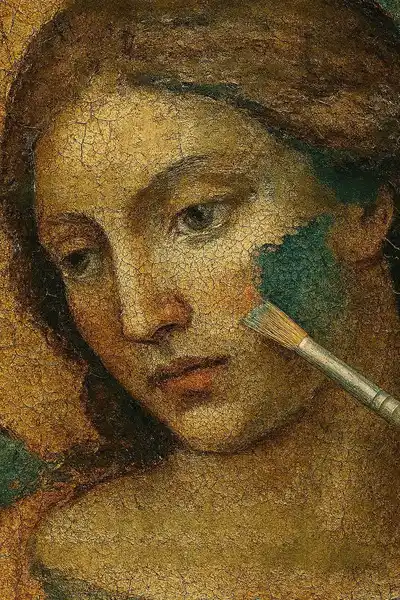
The sharpest test of the whole doctrine is what Brandi calls the lacuna — the gap, the missing patch where paint has flaked off, a fresco has fallen, a corner has been lost. Everyone who has ever stood in front of a damaged painting knows the discomfort. The eye snaps to the hole. The white plaster or bare wood interrupts the image and seems to shout for attention, breaking the very thing the picture was trying to be. The instinct is to fill it and move on.
But how? Fill it by repainting what was probably there, and you invent history — you put your own hand where the artist's used to be, and future viewers will not be able to tell the difference. Leave it bare and stark, and the gap dominates, pulling the image apart. Brandi's answer, worked out with his colleagues in Rome, is one of the most elegant ideas in the field. The gap must be treated so that it recedes — so it stops competing with the image — without ever pretending to be part of it.
04Chapter 4 — Reversibility as a promise to the future
Underneath every rule Brandi lays down runs one principle that ties them together: whatever the restorer does must be undoable. The materials used to consolidate, to fill, to retouch should be chosen so that a later hand can remove them without harming what lies beneath. Reversibility is not a technical footnote. It is the ethical center of the whole doctrine, the point where his philosophy becomes a duty.
The reasoning follows directly from that definition in the first chapter — restoration exists to transmit the work to the future. If the present belongs to the work only as a moment of passage, then the present restorer has no right to make permanent decisions. Our knowledge is partial. Our taste is dated. The methods we trust today may look crude or mistaken in fifty years, exactly as nineteenth-century repaintings look to us now. To bind a future generation to our choices, in materials that cannot be undone, is to steal from people not yet born the right to see the work with better eyes and better tools.
05Conclusion
Brandi died in 1988, but the institute he founded in Rome kept training the conservators who would carry his rules into the cleaning of the Sistine ceiling and the repair of works scarred by war and neglect. His thin 1963 book outlasted the specific controversies that produced it because it never really answered a technical question. It answered a moral one: what do we owe to the objects we did not make and will not keep? Recognize the work for what it is, serve its beauty and its history at once, confess every intervention rather than disguise it, and above all, do nothing that cannot be undone.
Related books