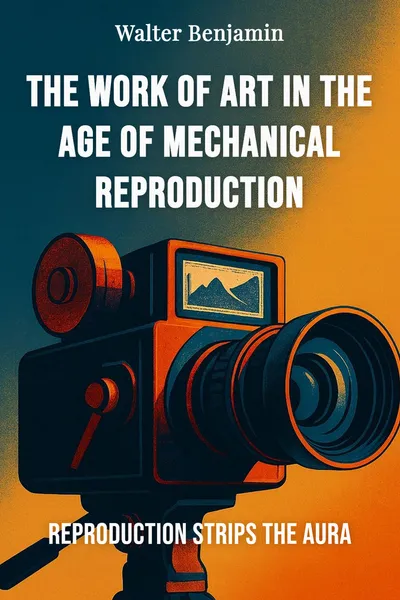
The Work of Art in the Age of Mechanical Reproduction
Reproduction strips the aura
Description
In the mid-1930s, a German-Jewish critic named Walter Benjamin sat down to work out why a photograph of a cathedral felt so different from standing in front of the cathedral itself. The essay he produced, drafted around 1935 and revised over the following years while he was in exile from the Nazi regime, carries a title that sounds like a seminar handout: The Work of Art in the Age of Mechanical Reproduction. What it actually contains is one of the sharpest arguments ever made about what happens to art once machines can copy it endlessly. Photography, then film, had made reproduction not just possible but ordinary. Benjamin wanted to know what got lost, and what got made, in the copying.
His answer turned on a single word: aura. There is something about an original — a painting hanging where it was hung, a statue in the temple it was carved for — that no reproduction carries. Benjamin called it the aura, and he argued that mechanical reproduction strips it away. That sounds like nostalgia, the lament of a man watching the old masters get printed on postcards. It is the opposite. Benjamin thought the loss of aura might be the most hopeful thing that had happened to art in centuries — and, at the same time, one of the most dangerous.
He was writing as Europe slid toward war, watching a regime turn torchlit rallies and cinema into instruments of power. The essay is not really about postcards. It is about what art becomes when it stops being sacred and starts being everywhere, and about who gets to use that shift, and for what ends. Benjamin died fleeing the Nazis in 1940. The essay outlived him and became one of the founding texts of how we think about media.
The question we’re asking : What does mechanical reproduction take from a work of art, and what does that loss set free?What we’ll see : How Benjamin's idea of aura reframes photography, film and, in the end, the way politics itself gets staged.
Table of contents
01Chapter 1 — The thing you can't photograph
Start with the word Benjamin builds everything on. Aura, in his account, is the peculiar presence of a work that exists in one place, at one time, with its own history stretching behind it. He gives a famous definition that sounds almost like a riddle: the aura is the unique appearance of a distance, however near the thing may be. Stand at the foot of a mountain range on a summer afternoon, follow the line of a branch that throws its shadow over you, and you feel it — a here-and-now that no image reproduces. A work of art has that same quality. It is embedded in a specific spot in the world, and it bears the marks of everything that has happened to it since it was made.
Two things give a work its aura, in Benjamin's telling. The first is authenticity — the fact that this canvas, this bronze, is the original and not a copy, with a documented physical existence that a chemical test or a provenance record can trace. The second is what he calls its place in tradition. For most of history, art was bound up with ritual: the statue lived in the temple, the icon in the church, the fresco on the wall of a chapel. Its value came first from being there, part of a cult, seen by the faithful in the setting it was made for. You did not download the Madonna. You made a journey to where she was.

02Chapter 2 — What copies do to originals
Reproduction is not new, Benjamin is careful to note. Casts, woodcuts, engravings, coins — humans have been copying artefacts for a very long time. What changed was scale and kind. Photography, arriving in the nineteenth century, freed the hand entirely and handed the work of reproduction to the lens. For the first time, a machine could capture a work faster and more faithfully than any engraver, and could do it in numbers without limit. The copy stopped being a labor-intensive homage and became an industrial output. That quantitative jump, Benjamin argues, produces a qualitative change in what art is.
The deepest change is in the work's function. As long as art carried an aura, its worth rested on what Benjamin calls cult value — its role in ritual, its being kept, half-hidden, in a sacred setting. Some medieval statues of the Virgin stayed veiled most of the year; certain images in a temple were meant to be seen only by the priest. Their power lay partly in not being seen. Reproduction inverts this. It pushes art toward exhibition value — worth measured by how widely it can be shown, displayed, circulated. A photograph exists to be seen by as many people as possible. The whole gravity of the work shifts from being present to being visible.
03Chapter 3 — Film, or the actor who performs for a machine
If photography strips the aura, film is where Benjamin sees the new order fully arrive — a medium that could not exist without reproduction and never pretends otherwise. There is no original print of a film hanging in a museum for the faithful to visit. The film exists to be copied and shown, a thousand identical reels in a thousand cinemas. It is exhibition value with nothing left over. This is why Benjamin treats film not as a lesser art but as the characteristic art of the reproductive age, the one that shows us what the others are becoming.
He is fascinated by what film does to the actor. On stage, a performer stands before a living audience, aura intact, present in the same room. In front of a camera, the actor performs for a machine. There is no audience to respond to, only a lens, and the performance is chopped into fragments, shot out of order, assembled later by editors the actor never meets. The finished screen presence is a construction, stitched from pieces. Benjamin notes the strange compensation the film industry builds in response — the cult of the movie star, the manufactured glamour of the personality, an artificial aura conjured up precisely because the genuine one is gone.
04Chapter 4 — When the crowd learns to see itself
Here is where Benjamin's essay stops being about art and becomes about power. The whole argument has been building toward a political fork. Once art loses its aura and its footing in ritual, it can no longer draw authority from the sacred. Its new ground, Benjamin says, is politics. The question is not whether reproductive art will be political but which politics it will serve — and he sees two roads opening from the same technological fact.
The first road is the one he hopes for. Film addresses a mass audience; it can turn that mass into something aware of itself, capable of examining its own conditions. A camera that dissects reality can also expose it, hand people images of their own lives and work, let a collective test the world rather than worship it. This is what Benjamin means when he gestures toward a communist or emancipatory use of the medium — art that serves the many by making them the subject rather than the spectacle. The withered aura clears the ground for an art without priests.
05Conclusion
Benjamin ends the essay with a sentence that has echoed ever since. Fascism, he writes, renders politics aesthetic; communism responds by politicising art. He wrote it as a man in exile, watching a regime turn cinema and spectacle into instruments of conquest, and he did not live to see how the story ran — he died in 1940 at the French-Spanish border, fleeing the Gestapo. The essay he left behind had traced a clean line from the photograph of a cathedral to the torchlit rally, arguing that both grow from the same root: the machine that copies.
Related books