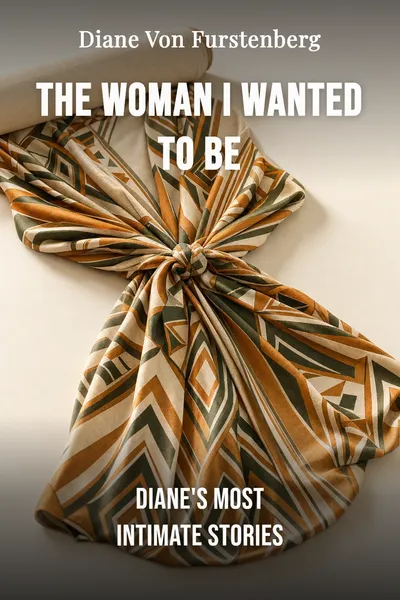
The Woman I Wanted to Be
Diane's most intimate stories
Description
On a spring day in 1970, a twenty-three-year-old Belgian woman walked into a New York showroom carrying a suitcase of jersey samples she had produced in a factory in Italy. She was pregnant, married into European aristocracy, and utterly unknown in American fashion. Within a few years, the dress she was about to build — a simple wrap of printed jersey that tied at the waist — would sell in the millions, land her on the cover of Newsweek, and turn her name into a household word. Diane von Furstenberg had arrived with almost nothing but a conviction about who she intended to become.
The memoir she published decades later, in 2014, is not the tidy success story that headline suggests. It is a woman looking back at seventy-plus years and refusing to smooth the edges. The wrap dress made her rich, then the business nearly bankrupted her; the marriage that gave her a princely title dissolved; the name she had made famous slipped out of her control and took years to win back. Between the triumphs sit divorces, a cancer diagnosis, financial collapse, and the long shadow of a mother who survived Auschwitz and raised her daughter to be fearless.
What holds the book together is not the clothes or the fame but a single idea Diane keeps returning to: that a life can be authored, that the woman she wanted to be was a project she worked at deliberately, choice by choice, mistake by mistake. She writes about family, love, beauty and money with the candor of someone who has stopped performing.
The question we’re asking : How does a woman decide who she wants to be, and then spend a lifetime becoming her?What we’ll see : A life told through the mother who shaped her, the dress that made her, the name she lost and reclaimed, and the belief that ties it all together.
Table of contents
01 Chapter 1 — The daughter of a survivor
Diane Halfin was born in Brussels in 1946, eighteen months after her mother, Liliane, walked out of a concentration camp weighing about fifty-nine pounds. Doctors had warned Liliane not to conceive so soon; a body that starved was not a body that should carry a child. She did it anyway. Diane grew up understanding that her own existence was, in her mother's telling, an act of defiance against everything that had tried to erase them both.
Liliane's parenting was severe and deliberate. She refused to let her daughter be afraid of the dark, locking her in a closet until fear lost its grip, then rewarding the courage. Fear, she taught, was not permitted — not because life was safe, but because fear was a luxury a survivor could not afford. "God saved me so that I could give you life," she told her. "By giving you life, you gave me my life back." It is a heavy inheritance to hand a small girl, and Diane carries it through the whole book as both burden and armor.

02 Chapter 2 — The wrap dress and the woman inside it
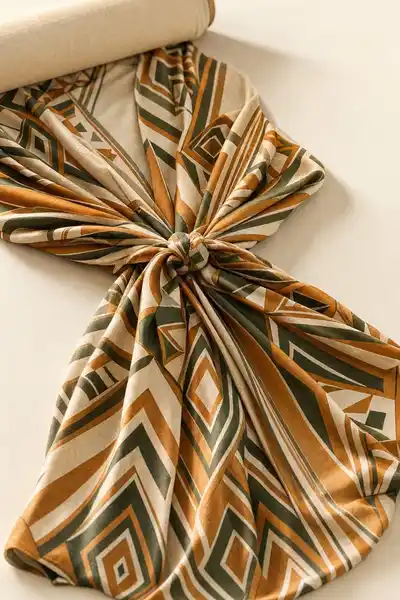
The wrap dress was, on the surface, almost nothing: a piece of printed cotton jersey, no buttons, no zippers, that a woman tied around herself and walked out the door. Diane launched it in the early 1970s and it became a phenomenon — by 1976 she was selling tens of thousands a week, and the dress ended up in the Metropolitan Museum's collection. But she is clear that she was never really selling fabric. She was selling a proposition about how a woman could live.
The context matters. This was the moment women were pouring into offices, into meetings, into lives their mothers had not led. They needed clothes that let them move through a working day and still feel like themselves at night. The wrap dress did that without asking permission from anyone. You could pull it on in the morning, and — as the era's whisper went — slip out of it just as easily. Diane wrote that she wanted women to feel confident and free, and the garment was engineered around that feeling rather than around a silhouette.
03 Chapter 3 — Losing the name, finding the self
Success on that scale rarely holds its shape, and Diane's did not. The wrap dress had been so ubiquitous that the market flooded and then turned; the business overextended, and by the early 1980s the empire that had made her famous was in serious trouble. She had also licensed her name widely — cosmetics, luggage, all manner of products stamped with von Furstenberg — and in doing so she gradually lost control of what her own name meant. The label was everywhere and, in the process, stood for less and less.
She writes about this period without self-pity but without hiding the wound either. To build a name and then watch it drift out of your hands is a particular kind of loss, because the name is not just a business asset — it is you. She had made "Diane von Furstenberg" mean confidence, freedom, a certain kind of woman. Watching it become a discount fragrance felt like watching a stranger wear her face. She stepped back, spent years partly in Europe, wrote, mothered, mourned relationships and, at one point, faced a diagnosis of tongue cancer that she confronted with the same refusal of fear her mother had drilled into her.
04 Chapter 4 — What it means to author a life
Step back from the dresses and the divorces and the balance sheets, and the book is really about a single conviction: that a life is something you write rather than something that happens to you. Diane returns again and again to the difference between the woman she wanted to be and the circumstances she was handed, and she insists the first is a choice. The circumstances included the Holocaust in her family's past, a fashion industry that did not expect women to run companies, and a body that got sick. None of it dictated who she became.
She frames beauty, love and work not as achievements to collect but as raw materials for that authorship. Beauty, for her, is confidence made visible — not a face but a way of carrying oneself, which is why the wrap dress was about feeling rather than flattery. Love she treats as something to be entered fully and released without bitterness; she writes warmly of the men in her life, including a long partnership and eventual marriage to Barry Diller, without pretending relationships owe anyone permanence. Work is where she proved to herself that she could stand alone.
05 Conclusion
The suitcase of jersey samples that Diane carried into a New York showroom in 1970 turned out to hold more than a product. It held a wager she was making about her own life — that she could decide, in advance, the kind of woman she meant to become, and then spend decades earning her way into that picture. The wager paid off, then failed, then paid off again, and the memoir refuses to pretend any of it was smooth. What survives all the reversals is the wager itself.
Related books