
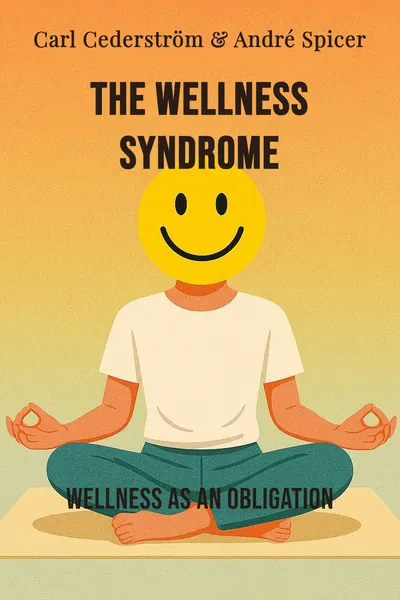
The Wellness Syndrome
Wellness as an obligation
Description
There's a moment familiar to almost anyone with a desk job: the annual health drive arrives, the office fills with fitness trackers, a Slack channel appears for step counts, and a poster in the break room announces that a healthier you is a happier you. Nobody forces you to join. And yet not joining starts to feel like a small confession — that you don't care enough, about yourself or, somehow, about the team. In 2015, two organizational scholars, Carl Cederström and André Spicer, gave this creeping pressure a name. They called it the wellness syndrome, and they meant it as a diagnosis of the culture, not of the person on the scale.
Their argument is that wellness has quietly changed register. It used to be one option among many, a private pursuit like any hobby. Now it operates more like a command — an ideology so thoroughly absorbed that we experience it as our own free desire. Eating clean, staying fit, thinking positive, managing stress: these read as acts of self-care, but Cederström and Spicer track how they double as acts of compliance. The healthy, optimized, upbeat individual has become a kind of moral ideal, and falling short of it now carries a whiff of shame that older societies reserved for very different sins.
What interests them is less the gym or the green smoothie than the machinery that made both feel obligatory — the workplaces, the apps, the language of positivity that turned looking after yourself into a duty you can never quite discharge. They are not against health. They are curious about what happens to a society when health stops being a means to a good life and becomes the measure of a good person.
The question we’re asking : How did looking after ourselves turn from a private choice into a moral obligation we can't refuse?What we’ll see : How wellness became a verdict on character, a workplace expectation, an endless personal project, and a way of quietly moving responsibility off institutions and onto us.
Table of contents
01Chapter 1 — The healthy body as a moral verdict
Cederström and Spicer open with a shift in how we read the body. For most of history, health was understood as luck, fate, or the hand of a physician — something that happened to you. Today it reads as a report card. A trim, energetic, well-slept body signals discipline, self-respect, employability. A heavier or exhausted one invites suspicion: someone who has let themselves go, who lacks willpower, who can't be trusted to manage anything if they can't manage their own weight. The scale, in this telling, stopped measuring pounds and started measuring character.
The authors trace how this collapses an old distinction. We used to separate the moral from the medical — sin from sickness. Wellness culture fuses them back together. Being unhealthy becomes not just unfortunate but faintly disgraceful, a failure of the self rather than a fact about circumstances. They point to the way smoking, sugar, and sitting are increasingly moralized, discussed less as risks than as vices. The healthy body becomes proof of virtue, and virtue becomes visible on the surface of the skin.

02Chapter 2 — When the office prescribes happiness
The place where wellness turns most clearly into obligation, the authors argue, is work. Corporate wellness programs — screenings, gym subsidies, meditation apps, resilience workshops — present themselves as generous perks. Cederström and Spicer read them differently: as a way for organizations to extend their reach into the body and mood of the employee, and to make health a matter of workplace performance. The fit, cheerful, resilient worker is more productive and less costly to insure. Wellness, in this frame, is less a gift than an investment the company expects to pay off.
They dwell on the arrival of happiness as a job requirement. It is no longer enough to do the work; one must be seen to enjoy it, to bring energy, to display a positive attitude. The scholars borrow the idea of emotional labor here — the effort of manufacturing the right feeling on demand — and note how wellness culture expands it. The stressed or cynical employee becomes a problem to be fixed, ideally by the employee themselves, through better self-management. Complaint gets recoded as negativity, and negativity as a personal deficiency.
03Chapter 3 — The self as a project that never closes
Beyond the body and the office, Cederström and Spicer describe wellness as a way of relating to oneself: the self treated as an ongoing project, always in need of optimization. There is a better version of you waiting — leaner, calmer, more focused, more productive — and reaching it becomes a full-time obligation running quietly under everything else. The authors call this the entrepreneurial self, the person who manages their own life the way a founder manages a startup, tracking metrics, cutting inefficiencies, investing in growth.
The trouble with a project like this is that it never finishes. Every goal met reveals the next one. Lose the weight and now you must maintain it; master meditation and now you should deepen the practice. The apps are built this way on purpose, with streaks and scores and gentle notifications that keep the target always slightly ahead. Cederström and Spicer note the strange exhaustion this produces: a life spent improving a self that is never allowed to be good enough, pursued in the name of relaxation and health.
04Chapter 4 — Who gets blamed when the system frays
Step back and the wellness syndrome reveals its central maneuver: it relocates responsibility. Cederström and Spicer argue that wellness culture takes problems that are structural — insecure work, long hours, stagnant wages, fraying safety nets, the ambient anxiety of precarious economies — and reframes them as personal, fixable through better individual choices. If you're stressed, meditate. If you're tired, sleep better. If you're anxious about the future, adjust your mindset. The world stays as it is; only you are asked to change.
This is why the authors treat wellness as more than a lifestyle trend. It functions, in their reading, as a quiet politics — one that dovetails with a broader shift in how societies handle risk and hardship. As public institutions retreat and the burdens of health, retirement, and resilience land on individuals, wellness supplies the perfect accompanying morality. It tells us the responsibility was ours all along, and that failure to thrive reflects a lack of effort rather than a lack of support. The unwell person becomes the author of their own condition.
05Conclusion
Return to the break-room poster: a healthier you is a happier you. It sounds like generosity, and part of it is. What Cederström and Spicer add is the second sentence the poster leaves out — that if you are neither healthy nor happy, the fault is now yours. Their book follows this logic from the bathroom scale to the corporate wellness dashboard to the endlessly optimizing self, and finds the same move at every stage: a burden that belongs to institutions and economies redescribed as a matter of personal willpower.
Related books