The Wager
Shipwreck, mutiny and rival testimonies
Description
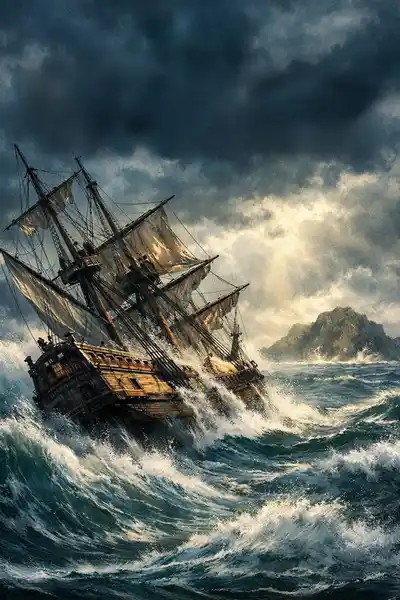
In January 1742, a battered longboat washed up on the coast of Brazil carrying thirty starving men who could barely stand. They had left England as part of a squadron of the Royal Navy, sailed halfway around the world, and been given up for dead. Their story was extraordinary: their ship, HMS Wager, had wrecked on a desolate island off Patagonia, and against every odd they had built a boat from the wreckage and sailed nearly three thousand miles to safety. They were greeted as heroes.
Six months later, on the far side of the world, three more emaciated survivors turned up in Chile. They too had been aboard the Wager. And they told a very different story. The men who reached Brazil, they said, were not heroes at all. They were mutineers who had seized the ship's authority, abandoned their captain on a barren shore, and left him and a handful of loyal men to die. When both parties eventually made it back to England, the Admiralty faced a problem no medal could solve: two groups of survivors, each calling the other criminals, and no neutral witness left alive to say which account was true.
This is the story the writer David Grann reconstructs in The Wager, drawn from the logbooks, journals and testimonies the survivors themselves produced. It is a shipwreck tale, but underneath it runs something colder — a fight over who gets to author the record when everyone involved has a reason to lie, and when the institution judging them has its own reasons to prefer one version over the truth.
The question we’re asking : When every survivor tells a different story and no impartial witness is left, who decides what actually happened?What we’ll see : How a disciplined naval expedition dissolved into starvation, violence and two irreconcilable accounts — and what the reckoning back home was really settling.
Table of contents
01Chapter 1 — Two crews, two impossible stories
The men who reached Brazil in 1742 had every reason to be believed. Led by the gunner John Bulkeley and the carpenter John Cummins, they had endured a journey of such length and misery that survival alone read as proof of virtue. They carried a journal — Bulkeley kept a careful log throughout — and when they landed they had a clean, coherent narrative ready. The captain, David Cheap, they explained, had lost his grip after the wreck. He had shot an unarmed man. He had insisted on a plan that would have gotten them all killed. They had simply made the rational choice: sail for home the practical way, around Cape Horn, and leave behind those who refused to come.
Their account held for months, because there was no one to contradict it. Cheap was presumed dead. The island where the Wager broke apart was one of the most remote places on the planet, lashed by storms and empty of rescue. A story told first, told confidently, and told without a rival tends to become the truth. Bulkeley even published his journal, which turned his version into the public record before the Admiralty had said a word.

02Chapter 2 — The voyage that came apart on the water
To understand how it reached that point, you have to go back to the mission. In 1740, Britain was at war with Spain, and the Admiralty dispatched a squadron under Commodore George Anson to raid Spanish holdings in the Pacific and, if fortune allowed, capture a treasure galleon. The Wager was one of the ships — an aging merchant vessel converted for war, overloaded, undermanned, and crewed in part by men pressed into service or dragged from a hospital for invalids. Before it ever left, the expedition was carrying the seeds of its own collapse.
The Atlantic crossing was punishing, but the real disaster came at Cape Horn. Rounding the tip of South America, the squadron met weeks of storms so violent that ships were scattered and men were swept overboard. Scurvy did the rest. With no understanding yet of what caused it, the disease rotted the crews from within — gums bleeding, old wounds reopening, men dying by the dozen. On the Wager alone, the toll was staggering. The ship that finally struggled into the Pacific was a floating hospital, its rigging half-shredded, its captain newly promoted and its crew hollowed out.
03Chapter 3 — The island that undid the chain of command
The island — the survivors called it Wager Island — was a place of near-constant rain, thin food and killing cold. The men built crude shelters, scavenged the wreck for salvage, and began, slowly, to starve. In these conditions the ordinary logic of naval discipline started to fray. Cheap insisted he was still their captain, still owed obedience, even though there was no ship, no pay reaching them, and no clear prospect of rescue. Many of the men saw it differently: without a vessel, they reasoned, the articles that bound them no longer applied.
The turning point came when Cheap shot a young midshipman named Henry Cozens. The circumstances were disputed even by those present — Cozens may have been drunk and insubordinate — but the man was unarmed, and he died slowly of the wound over days. For much of the crew, that killing dissolved whatever legitimacy Cheap had left. A captain who executed his own men on a whim was not an authority to be obeyed; he was a danger to survive. From that moment, the community on the island effectively split.
04Chapter 4 — The court-martial that judged the wrong crime
When the full reckoning finally came, in a court-martial in 1746, it revealed what the whole affair had really been about. The Navy convened the tribunal partly because the surviving officers demanded it and partly because the Bulkeley faction's published account had made the scandal too public to ignore. But the court did not set out to establish, cleanly, whether a mutiny had occurred. It focused instead on the narrower question of the loss of the ship — and on that, the outcome was strikingly mild. The men were largely acquitted or lightly dealt with. The hanging that the word 'mutiny' promised never came.
Grann's reconstruction makes clear why. A full mutiny trial would have been ruinous for everyone, the Admiralty included. It would have advertised how badly the expedition had been provisioned, how many pressed and dying men had been sent to sea, how the institution's own failures had produced the catastrophe. Convicting the survivors of mutiny meant putting the Navy itself in the dock. So the empire, needing a version of events it could live with, quietly chose the version that closed the matter — not the one that resolved the truth.
05Conclusion
The two crews arrived in England certain that the record would vindicate them, and in a sense both were disappointed and both survived. Bulkeley's men were not hanged, but they were never cleared of the shadow either; Cheap got his court but not the reckoning he wanted. The neutral witness who could have settled it — the sea itself, or the men who died on that island — never testified. What remained were competing manuscripts, and a tribunal that preferred to answer a smaller question than the one everyone was really asking.
Related books