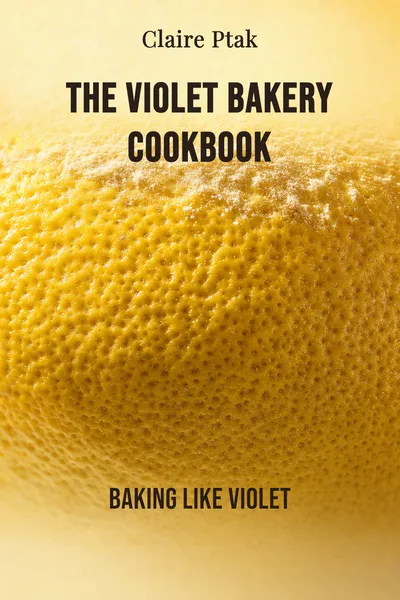
The Violet Bakery Cookbook
Baking like Violet
Description
Claire Ptak grew up in Inverness, a small town on the northern California coast, in a house where her mother made jam and her father grew vegetables, and where the food that reached the table had usually come from somewhere close by. She trained in the kitchen at Chez Panisse in Berkeley, Alice Waters's restaurant, which had spent decades arguing — through cooking rather than manifestos — that the quality of an ingredient matters more than what a cook does to it. Then she moved to London, sold cakes from a stall in Broadway Market, and in 2010 opened a small bakery in Hackney called Violet.
The Violet Bakery Cookbook, published in 2015, is the record of what that shop learned. It is a baking book, so it is full of the things a baking book is full of: buttermilk cakes, salted caramels, jam tarts, morning buns, meringues. But the recipes sit inside a particular way of thinking about food — one that treats a lemon or a stick of butter as the real subject, and the pastry around it as a way of showing that ingredient off rather than covering it up.
That posture sounds simple. In practice it reorganizes almost everything about how a person bakes: what they buy, when they bake it, how sweet they let it get, and how much they are willing to throw away. A cookbook that begins with the ingredient rather than the technique ends up asking the home baker to change habits that most recipe books never touch.
The question we’re asking : What does it actually mean to bake the way Violet does — and why does starting from the ingredient change so much?What we’ll see : A California cook who built a London bakery on quality, seasonality and taste, and what her approach asks of anyone baking at home.
Table of contents
01Chapter 1 — A stall in Broadway Market, then a shop in Hackney
Before Violet was a bakery it was a folding table. Ptak had arrived in London in the mid-2000s, and she began selling cakes at Broadway Market, the Saturday market in east London where traders set up stalls of bread, cheese, flowers and produce. She baked at night in a rented kitchen and carried the results across the city in the morning. The stall was where the shop's sensibility got worked out in public: what people actually wanted to eat, what held up on a market table, what was worth the effort of making by hand.
The market mattered because of what surrounded it. A cake stall next to a fruit trader and a dairy stall is a cake stall with easy access to good raspberries and proper cream, and it is also a cake stall answerable to customers who can taste the difference. Ptak has said the market taught her to cook seasonally without deciding to — the strawberries were only there for a few weeks, so the strawberry cake was only there for a few weeks. Scarcity did the planning.

02Chapter 2 — Ingredients first, everything else second
The Violet Bakery Cookbook opens the way a good cook thinks: with the pantry, not the oven. Before the recipes there is a long, plain account of what to buy and why — the flour, the butter, the sugar, the eggs, the salt, the chocolate. This is not filler. It is the argument of the whole book made concrete, because if the ingredients are chosen well the recipes become almost easy, and if they are chosen carelessly no technique will rescue them.
The specifics are practical rather than precious. Ptak asks for good unsalted butter with a high fat content, because it behaves better in pastry and tastes of something. She uses eggs from hens that have eaten well, because the yolks are richer and the cakes are the colour they should be. She reaches for unrefined sugars — light and dark muscovado, demerara — not only for sweetness but for their molasses flavour and their moisture, which change the texture of a biscuit or a cake in ways white sugar cannot. Salt is treated as a seasoning in sweet baking, not an afterthought, and the flaky sea salt on a caramel is doing real work.
03Chapter 3 — The seasons decide the menu
The second organising idea of the book is seasonality, and Ptak means it more literally than most. The recipes are arranged so that the fruit shows up when the fruit is actually good: rhubarb in spring, berries and stone fruit through summer, apples and pears and quinces in autumn, citrus and dried fruit in winter. This is not a stylistic gesture. It is the market discipline from Broadway carried into the structure of a book — you bake what is ripe, because ripe is when it tastes of the most.
Working this way changes the rhythm of baking. Instead of making the same lemon tart all year, a Violet baker makes it when the citrus is at its best and lets it go the rest of the time, replacing it with whatever the season has brought forward. The pleasure of a thing is partly the fact that it is not always available. A blackberry cake in September means more, and tastes more, than a blackberry cake assembled from cold-store fruit in February. The calendar does some of the work that a recipe otherwise has to fake.
04Chapter 4 — What a bakery teaches about cooking at home
Step back from the individual recipes and The Violet Bakery Cookbook is really making an argument about baking as a practice rather than a performance. Most baking books present the recipe as the unit of value: follow these steps, get this cake. Violet keeps insisting that the recipe is downstream of a hundred small choices made before the oven is ever turned on — the shop you bought the butter from, the week you decided to make the tart, the fruit you let ripen a day longer on the counter. The cake is the last thing that happens, not the first.
This reframes what precision means in baking. Baking has a reputation as the exacting branch of cooking, the one where a gram matters and improvisation punishes you. Ptak does give precise weights, because pastry genuinely needs them, but the book's deeper instruction is to trust your own taste. Adjust the sugar to the fruit in front of you. Pull the cake when it looks right, not only when the timer says so. The exactness serves the flavour; it is not an end in itself, and a baker who understands why a step exists can bend it.
05Conclusion
Violet is still a small shop on Wilton Way, still making cakes in view of the people who buy them, still tied to the season the way the market stall taught Ptak to be. The cookbook is that shop translated into a domestic kitchen: a set of recipes, certainly, but also a way of standing at the counter — starting with the ingredient, letting the calendar set the menu, and trusting your mouth over the clock. The buttermilk cakes and salted caramels are the visible part. The method underneath is the real inheritance.
Related books