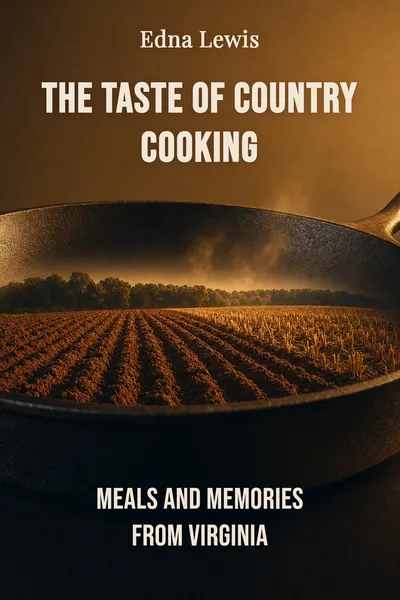
The Taste of Country Cooking
Meals and memories from Virginia
Description
Edna Lewis grew up in Freetown, a farming settlement in the Virginia Piedmont founded after Emancipation by freed people, among them her grandfather. When she published The Taste of Country Cooking in 1976, she was in her sixties and had spent decades away — in New York, cooking at Café Nicholson, where she had built a reputation among writers and artists. The book she wrote was not a chef's manual. It was a return, in prose and recipes, to a place and a rhythm she had watched fade.
What makes the book unusual is its shape. Lewis does not sort dishes by category — appetizers, mains, desserts — the way cookbooks do. She organizes everything by the season, and within the season by whole meals, each one framed by a memory: a spring morning, wheat-harvest dinners, the hog killing after the first frost, Revival Sunday. The recipe for braised mutton sits inside the account of a particular afternoon. The scuppernong wine belongs to a specific stretch of late summer. Food and time are the same subject.
Lewis was writing at a moment when the food she describes was already becoming hard to find — when supermarkets, refrigeration, and shipping had begun to sever the connection between a meal and the ground and season that produced it. Her book is a record of how one community ate before that happened, and an argument, made quietly through detail, about what that way of eating was worth.
The question we’re asking : What was Lewis actually preserving when she wrote down the meals of a village that was disappearing?What we’ll see : A settlement of freed families, a year measured in harvests and killings and feasts, recipes that double as memory, and a whole culture of the table set against its own vanishing.
Table of contents
01 Chapter 1 — A village built by freed people
Freetown was not a name on any official map. It was the name the community gave itself, and the name told the story: a settlement started by people who had been enslaved and who, after the Civil War, acquired land and began to farm it as free families. Lewis's grandfather was among the founders. The village she describes is small, largely self-contained, and organized around what the land could provide — a place where a family grew, raised, hunted, or preserved nearly everything it ate.
This origin runs underneath every page, though Lewis rarely raises her voice about it. The self-sufficiency she recalls was not a lifestyle choice or a rustic charm. It was the practical shape of a community that had built its independence out of very little and intended to keep it. The gardens, the smokehouse, the cellar, the shared labor of harvest and slaughter — these were the infrastructure of freedom, the means by which Freetown fed itself without depending on anyone.

02 Chapter 2 — Cooking with the calendar
The organizing principle of the whole book is the season, and Lewis follows it strictly. She opens in spring and moves through the year, because that is how the food actually arrived. There was no other way to eat. You had what was ready, and you had it when it was ready, and the cook's art lay in knowing what each moment offered and what to do with it before it passed.
Spring meant the first wild greens, shad and its roe coming up the rivers, young chickens, the earliest garden vegetables after a winter of preserved food. Summer brought the long labor of the wheat harvest and the enormous dinners cooked to feed the men working the fields, along with berries, tomatoes, and the corn at its peak. Lewis lingers on these summer meals because they were communal by necessity — a harvest fed everyone, and everyone was fed.
03 Chapter 3 — The recipes as memory
Lewis writes her recipes with unusual precision — she wants them to work, and she is exacting about ingredients, timing, and technique. But she rarely lets a recipe stand alone. Each one is embedded in the memory of a particular meal, a day, a gathering, so that reading the book is less like consulting a manual than like listening to someone recall her childhood through the food that marked it.
The method has a purpose beyond charm. Much of what Lewis is describing cannot be reduced to a list of quantities. The flavor of a chicken depended on how it had been raised; the taste of a vegetable depended on soil and season and how quickly it went from garden to pot. A recipe that assumes an industrial supermarket ingredient will not reproduce the dish she remembers. By wrapping each recipe in its context, Lewis smuggles in everything the ingredient list leaves out — the freshness, the source, the moment.
04 Chapter 4 — What a table holds together
Step back from the individual dishes and the book reveals what it is really defending: an entire relationship between people and their food that was, when Lewis wrote, in the process of disappearing. Freetown ate what was in season because it ate what it grew, and it grew things whose flavor came from care and freshness rather than from shipping and shelf life. That whole system — local, seasonal, communal, skilled — was being replaced in Lewis's lifetime by supermarkets, refrigeration, and produce engineered to travel. She was writing down a way of eating just as it slipped out of reach.
What she insists on, without ever lecturing, is that this was not simply a technical arrangement but a culture. The food was inseparable from the community that produced it — from the shared harvests and hog killings, the church feasts, the passing of knowledge from one cook to the next. To lose the food was to lose the web of relationships and skills the food expressed. A convenience that let you buy a tomato in January also quietly dissolved the reasons a village had to work and eat together.
05 Conclusion
The book ends where it began, in Freetown, with a woman who left the Virginia Piedmont for a New York kitchen and then turned back, decades later, to set down what she had grown up eating. What she produced was a year of meals — spring greens through winter's cured hams, ordinary suppers through the great communal feasts — each one held in the memory of the day it belonged to. The recipes work, but they carry more than instructions. They carry a place.
Related books