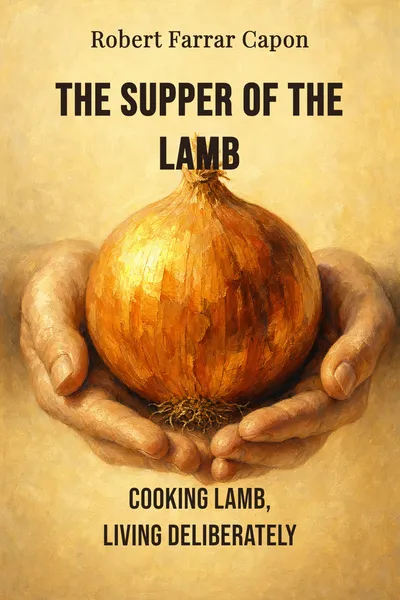
The Supper of the Lamb
Cooking lamb, living deliberately
Description
In 1969, an Episcopal priest on Long Island named Robert Farrar Capon published a cookbook that was barely a cookbook. He had nine children, a modest salary, and a conviction that the kitchen was one of the last honest places left in modern life. The Supper of the Lamb offered exactly one main dish worth building a book around — a leg of lamb, stretched across four separate dinners for eight people — and around that single frugal cut he wound a set of meditations on knives, wine, water, love, extravagance, and death. It reads less like Julia Child than like a sermon delivered from behind a cutting board, by a man who genuinely believed that paying attention to food was a spiritual act.
The book has never quite gone out of print, and it has never quite fit any shelf. Cooks read it for the recipes and stay for the theology; readers who came for the theology find themselves being told, in loving detail, how to butterfly a leg of lamb. Capon called himself an amateur, in the old sense — one who does a thing for love. He was suspicious of convenience, of the diet culture already gathering steam in the late 1960s, of any way of eating that treated the meal as fuel to be gotten past. Against all of it he set a slower, stranger proposition: that the world is delicious on purpose, and that noticing this is close to the whole point.
What makes the book endure is not its instruction but its posture — a way of standing at the counter that turns dicing an onion into an occasion. Capon insists that abundance and thrift are not opposites, that a cheap cut fed to a crowd four times is not a compromise but a feast. Half a century later, in a food culture torn between optimization and spectacle, that middle path feels almost radical.
The question we’re asking : Why would a priest build an entire book around a single leg of lamb served four times, and what is he really teaching us to do?What we’ll see : How Capon turns cooking into a discipline of attention, gratitude, and a particular way of being alive at the table.
Table of contents
01Chapter 1 — An onion, held for sixty seconds
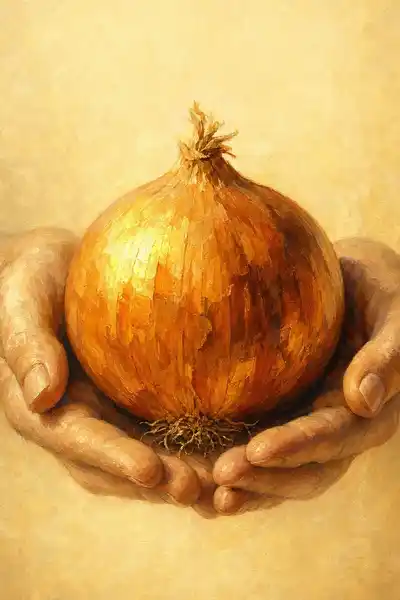
Early in the book, Capon stops the cooking altogether and asks us to do something absurd. Take an onion, he says, set it on the counter, and simply look at it for a full hour. Turn it over. Notice the papery skin, the faint green ghost of the shoot inside, the way the layers fold into one another with no center to arrive at. He is not being precious for effect. He is trying to break a habit — the habit of treating the things we eat as raw material, interchangeable, invisible until they hit the plate. The onion, held long enough, stops being a chore and becomes a small astonishment: this thing exists, it did not have to, and it is beautiful.
This is the book's founding move, and everything else grows from it. Capon's real subject is not lamb or onions but attention — the discovery that the material world rewards being looked at, and punishes being rushed through. He calls the modern eater a kind of sleepwalker, someone who consumes without ever quite seeing. Against that, he offers the cook as the person most likely to stay awake, because cooking forces contact. You cannot dice something you refuse to hold.

02Chapter 2 — Lamb for eight, four times over
The spine of the book is a single leg of lamb, and Capon's plan for it borders on the outrageous in its thrift. One leg, he shows, can feed eight people not once but four times — if the cook is willing to think like someone with more time than money. The first night it is roasted whole, the centerpiece, carved with ceremony. What matters is that this is not four cheap meals grudgingly endured. It is one animal honored completely, refusing to let anything go to waste, and finding real pleasure in the discipline of that refusal.
The subsequent dinners are where his imagination runs. The cold remains become a second meal, sliced and dressed. The bones and scraps build a stock; the stock builds a soup or a braise for the third. By the fourth appearance the lamb has been transformed almost past recognition, folded into something that no longer announces itself as leftovers. Capon lingers over each version with the same care he gave the roast, because to him the fourth night is not a lesser event. Frugality, done with love, is simply another shape of abundance.
03Chapter 3 — The recipe as a way of noticing
Capon writes recipes the way other people write essays — full of tangents, opinions, and sudden bursts of feeling. He will interrupt a set of instructions to defend the honor of an ingredient, or to rage gently against some shortcut the food industry has sold us. This is deliberate. A recipe, for him, is not a set of orders to obey but an invitation to pay attention to what is actually happening in the pan. The point is never mere compliance; it is the cook waking up to heat, to salt, to the smell that tells you the onions have turned.
He is especially hard on the anxieties of his moment — the calorie-counting, the fear of fat, the creeping sense that eating well is somehow a moral failing. Writing at the end of the 1960s, he watched a culture beginning to treat food as a problem to be managed rather than a gift to be received, and he found the whole posture joyless and a little sad. His counter-argument is not scientific but sensual: taste the butter, drink the wine, salt the water for the pasta as if you meant it. Pleasure taken with gratitude, he insists, is not a vice.
04Chapter 4 — Ferial and festal, or how to live on what there is
Late in the book Capon reaches for two old words — ferial and festal — and they turn out to hold his whole vision. A festal meal is a feast, rare and lavish, meant to blow the budget and mark an occasion. A ferial meal is an ordinary weekday dinner, made from what happens to be there. Modern life, he thinks, has lost the art of both: we no longer feast properly, because we are always half-indulging, and we no longer cook the humble weekday meal with care, because we have decided it is beneath us. His lamb-for-eight-four-times is precisely a ferial dish done with festal love.
This is where the cooking opens into a philosophy of living deliberately. Capon is arguing that most of life is ferial — ordinary, repeated, unglamorous — and that the question is not how to escape the ordinary but how to inhabit it fully. The person who can make a weeknight leg of lamb into an event has learned something the person chasing constant novelty never will: that abundance is a way of seeing, not a quantity of things. Gratitude, he suggests, is the faculty that turns what there is into enough.
05Conclusion
The single leg of lamb was never really the subject. It was the vehicle — a frugal, ordinary cut that Capon could return to four times, each time proving that care rather than cost is what makes a meal worth having. Around it he built a case that the world is edible on purpose, that attention is a form of love, and that the kitchen is one of the few places where a person can still practice being fully awake. The book instructs, but what it teaches is a posture: hold the onion, honor the animal, salt the water as though it mattered.
Related books