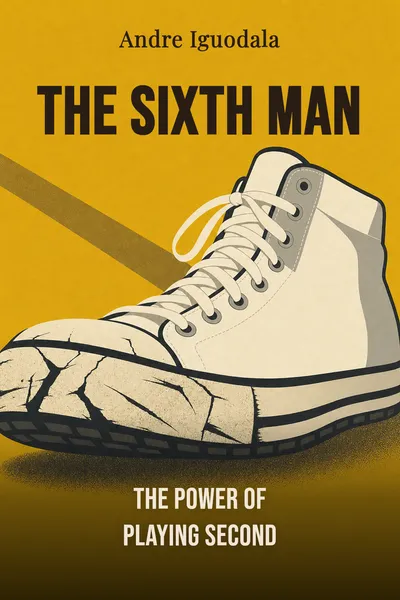
The Sixth Man
The power of playing second
Description
In June 2015, the NBA Finals Most Valuable Player award went to a player who had not started a single game that season until the series was already underway. Andre Iguodala had spent the year coming off the bench for the Golden State Warriors, a role he had accepted without enthusiasm after a decade as a starter and a former All-Star. Then, with the Finals slipping away against LeBron James and the Cleveland Cavaliers, the Warriors' coaches asked him to guard the best player alive and inserted him into the starting lineup. Golden State won the next three games and the championship. Iguodala, the sixth man, walked away with the trophy nobody had predicted.
His memoir, written with the sportswriter Carvell Wallace and published in 2019, uses that improbable award as its organizing paradox. Here was a man raised on the playground logic of American basketball, where status flows to the one who scores, who instead built a career and a legacy out of the parts of the game that go uncounted: the defensive assignment, the extra pass, the willingness to be third or fourth option so that others could be first. The book is not a highlight reel. It is a long argument about what winning actually requires and who gets credit for it.
Iguodala grew up in Springfield, Illinois, reached the University of Arizona, and entered the league in 2004 with the Philadelphia 76ers as the franchise's hoped-for star. What he became instead was something the sport has always needed and rarely honors. The memoir tracks how he got there, and what it cost him to make peace with a role he never asked for.
The question we’re asking : What does it take to succeed at being the second player rather than the first, and why does the sport so rarely reward it?What we’ll see : A journey from an Illinois childhood to the summit of the NBA, told from the seat on the bench where championships are quietly decided.
Table of contents
01 Chapter 1 — From Springfield to the number one pick
Iguodala grew up in Springfield, Illinois, raised largely by his mother, in a household where discipline and expectation were constant. He describes a childhood that was not desperate but was watchful, a kid who learned early to read rooms and adults, to figure out what a situation demanded before it demanded it. That habit of observation, he suggests, was already the beginning of the player he would become. He was tall, athletic, and quick, but the thing that separated him was less physical than mental: he saw the whole floor before he had the vocabulary to name what he saw.
His talent carried him to the University of Arizona, where he played for the demanding Lute Olson. Iguodala arrived expecting to be the centerpiece and discovered a system that valued fit over stardom, that asked him to defend, rebound and distribute rather than to dominate the ball. It stung at the time. He wanted the shots, the attention, the numbers that scouts noticed. But the Arizona experience, in retrospect, was the first place the sport told him what it would keep telling him: his highest use was rarely as the man with the ball in the final seconds.

02 Chapter 2 — The role nobody dreams of
A trade sent Iguodala to Denver, then a signing brought him to Golden State in 2013, to a young team built around the shooting of Stephen Curry and Klay Thompson. He arrived as a starter and a respected veteran. Two years later, before the 2014-15 season, the new coach Steve Kerr made a request that Iguodala describes as one of the hardest things he ever heard: he wanted him to come off the bench. Not because he had declined, but because moving him allowed a better starting five and a stronger second unit. The math served the team. It did not serve Iguodala's pride.
No child growing up on a court dreams of being a substitute. The playground teaches the opposite lesson from the day you first pick up a ball. Status is the first pick, the last shot, the name the crowd chants. To be asked, at the peak of your abilities and with an All-Star selection behind you, to sit and wait for a coach's signal is to be told your ego is now a cost the team can no longer afford. Iguodala is honest about how much it wounded him, and honest that he almost refused.
03 Chapter 3 — 2015 — the demotion that won a title
The 2015 Finals is the hinge of the book, and Iguodala tells it as the vindication of everything the bench had taught him. Golden State faced Cleveland, and Cleveland had LeBron James, who was carrying an injury-thinned roster almost single-handedly and dragging the series toward an upset. Through three games the Warriors looked out of answers. James was too large a problem for any conventional solution, and the smaller Golden State lineups were being overpowered.
The coaching staff made a decision that ran against basketball orthodoxy. They shrank the lineup, went small and fast, and put Iguodala into the starting five with the primary job of guarding James. It was punishing, thankless work: no play is designed to reward the defender, and guarding the best player on earth for forty minutes leaves no energy for glory of your own. Iguodala did it anyway, night after night, making James work for everything and quietly scoring when the defense forgot about him.
04 Chapter 4 — The intelligence of the second player
Step back from the games and Iguodala's memoir is making a claim that reaches past basketball: that the willingness to play second is not a lack of ambition but a form of intelligence the culture systematically misreads. We are trained, in sport and out of it, to equate value with visibility. The one who scores, who leads, who takes the final shot is the one who matters. Everyone else is support. Iguodala spent a career proving that the support is often where the outcome is actually decided, and that seeing this clearly is harder than wanting the ball.
He extends the argument to his life away from the court. During his Bay Area years he became an unusually serious investor in technology and start-ups, learning the ecosystem the way he had once learned defensive rotations: by watching, asking, and positioning himself where he could be useful rather than central. He describes tech the same way he describes his role on the Warriors, as a game where the loudest founder is not always the one who wins, and where knowing your function precisely beats performing importance. The same instinct that made him a great sixth man made him a patient one off the floor.
05 Conclusion
The player who accepted the bench in 2014 walked off the court in 2015 holding a trophy that history had reserved for stars. Iguodala never became the first option he was drafted to be, and by the end of the memoir it is clear he stopped wanting to. He had chased recognition through his Philadelphia years and won almost nothing; he chased outcomes through his Golden State years and won more than nearly anyone of his era. The trade he made was his identity for the standings, and he never regretted it.
Related books