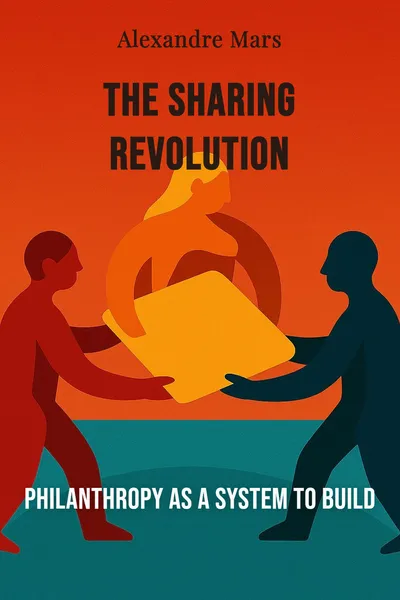
The Sharing Revolution
Philanthropy as a system to build
Description
In the early 2010s, a French-born entrepreneur named Alexandre Mars sold the companies he had built and found himself, in his thirties, with more money than he knew what to do with. The obvious move was the one everyone around him expected: pick a cause, write a check, feel good, repeat. He did some of that. But the experience left him uneasy, because the giving felt improvised — a reaction to whoever asked, whoever moved him, whoever got to him first. For someone who had spent his career building companies with strategies and metrics and feedback loops, the sloppiness of his own generosity was hard to ignore.
Out of that unease came a question that eventually turned into a book, The Sharing Revolution, and a foundation, Epic, built to answer it. The question was almost embarrassingly simple: if giving matters, why do we do it so badly? Why is the most emotionally loaded thing a person can do with their money also the least structured? Mars had noticed something most of us feel but rarely name — that we want to be generous, and somehow almost never get around to it in any serious way.
His answer is not a plea to be kinder. It is closer to an engineering problem. The gap between how generous we think we are and how generous we actually are, Mars argues, is not a flaw in human character. It is a flaw in the machinery — and machinery can be redesigned.
The question we’re asking : If almost everyone wants to give, why do so few of us do it in any serious, sustained way — and what would it take to change that?What we’ll see : How one entrepreneur turned his discomfort with his own giving into an argument for building generosity like a system rather than feeling it like a mood.
Table of contents
01 Chapter 1 — A fortune, and the question that comes with it
Mars's path to the question runs through a fairly specific life. Born in Paris, he started businesses young, built and sold a mobile-advertising company, and ended up with the kind of wealth that reorganizes your choices. What makes his account useful is that he does not pretend the money arrived with a sense of purpose attached. It didn't. He describes a stretch where the dominant feeling was not triumph but a strange flatness — the goal he had chased for years had been reached, and the question of what the money was for had not been answered.
So he started asking people. Entrepreneurs, friends, strangers at dinners — he put the same question to anyone who would sit still: do you want to give? The answer, overwhelmingly, was yes. Almost nobody said they wanted to hoard everything they had. And then he asked the follow-up: do you actually give, in any organized way? Here the yes collapsed. People gave occasionally, reactively, guiltily. Very few gave on purpose.

02 Chapter 2 — Why most of us never actually give
The most interesting move in the book is that Mars refuses the usual explanation. The easy story is that people don't give because they're selfish, or strapped, or indifferent. He doesn't buy it. The data he leans on, and the conversations he had, point somewhere less flattering to our systems and more forgiving of us: we don't give because giving is genuinely hard to do well, and we know it.
Think about what actually happens when the impulse strikes. You see something — a disaster, a cause, a kid on a screen — and you feel the pull. Then the friction starts. Which organization? Is it legitimate? What share reaches the ground versus the overhead? How much should you give? Is this a one-time thing or a commitment? Will you ever know if it did anything? Faced with that pile of unanswered questions, the easiest thing to do is close the tab and tell yourself you'll sort it out later. Later rarely comes. The impulse doesn't survive the friction.
03 Chapter 3 — The friction problem, and how to remove it
If the diagnosis is friction, the prescription is instruments that remove it. This is where Mars moves from analysis to building, and where his foundation, Epic, becomes the working example rather than a victory lap. The logic is that generosity, like any behavior you want more of, needs to be made easy, trustworthy, and measurable — and those three jobs can be engineered.
The first job is trust, and Mars treats it as a vetting problem. Most people can't evaluate whether an organization is effective; they don't have the time, the access, or the expertise. So Epic's model is to do that work on everyone's behalf — rigorously screening organizations, especially those serving children and young people, and selecting a small portfolio that has survived real scrutiny. The donor no longer has to be an expert on impact. They outsource that judgment to someone who has done the homework, the way you'd trust a well-run fund rather than pick individual stocks blind.
04 Chapter 4 — Giving as infrastructure, not charity
Step back from Mars's own fortune and the deeper argument comes into view: philanthropy fails not when people stop caring but when caring is left unstructured. The book's quiet provocation is that we have been thinking about generosity in the wrong category. We file it under emotion — a warm impulse, a spontaneous gesture, a matter of the heart. Mars wants to refile it under infrastructure, alongside the systems we've already built for every other serious thing we do with money.
That reframing has teeth. Infrastructure is designed, not felt. It is built once and then runs continuously. It has standards, feedback, and accountability. Nobody admires a bridge for its good intentions; they ask whether it holds. Mars's wager is that generosity should be held to the same standard — judged by whether it works, built to run without depending on a surge of feeling, and measured honestly enough that failure can be seen and corrected. The warmth isn't removed; it's given a structure strong enough to actually deliver on itself.
05 Conclusion
The book ends more or less where Mars began — a person with resources, a genuine wish to do some good, and the uncomfortable realization that wishing was not getting it done. The difference is that he no longer treats that gap as a personal failing to feel bad about. He treats it as a problem to be solved, and the solution he lands on is not a nobler heart but a better machine: vetting that supplies trust, automation that removes friction, measurement that proves it worked. Epic is his proof of concept, but the argument is meant to outlive any single foundation.
Related books