The Sesame Street Cookbook
Recipes from Sesame Street
Description
Somewhere in the long life of Sesame Street — the show that arrived on American public television in November 1969 and never quite left — someone made a decision that sounds almost too obvious to notice. The characters children already loved could stand next to a mixing bowl. Not in a sketch, not for a song, but on the page, in a book a kid could hold in a kitchen. The Sesame Street Cookbook takes Big Bird, Cookie Monster, Grover, Oscar, and the rest of the Sesame Street residents and lets them do the one thing the show had trained them to do since the start: talk directly to the child, at eye level, about something worth doing.
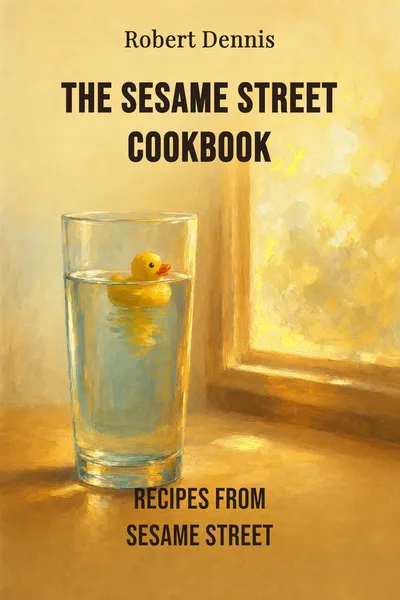
The premise is disarmingly simple. Each recipe belongs to a character, and the character's personality shapes the dish. Oscar the Grouch, who lives in a trash can and prefers things unpleasant, contributes a Junk Food Pie. Ernie's rubber duckie floats in a glass. There is a recipe attributed to Snuffleupagus, and directions that read as if a Muppet were leaning over the counter beside you. The food is real. The instructions work. But the framing is doing something more than feeding a child — it is turning a familiar cast into cooking companions.
That combination is easy to underestimate. A cookbook aimed at very young cooks has to solve a genuine problem: how do you make instructions feel safe, doable, and fun to a person who cannot yet read fluently and has never been trusted near a stove? Sesame Street had spent years answering a version of that question on screen, and the cookbook inherits the answer wholesale.
The question we’re asking : What happens when the most familiar characters in children's television stop telling stories and start handing a child a recipe?What we’ll see : A cookbook that turns beloved Muppets into kitchen companions, and the small, deliberate act of teaching a child to actually make something.
Table of contents
01Chapter 1 — A cookbook where Grover does the talking
The first thing to understand about The Sesame Street Cookbook is that it is not organized like an adult cookbook wearing a costume. It is organized around the characters, and the characters carry the voice. A recipe is not merely listed; it is presented by someone the child already knows and trusts. That shift — from an anonymous instructional voice to a familiar one — is the whole engine of the book. When Grover explains a step, the child is not reading directions. The child is being talked to by Grover.
This matters more than it might seem. Sesame Street was built on a specific insight from its earliest planning in the late 1960s: that children learn from characters they have a relationship with, and that the warmth of that relationship carries the content. The show borrowed the pacing and repetition of television advertising and pointed it at letters, numbers, and kindness. The cookbook applies the same logic to a bowl and a spoon. The teacher is not a stranger. The teacher is Cookie Monster, and a child will follow Cookie Monster into places a plain recipe card could never lead.

02Chapter 2 — Recipes with names before ingredients
The recipes themselves are the clearest sign of what the book is trying to do. Consider the names first, because the names arrive before the ingredients ever do. Oscar's Junk Food Pie. Rubber Duckie Floats. Snuffle's Truffles. These are not descriptions of food; they are invitations, built from the character's world. A child does not decide to make a pie. A child decides to make Oscar's pie, and that small possessive changes everything about whether the child wants to begin.
Each name does double duty. It tells you, roughly, what you are making — a pie, a float, a truffle — while it also tells you whose kitchen you are standing in. Oscar's Junk Food Pie belongs to the Grouch precisely because it leans into the messy, the sweet, the deliberately unrefined; it is a joke about Oscar's taste that also happens to be a real dessert. Rubber Duckie Floats take Ernie's most famous prop and turn it into a drink, so the recipe carries a whole song's worth of association before you have poured anything. The food and the character are inseparable.
03Chapter 3 — Cooking as a thing kids are allowed to touch
Underneath the Muppets and the playful names, the cookbook is making a quieter argument about children and kitchens. The kitchen is, for most young kids, a place of prohibition — the hot thing, the sharp thing, the grown-up's territory. The book gently reverses that. It treats cooking as a domain a child is allowed to enter, with the right guide and the right dish. Handing a kid a recipe with their name on it is a way of saying: this is yours to do.
That is consistent with what Sesame Street had always been about. The show did not talk down to children; it assumed they were capable of learning real things and simply needed those things delivered with care. The cookbook extends the same respect to a practical skill. Measuring, mixing, pouring, waiting, tasting — these are genuine competencies, and the book treats a four- or five-year-old as someone who can begin to acquire them, not as someone to be entertained until they are older.
04Chapter 4 — When a franchise decides to teach a small skill
Step back from the specific recipes and the book reveals a decision that not every beloved property makes. A cast of characters as commercially valuable as the Sesame Street Muppets could be attached to almost anything — more stories, more toys, more of the same warm loop that keeps a child watching. Instead, in the cookbook, the franchise points that affection at a genuine, transferable skill and effectively steps aside once the child is at the counter. The characters get the child to the kitchen; the cooking is the child's.
That is a particular kind of trust, and it is easy to miss because it is delivered by puppets. The book does not use Cookie Monster to sell more Cookie Monster. It uses Cookie Monster to get a kid to try measuring and mixing, and the measuring and mixing outlast the tie-in. A child forgets a lot of what a screen shows them. They tend not to forget the first thing they made themselves, and the book seems to understand that the durable gift is the doing, not the branding around it.
05Conclusion
The book comes back, in the end, to the same place it started: a familiar character standing next to a mixing bowl, talking to a child. Oscar hands over his Junk Food Pie, Ernie pours a Rubber Duckie Float, someone rolls Snuffle's Truffles, and each recipe works because the child already trusts the voice reading it aloud. The food is real, the steps are reachable, and the whole thing sounds like the show a kid was already watching — which is precisely how it gets that kid to the counter.
Related books